
Introduction to Gyaca County
Gyaca County, known in Tibetan as Rgya-tsha, meaning “Chinese Salt,” is a culturally and historically rich county located in southeastern Tibet, under the administration of Shannan City. The name Gyaca is closely linked to a local legend of Princess Wencheng, who is said to have placed a piece of salt in a cave during her journey through the region, causing saltwater to emerge and giving the area its enduring name.
Situated along the middle reaches of the Yarlung Tsangpo River, Gyaca County occupies a strategic and fertile river-valley location. It borders Lang County to the east, Longzi County to the south, Sangri and Qusong counties to the west, and Gongbo’gyamda County to the north. The county uses postal code 856400 and area code 0893, serving as an important gateway between southern and eastern Tibet.
Geographical Coordinates and Regional Setting
Gyaca County lies between 28.8°–29.8° north latitude and 92.3°–93.1° east longitude. The county stretches approximately 102 kilometers from north to south and 88 kilometers from east to west, covering a total area of about 4,390 square kilometers.
The county seat is located in Anrao Town, positioned at an altitude of around 3,240 meters. Gyaca’s landscape spans both sides of the Yarlung Tsangpo River, forming a classic Tibetan river-valley terrain that has supported agriculture, settlement, and religious activity for centuries.
Historical Evolution of Gyaca County
Early Human Activity and Pre-Tubo Period
Archaeological discoveries in areas such as Lengda, Gyaca, Anrao, and Lasui reveal Neolithic stone-coffin burial sites, along with pottery artifacts including bowls and jars. These findings confirm that human activity existed in Gyaca thousands of years ago. Before the rise of the Tibetan Empire, the region belonged to a small polity known as Da-yu, centered around present-day Zangmu Township.
Tubo Period and the Rise of Buddhism
During the 7th century, following the unification of Tibet under Songtsen Gampo, Gyaca was incorporated into the “Left Wing (Yo-ru)” administrative region, serving as a strategic area safeguarding Lhasa. In the 12th century, the Kagyu master Sonam Rinchen (Dabula Jie) founded Dala Gambu Monastery, establishing Gyaca as a major spiritual center of the Kagyu school of Tibetan Buddhism.
Later and Ganden Phodrang Dynasties
Under the Sakya Dynasty, Gyaca was administered as part of the Yarlung Myriarchy. During the Phakdru Dynasty, the Phagmodrupa regime implemented the Dzongshi system, setting up administrative units in Gyaca, Lasui, and Chokhor Gyal. In the Ganden Phodrang period, Gyaca Dzong and Lasui estates were governed directly by the Tibetan government.
Modern Administrative Changes
After the peaceful liberation of Tibet:
- 1959: Gyaca Zong and Lasui estates were merged to form Gyaca County.
- 1960: The State Council officially named Gyaca County.
- 2016: With the establishment of Shannan City, Gyaca became one of its counties.
Administrative Divisions and Population
Gyaca County administers:
- 2 towns: Gyaca Town and Anrao Town
- 5 townships: Lasui, Cuijiu, Ba, Lengda, and Luolin
- 74 administrative villages, including 55 central villages
As of 2019, the county had a registered population of 22,977 people. In October 2018, Gyaca achieved a significant milestone by being officially declared free from poverty, marking a major step in its social and economic development.
Topography and Natural Landscape
Terrain and Elevation
Gyaca County is characterized by dramatic topography shaped by tectonic uplift and river erosion since the Tertiary period. The land slopes from west to east, with an average elevation of around 3,500–4,000 meters. The elevation difference across the county reaches approximately 1,700 meters.
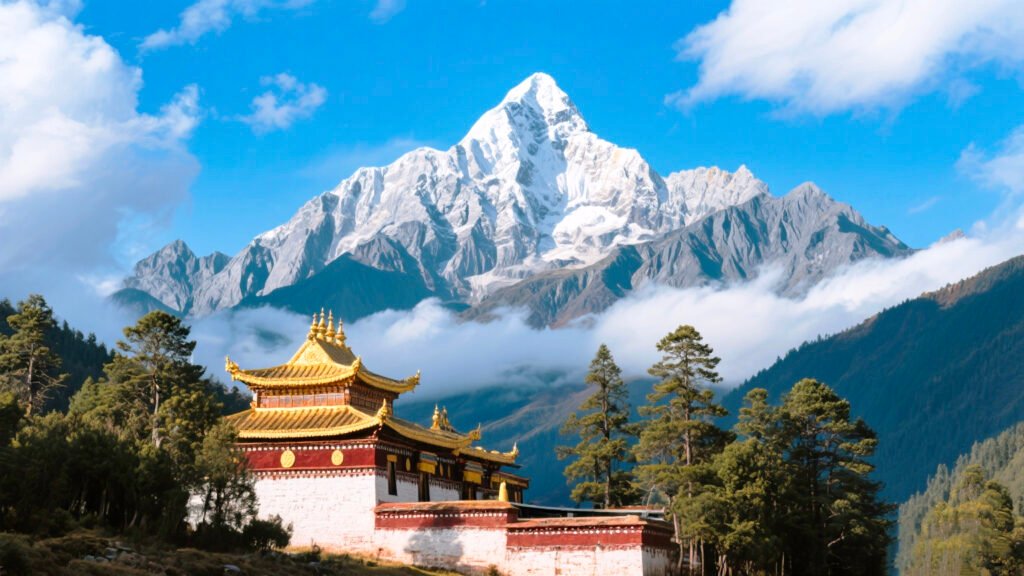
More than 180 mountain peaks exceed 5,000 meters, including the towering Niela Jiangba Snow Mountain, which rises to 6,700 meters, the highest point in the county. The lowest elevations occur in the Yarlung Tsangpo river valley, around 3,100 meters.
River Systems and Lakes
The Yarlung Tsangpo River flows for nearly 93 kilometers through Gyaca County, accompanied by 265 tributaries and over 160 lakes, including glacier-fed and barrier lakes. Among the most sacred is Lhamo La-tso, a renowned holy lake traditionally associated with the search for reincarnated Tibetan spiritual leaders.
Climate Characteristics of Gyaca County
Gyaca County experiences a plateau temperate semi-arid monsoon climate, strongly influenced by the Indian Ocean southwest monsoon.
Key Climate Features
- Average annual temperature: 8.8–8.9°C
- Extreme temperatures: up to 30.7°C in summer and down to –15.1°C in winter
- Annual sunshine: approximately 2,750–2,814 hours
- Annual precipitation: 493–637 mm, with over 90% falling between May and September
- Frost-free period: over 100 days in river valleys, less than 75 days in high-mountain areas
Winters and springs are typically dry and windy, while summers bring concentrated rainfall. Vertical climate zones vary significantly with altitude, ranging from warm semi-humid river valleys to cold alpine and glacial environments above 4,800 meters.
World Record Recognition: Thousand-Year-Old Walnut Forest
On December 15, 2023, Gyaca County gained international recognition when the World Record Certification Agency (WRCA) officially named it home to “The World’s Largest Thousand-Year-Old Walnut Forest.” The county is widely known as the “Land of Millennium Walnuts,” with thousands of ancient walnut trees, including over 2,300 trees more than a century old. Gyaca walnuts are a national geographical indication product, forming a key part of the county’s ecological and cultural identity.
Economic Structure and Key Industries
Agricultural and Pastoral Foundations
Gyaca’s economy is traditionally based on farming and animal husbandry. Major crops include highland barley, wheat, potatoes, and rapeseed, primarily cultivated in fertile river valleys. Livestock farming focuses on yaks, Tibetan sheep, and goats, supported by vast alpine grasslands.
Hydropower and Energy Development
Gyaca is often referred to as the “Capital of Plateau Hydropower.” Major projects include:
- Zangmu Hydropower Station (510 MW), the first large dam on the Yarlung Tsangpo main stream
- Gyaca Hydropower Station (360 MW)
- Lengda Hydropower Station (under construction)
Hydropower forms the backbone of Gyaca’s secondary industry and drives related sectors such as construction and transportation.
Cultural Tourism and Services
Gyaca’s tourism resources center on a unique combination of sacred lakes, ancient monasteries, primeval forests, and walnut groves. Key attractions include Lhamo La-tso Sacred Lake, Dala Gangbu Monastery, millennium-old walnut forests, and traditional cultural heritage such as Zheba Zhuo Dance. Tourism and service industries continue to grow alongside hydropower development.
Gyaca County Guide: Specialty Products, Transportation, Tourism, and Cultural Heritage
Specialty Products of Gyaca County
Gyaca County, located in eastern Shannan City, Tibet, is widely known as the “Land of Millennium Walnuts.” Thanks to its unique plateau climate, fertile river valleys, and rich cultural traditions, Gyaca produces a wide range of distinctive agricultural products, handicrafts, and medicinal resources that reflect both nature and heritage.
Agriculture and Livestock Resources
Gyaca is a mixed agricultural and pastoral county with a long history of farming and animal husbandry. The county has approximately 24,000 acres of cultivated land, where local farmers grow highland barley, wheat, peas, and other plateau crops that form the foundation of daily Tibetan life.
Its vast grasslands, covering about 810,000 acres, support the raising of yaks, cattle, sheep, goats, and bisons, making livestock breeding a vital source of income. In addition, Gyaca has abundant forest resources, with a forest coverage rate of over 30% and timber reserves reaching 1.35 million cubic meters, contributing to ecological balance and traditional wood-based crafts.
Local Delicacies and Traditional Handicrafts
Gyaca Walnuts
Among Gyaca’s most famous products are its walnuts, celebrated nationwide for their thin shells, full kernels, and exceptionally high oil content. With an oil extraction rate exceeding 65%, Gyaca walnuts are recognized as a national geographical indication product and are supported by vast ancient walnut forests, some trees over a thousand years old.
Medicinal Herbs and Plateau Specialties
Gyaca is also rich in high-altitude medicinal herbs, including:
- Cordyceps
- Fritillaria
- Musk
These natural products grow in pristine alpine environments and are highly valued in traditional Tibetan medicine.
Gyaca Blueberries
The Gama Jitang Blueberry Base has introduced a new specialty to Gyaca’s agricultural landscape. Grown at an altitude of around 3,500 meters, Gyaca blueberries are deep blue, glossy, and rich in anthocyanins. Often described as looking like dazzling sapphires, they have become a popular attraction for visitors and an emerging highland agricultural brand.
Intangible Cultural Heritage Handicrafts
Gyaca Wooden Bowls (Rgya-tsha-phor-pa)
Gyaca is one of Tibet’s most important production centers for traditional wooden bowls, locally known as Rgya-tsha-phor-pa. These bowls were listed in Tibet’s third batch of intangible cultural heritage.
Traditionally carved from birch wood or knotted hardwood, Gyaca wooden bowls are:
- Strong and crack-resistant
- Smooth and warm to the touch
- Decorated with natural grain patterns
They are widely used for butter tea, barley flour, and daily meals, and have been crafted in Gyaca for centuries. Today, these bowls are sold across Zedang, Lhasa, Nyingchi, and other regions, providing a stable source of income for local families.
Other Recognized Cultural Heritage
In addition to wooden bowl craftsmanship, Gyaca Tibetan papermaking techniques and the Zheba Zhuo Dance are also officially recognized as intangible cultural heritage, highlighting the county’s deep cultural roots.
Tourism and Transportation in Gyaca County
Main Transportation Routes
Gyaca County’s transportation network makes travel increasingly convenient for visitors exploring southern Tibet. The Lin–Qiong Highway serves as the main arterial road, connecting Gyaca with surrounding counties and cities. Together with township and village roads and the Gyaca Suspension Bridge, the county has a total road mileage of approximately 230 kilometers.
The National Defense Highway runs east–west through Gyaca:
- 160 km west to Zedang (Shannan city center)
- 350 km west to Lhasa
- Eastward connection to the Sichuan–Tibet Highway via Bayi Town
The Lhasa–Xigaze Railway also passes through the broader region, further enhancing regional accessibility.
Practical Travel Tips
Transportation Options
The distance from Zedang to Gyaca is about 144 kilometers. Travelers can choose:
- Regular long-distance buses
- Self-driving routes for flexibility
- Chartered vehicles for sightseeing and photography stops
Dining and Accommodation
Gyaca’s county town offers a variety of Tibetan and Sichuan-style restaurants, along with guesthouses, hotels, and small hostels that cater to different budgets. Accommodation conditions are suitable for both pilgrims and leisure travelers.
Festivals and Cultural Events
Every June, Gyaca County hosts the Sacred Lake Tourism and Cordyceps Festival, a vibrant seven-day celebration that combines:
- Local trade fairs
- Cultural performances
- Cordyceps markets
- Tourism promotion activities
The festival attracts visitors, businesses, and pilgrims, creating a lively atmosphere that showcases Gyaca’s natural resources and cultural traditions.
A Living Showcase of Plateau Culture
With its distinctive specialty products, ancient handicrafts, improving transportation network, and rich festival culture, Gyaca County offers visitors a rare opportunity to experience the harmony between Tibetan traditions and highland nature. From millennium-old walnut forests to handcrafted wooden bowls and sacred-lake festivals, Gyaca stands out as a unique and rewarding destination in southern Tibet.