
Vajravarahi: The Embodiment of Spiritual Power and Wisdom
In Tibetan Vajrayana Buddhism, Vajravarahi, known in Tibetan as Dorje Phagmo (རྡོ་རྗེ་ཕག་མོ)meaning “Vajra Sow,” is one of the most important and revered female deities. She represents the union of bliss and emptiness, embodying supreme wisdom, spiritual power, and transformation.
Vajravarahi is the principal female deity of the Hevajra Tantra, a foundational tantric system especially influential within the Kagyu tradition. She is traditionally regarded as the consort of Hevajra, one of the most important yidams (meditational deities) in Tibetan Buddhism. Together, they symbolize the inseparable union of method and wisdom.
Vajravarahi’s Role in Vajrayana Buddhist Practice
Vajravarahi is not merely a symbolic figure but a fully enlightened dakini whose practice is considered direct, profound, and highly effective. She is often described as the essence of all dakinis, representing awakened feminine awareness in its most dynamic and transformative form.
Her practice is especially valued for its ability to:
- Cut through ego-clinging and dualistic perception
- Transform strong emotions into wisdom
- Accelerate the path to enlightenment
- Reveal the innate Buddha-nature of the practitioner
Because of her direct and powerful nature, Vajravarahi practices are commonly transmitted through advanced tantric initiations within authentic lineages.
Historical Origins of Vajravarahi Practice in Tibet
The practice of Vajravarahi entered Tibet during the 11th century, a period known as the Tibetan religious renaissance. It was transmitted from India through the Hevajra Tantra lineage, preserved and taught by renowned Indian mahasiddhas such as Luipa, Kanhapa, and Dombipa.
One of the most influential transmissions was the lineage of Dombipa (also known as Gantapa), called the Hevajra Five-Deity Mandala. This lineage was later passed to the great Indian master Tilopa, then transmitted to Naropa, and finally brought to Tibet by the famous translator Marpa Lotsawa, the teacher of Milarepa.
This transmission became a cornerstone of the Karma Kagyu school and its many sub-lineages, where Vajravarahi remains a central meditational deity.
Vajravarahi in the Kagyu Tradition
Within the Kagyu school, Vajravarahi practice holds exceptional importance. Many Kagyu masters consider her sadhana to be a swift and direct path to realization, especially suited for practitioners in degenerate times.
Her practice is often combined with completion-stage yogas, including inner heat (tummo) and subtle body practices, making her one of the most profound tantric deities in Tibetan Buddhism.
Iconography of Vajravarahi in Tibetan Thangka Paintings
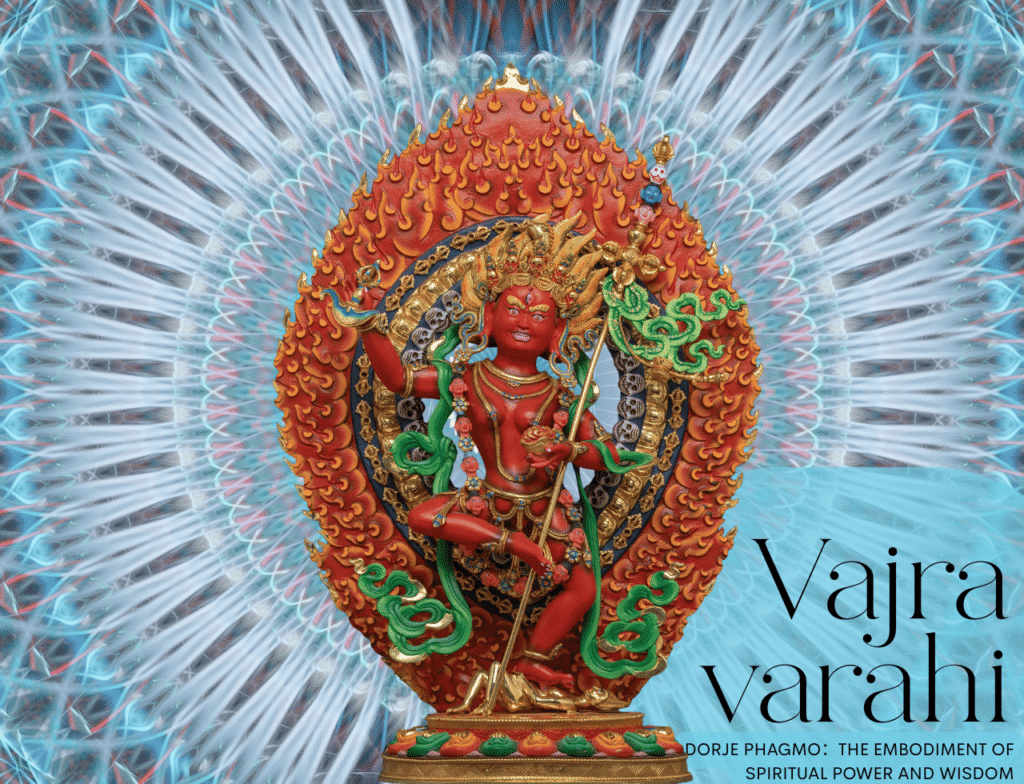
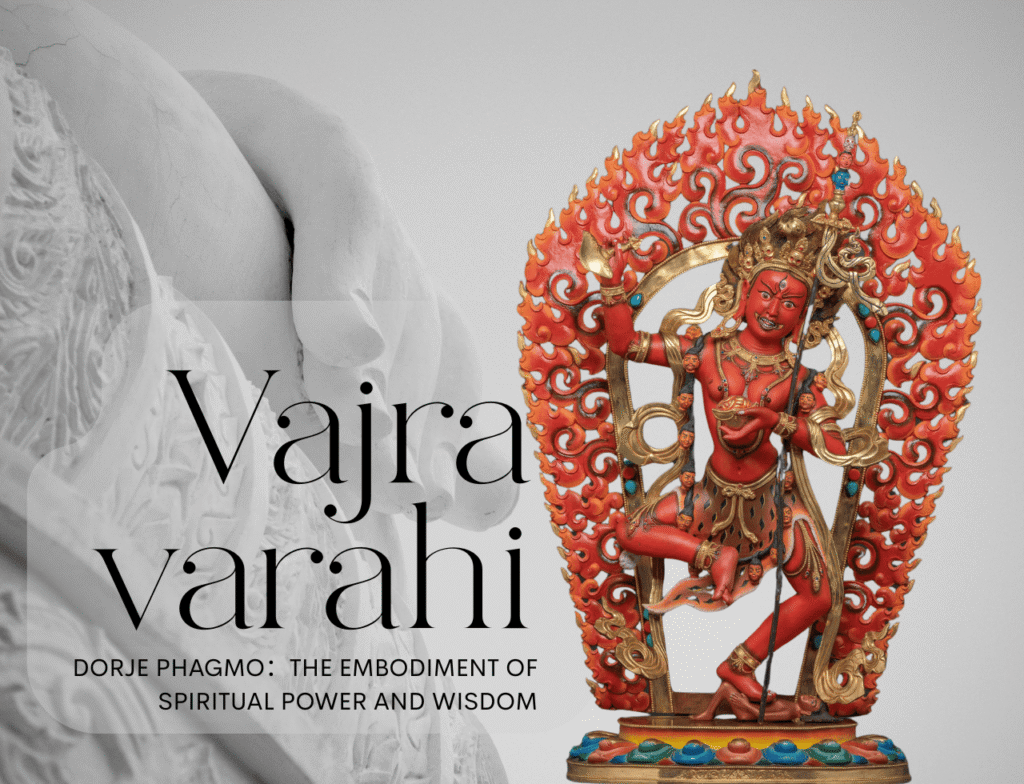
In traditional Vajravarahi thangka paintings, her appearance conveys deep symbolic meaning rooted in Vajrayana philosophy.
She is depicted with a naked red body, symbolizing intense passion transformed into all-pervasive wisdom. Her nudity represents freedom from conceptual fabrications and attachment, while the red color signifies magnetizing activity and discriminating awareness.
Her expression is semi-wrathful, reflecting her mastery over the four Buddha activities:
- Pacifying
- Enriching
- Magnetizing
- Subjugating
Sacred Attributes and Physical Symbolism
Vajravarahi wears a five-skull crown, symbolizing the transformation of the five mental afflictions—ignorance, desire, anger, pride, and jealousy—into the five wisdoms. Her dark brown hair flows upward, indicating mastery over inner winds and the awakening of enlightened energy.
Her three eyes signify omniscient awareness of the past, present, and future, a hallmark of fully realized wisdom.
Ritual Implements and Their Meaning
Each object Vajravarahi holds is deeply symbolic:
- Right hand: A vajra chopper (kartika), representing wisdom that cuts through ego-clinging and ignorance
- Left hand: A kapala (skull cup), symbolizing the bliss of enlightenment and transformation of desire
- Left arm: A khatvanga (trident), indicating realization of the three kayas—Dharmakaya, Sambhogakaya, and Nirmanakaya
These implements emphasize her role as both a fierce wisdom dakini and a fully enlightened Buddha.
Vajravarahi’s Posture and Dynamic Movement
Vajravarahi is shown dancing within a circle of blazing wisdom fire, symbolizing the burning away of karmic obscurations and delusion. She stands upon a lotus and moon disc, representing purity and emptiness, while her left foot presses upon a supine figure, signifying the subjugation of ego and ignorance.
Her dancing posture expresses continuous enlightened activity, reminding practitioners that awakening is dynamic and ever-present.
Spiritual Benefits of Vajravarahi Practice
The practice of Vajravarahi is believed to bring profound spiritual accomplishments, including:
- Removal of emotional and cognitive obstacles
- Awakening of innate wisdom and clarity
- Rapid spiritual progress on the Vajrayana path
- Transformation of samsaric experience into enlightenment
Advanced Vajravarahi practice is also associated with the attainment of the rainbow body, a rare state of realization in which the physical body dissolves into light at death, symbolizing liberation from the cycle of birth and rebirth.
Vajravarahi as the Supreme Dakini of Transformation
Vajravarahi stands as a powerful reminder that enlightenment is not achieved by rejecting passion or emotion, but by transforming them into wisdom. She embodies the fearless path of Vajrayana Buddhism, where every experience—pleasant or painful—becomes fuel for awakening.
Her enduring presence across Tibetan Buddhist lineages highlights her role as one of the most profound and transformative female deities in Vajrayana practice.