
Early Tibetan Kings and Dynasties Series
Nyatri Tsenpo (Tibetan: གཉའ་ཁྲི་བཙན་པོ།) is recorded in Tibetan tradition as the first Tsenpo (king) in Tibetan history. He stands at the head of the legendary “Seven Heavenly Kings” and is recognized as the founder of the Yarlung (Tubo) royal lineage, making him a central figure in the origins of Tibetan civilization.
Straddling the boundary between myth and early history, Nyatri Tsenpo represents the sacred beginning of Tibetan kingship. His story reflects the crucial transition of the Tibetan Plateau from loosely connected tribal groups to an early political and cultural entity rooted in divine authority, ritual tradition, and emerging governance.
The Origin of the Title “Nyatri Tsenpo” and His Legendary Background
The name Nyatri Tsenpo carries strong narrative symbolism in Tibetan culture:
- Nya (gnyav) means neck
- Khri (Tri) means throne
- Tsenpo (btsan-po) means a mighty or heroic ruler
Together, the title is often interpreted as “the heroic king enthroned upon the necks of his people.” This name originates from the legendary scene in which he was elevated to power.
According to Tibetan historical texts such as The Chronicle of Yumbu Lhakhang and Records of the Tibetan Kings, Nyatri Tsenpo was born in what is now the Bomi region of eastern Tibet. Due to his unusual appearance—described in legends as having physical traits seen as extraordinary—and his fierce temperament, he was reportedly exiled by his clan. He later traveled westward to the Yarlung Valley, the cradle of early Tibetan civilization.
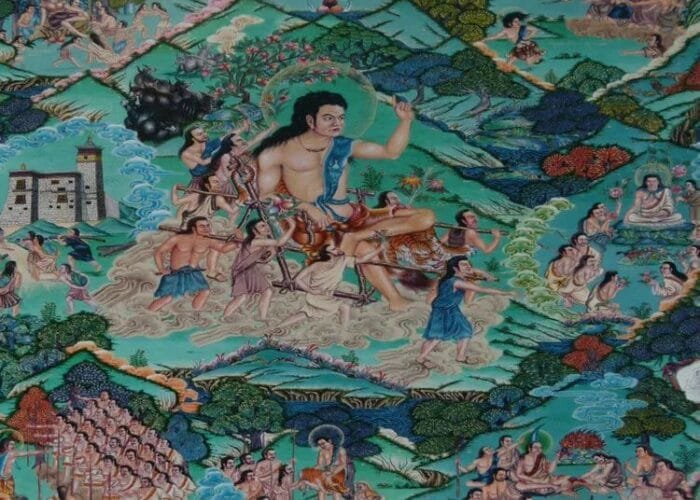
When local nomadic tribes encountered this unfamiliar young man, they sent twelve Bon religious leaders to question him. Unable to communicate clearly, he simply pointed toward the sky. This gesture was interpreted as a sign that he was a son of the heavens, descended to the human world. The Bon priests and tribal leaders then took turns carrying him on their shoulders back to the settlement and proclaimed him king—thus giving rise to the name Nyatri Tsenpo.
This legend reveals how early Tibetan kingship was shaped by Bon religious authority, collective consent, and the concept of divinely sanctioned rule.
Competing Theories About His Origins
Over centuries, several theories have emerged regarding Nyatri Tsenpo’s true origins. These include:
- The Heavenly Descent Theory, rooted in Bon cosmology
- The Local Bomi Origin Theory, viewing him as a regional tribal leader
- The Indian Royal Descent Theory, proposed in later Buddhist writings
Modern scholars generally dismiss the Indian royal origin theory due to a lack of early textual or archaeological evidence. Instead, many researchers believe Nyatri Tsenpo was likely a local patriarchal leader from the Yarlung or Bomi region. His divine identity, they argue, was a form of political theology, jointly constructed by Bon priests and tribal elites to legitimize authority and stabilize leadership succession.
Founding the Yarlung Royal Lineage
Nyatri Tsenpo is traditionally credited with founding the Yarlung royal lineage, also known as the Sibuye (悉补野) lineage, which lasted for 31 or 32 generations. According to Tibetan royal genealogy, Songtsen Gampo, the great unifier of the Tibetan Plateau, identified himself as the 33rd descendant of Nyatri Tsenpo.
Under Nyatri Tsenpo, scattered clans in the Yarlung Valley were gradually brought under a single ruler. Governance began to shift away from purely blood-based tribal alliances toward territorial administration, with early social hierarchies and systems of rank emerging. This marked a crucial step toward the formation of a proto-state on the Tibetan Plateau.
Yumbu Lhakhang: The First Palace in Tibetan History
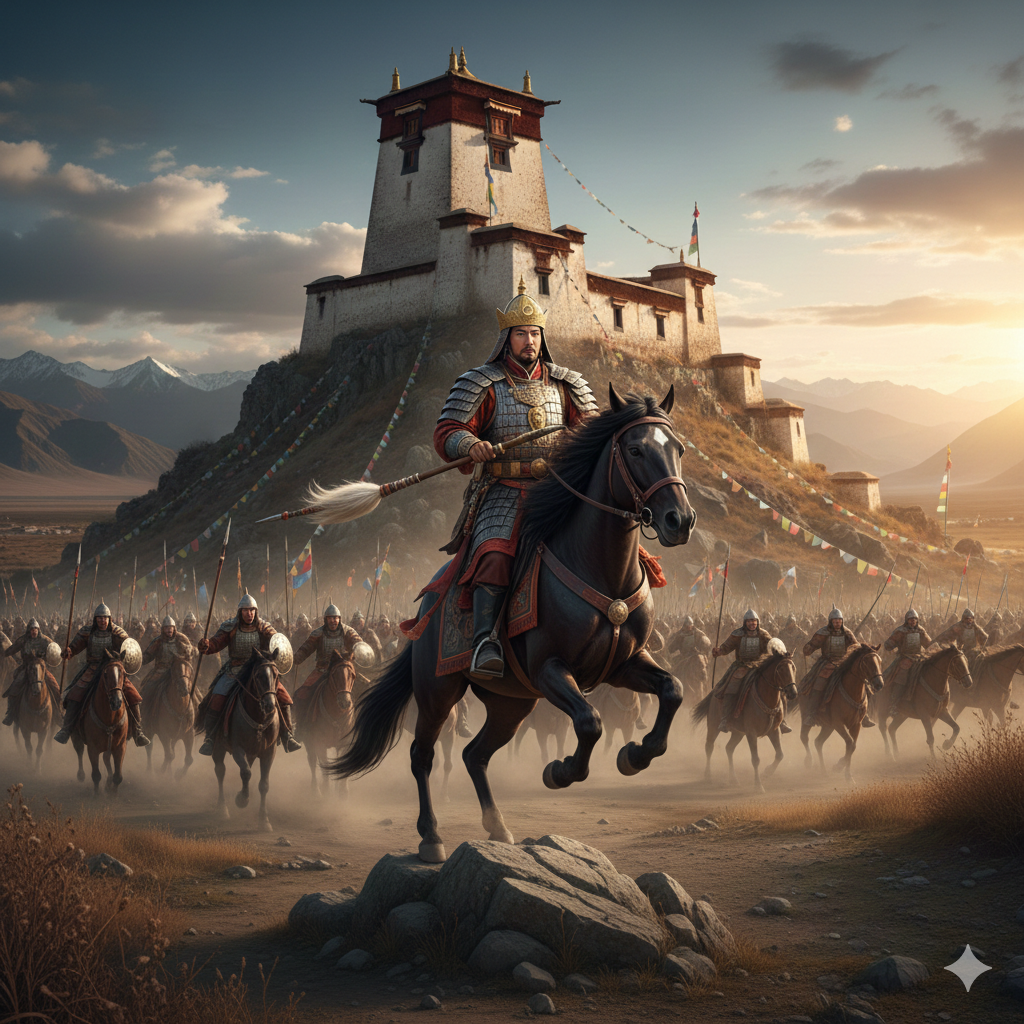
One of Nyatri Tsenpo’s most enduring legacies is the construction of Yumbu Lhakhang, widely regarded as the first palace in Tibetan history. Built atop Mount Tashi Tsere in today’s Nêdong (Nedong) County, the structure originally functioned as a defensive fortress against enemies and wild animals.
Over time, Yumbu Lhakhang evolved into a royal residence and a site for religious rituals. It remains standing today and is revered as a powerful symbol of the origin of Tibetan civilization. Some Bon historical sources also credit Nyatri Tsenpo with initiating the construction of other early palatial structures, contributing to the development of early Tibetan architectural traditions.
Bon Religion and the Sacred Model of Kingship
During Nyatri Tsenpo’s reign, Yungdrung Bon was firmly established as the dominant spiritual tradition. Bon priests served as royal advisors and ritual specialists, while Bon temples and ceremonial practices were promoted across the Yarlung region.
Religion and kingship became deeply intertwined. Through sacred rituals, the Tsenpo’s divine status was reinforced, forming an early model of coexisting spiritual and political authority. This pattern of governance—where religious legitimacy supported royal power—would later influence both the Tubo Dynasty and the development of Tibetan Buddhism.
Economic Development and Social Transformation
Legendary accounts attribute several social and economic innovations to Nyatri Tsenpo’s rule. He is said to have organized irrigation systems that channeled glacier meltwater into farmlands and encouraged the cultivation of barley (qingke), Tibet’s staple crop.
These developments marked a gradual shift from a purely nomadic economy toward early agricultural settlement, increasing food production, population stability, and regional prosperity. In Tibetan historiography, his reign is often described as the turning point from a “mythic age” to an “age of heroes,” laying material and institutional foundations for later state formation.
Historical Debates and Academic Perspectives
The exact period of Nyatri Tsenpo’s life remains debated. Different Tibetan texts place him anywhere from the 10th century BCE to the 3rd century BCE. Modern scholars generally situate him around the 2nd–3rd century BCE, though precise dating remains impossible due to limited archaeological evidence.
From an academic perspective, the myths surrounding Nyatri Tsenpo are viewed as cultural reflections of early state-building. The “descent from heaven” narrative mirrors a widespread human tendency to sanctify authority, while accounts of linguistic differences may hint at interregional migration and cultural integration within ancient Tibet. Some scholars point to Dunhuang manuscripts noting his inability to speak the local language as possible evidence of his status as an outsider who unified diverse groups.
Cultural Symbolism in Tibetan Memory
As the first Tsenpo, Nyatri Tsenpo has long transcended the role of a historical figure to become a symbol of Tibetan identity. He represents:
- The sacred origin of Tibetan kingship
- The continuity of royal lineage
- The unity of political authority and spiritual belief
According to tradition, Nyatri Tsenpo and the other “Seven Heavenly Kings” did not die ordinary deaths but ascended back to the heavens via a rainbow, reinforcing the divine nature of early Tibetan rulers.
Today, Yumbu Lhakhang stands as a living monument to his legacy, drawing pilgrims, historians, and travelers alike. As the opening figure in the series of early Tibetan kings and dynasties, Nyatri Tsenpo set in motion the historical processes that would eventually lead to the rise of the Tibetan Empire and the formation of Tibetan civilization as it is known today.