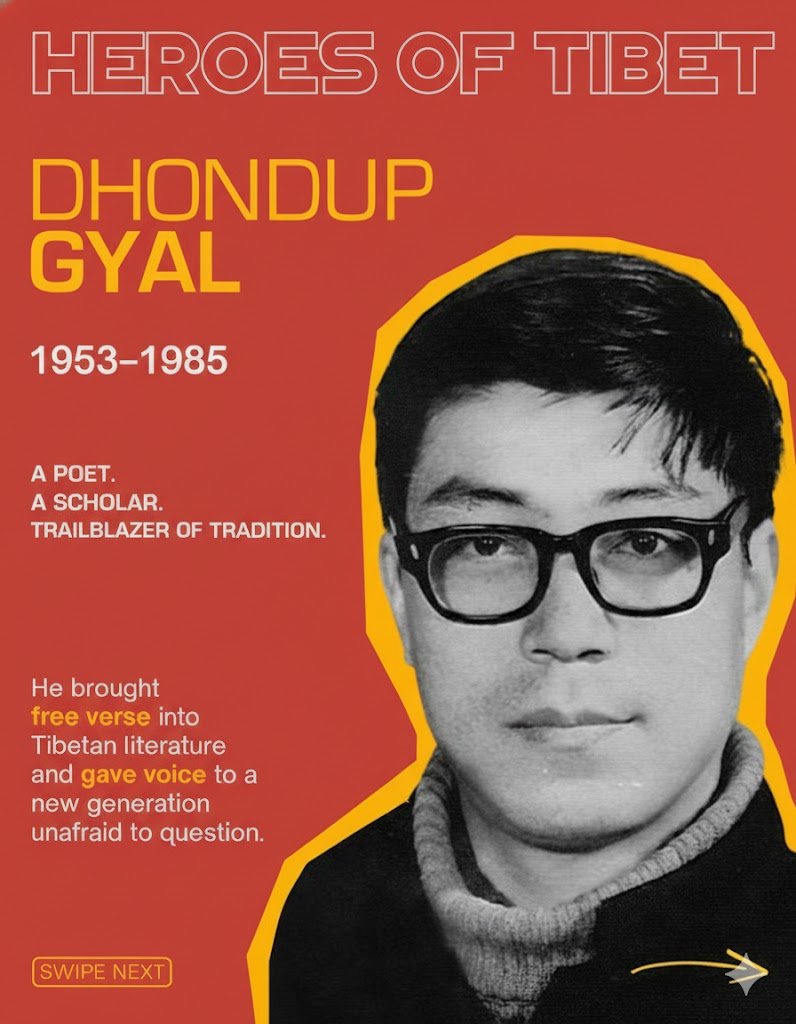
Dondup Gyal (Tibetan: དོན་གྲུབ་རྒྱལ་) stands as one of the most influential figures in modern Tibetan literature. Though his life was tragically short, his intellectual depth, literary innovation, and cultural sensitivity left a lasting imprint on Tibetan literary history. Born in the mid-20th century, Dondup Gyal belonged to a generation of Tibetan thinkers who bridged traditional learning and modern academic thought.
Early Life and Family Background
Dondup Gyal was born in 1953 in Gurong Village, Jianzha County, (ཨ་མདོ་གཅན་ཚ་རྫོང་) located in the Huangnan TAP of Qinghai. His early life was marked by emotional and social challenges. After his parents divorced when he was very young, he was raised by his uncle, who was a monk.
Growing up under monastic care exposed him to Buddhist ethics, classical Tibetan culture, and disciplined study, while still remaining connected to everyday village life. This rare combination of secular hardship and spiritual influence later shaped his deep understanding of Tibetan society and human emotions, which became central themes in his literary works.

Education and Academic Training
Dondup Gyal received systematic academic training at the Central Institute for Nationalities (now Minzu University of China), one of the most important institutions for ethnic studies and minority literature in China.
From 1971 to 1974, he majored in Tibetan Language and Literature, earning his bachelor’s degree. During this period, he developed a solid foundation in classical Tibetan texts, modern literary forms, and linguistic analysis, which later became essential to his scholarly and creative work.
Between 1978 and 1981, he pursued a master’s degree in Old Tibetan Studies at the same institution. His research focused on Tibetan literature, with particular attention to its historical, religious, and spiritual dimensions. This advanced training positioned him among the earliest Tibetan scholars to apply modern academic methods to traditional literary subjects.
Master’s Thesis and Scholarly Significance
Dondup Gyal’s master’s thesis, The Origins and Development of Tibetan Songs of Realization (《藏族道歌源流》), represents one of his most important academic achievements. The study explores the historical evolution, religious background, and literary characteristics of Tibetan “songs of realization” (dohas), a key genre in Tibetan Buddhist literature.
The thesis was published in 1984 by the Nationalities Publishing House, gaining recognition as a valuable scholarly reference. It remains influential in the fields of Tibetan literary studies, religious poetry, and cultural history, reflecting Dondup Gyal’s ability to combine textual scholarship with deep cultural insight.
Three Major Areas of Literary Activity
Dondup Gyal’s contributions to modern Tibetan literature can be clearly divided into three major areas, each of which played a vital role in literary modernization.
Translation of Chinese Literary Classics into Tibetan
One of his key contributions was the translation of influential Chinese literary works into Tibetan. Through these translations, he introduced new narrative structures, themes, and aesthetic ideas to Tibetan readers. This work broadened intellectual horizons and helped integrate Tibetan literature into wider modern literary conversations.
Annotation and Critical Evaluation of Tibetan Texts
Dondup Gyal was also deeply engaged in literary criticism and textual annotation. He produced detailed commentaries and critical evaluations of traditional Tibetan literary works, reinterpreting them through modern academic and theoretical perspectives. His critical approach encouraged new ways of reading Tibetan literature beyond purely religious or classical frameworks.
Original Literary Creation in Tibetan
In addition to translation and scholarship, Dondup Gyal was an accomplished creative writer in Tibetan, producing poetry and fiction marked by stylistic innovation and modern themes. His original works reflect a strong awareness of cultural identity, personal emotion, and social change, making him a defining literary voice of his generation.
Career in Broadcasting and Translation
After graduation, Dondup Gyal joined Qinghai People’s Radio Station, working in broadcasting. This period was crucial in sharpening his command of spoken Tibetan, narrative rhythm, and public communication. Through radio, he reached a broad Tibetan-speaking audience and gained firsthand insight into contemporary social issues.
In 1971, he was accepted into the Central Institute for Nationalities (now Minzu University of China) in Beijing, where he majored in Tibetan–Chinese Translation. This formal training deepened his bilingual proficiency and strengthened his ability to move between classical Tibetan, modern Tibetan, and Chinese literary forms.
He completed his studies in 1975 and returned to Qinghai, continuing his work in media and translation while steadily developing his literary voice.
Advanced Studies in Tibetan Literature
Dondup Gyal’s true academic turning point came in 1978, when he returned to the Central Institute for Nationalities to pursue postgraduate research in Tibetan literature. Unlike earlier practical roles, this phase allowed him to engage deeply with literary theory, modern poetry, prose, and cultural criticism.
His research reflected a strong desire to modernize Tibetan literature without losing its cultural roots. In 1981, he earned a master’s degree in Tibetan literature and was retained by the institute as a faculty member. As a young scholar, he became part of a new intellectual generation working to reshape Tibetan literary studies within modern academic frameworks.
Teaching Career and Personal Life
In 1983, Dondup Gyal moved to Hainan Tibetan Autonomous Prefecture, where he began teaching at the Hainan Nationalities Normal School. As a teacher, he was known for his seriousness, intellectual independence, and strong sense of responsibility toward students and Tibetan education.
The same year also marked significant changes in his personal life. He divorced his Tibetan wife and later married a Mongolian woman, a decision that reflected both personal transformation and the complex cultural intersections present in his life. These experiences further influenced his reflections on identity, belonging, and emotional struggle, themes that appeared in his writings.
Untimely Death and Enduring Influence
On November 29, 1985, Dondup Gyal died tragically from gas poisoning at his residence in the Hainan Nationalities Teachers College. He was only 32 years old. His sudden death shocked the Tibetan intellectual and literary communities.
Despite his brief life, Dondup Gyal’s contributions to modern Tibetan literature, education, translation, and cultural thought continue to be studied and discussed. His life journey reflects the tension and creativity of a generation striving to express Tibetan identity in a rapidly changing world.
Literary Achievements of Dondup Gyal
Dondup Gyal’s literary achievements place him among the most important pioneers of modern Tibetan literature. Through translation, literary criticism, and original creative writing, he played a decisive role in reshaping Tibetan literary expression during the late 20th century. His work helped Tibetan literature move confidently toward modernity while remaining deeply rooted in cultural tradition.
Contributions to Tibetan Literary Translation and Criticism
One of Dondup Gyal’s most significant contributions was his work in Tibetan literary translation and criticism. He translated influential Chinese literary classics into Tibetan, allowing Tibetan readers access to modern literary ideas, narrative styles, and philosophical perspectives that were previously unavailable in their own language.
Beyond translation, he produced annotations, interpretations, and critical reviews of both classical and contemporary Tibetan texts. His critical writings introduced modern literary theory into Tibetan scholarship, offering new ways to analyze structure, symbolism, and thematic depth. Through this work, he successfully built a bridge between traditional Tibetan literary heritage and modern critical thought.
These efforts enriched the Tibetan literary language, expanded its expressive capacity, and encouraged intellectual dialogue at a time of rapid cultural and social transformation.
Original Creative Writing in Tibetan
In addition to his academic and translation work, Dondup Gyal was a highly respected creative writer in Tibetan. He wrote poetry and short fiction that reflected strong emotional awareness, youthful idealism, and a deep concern for Tibetan cultural identity.
His writing style stood out for its lyrical beauty, clarity of language, and modern sensibility. Rather than imitating classical forms, he experimented with new poetic rhythms and narrative voices, helping to define a fresh literary direction for Tibetan writing in the 1980s. His works spoke directly to young readers who were searching for meaning, self-expression, and cultural confidence.
Dawn Collection (འབོལ་རྩོམ་ཞོགས་པའི་སྐྱ་རེངས): A Landmark Work
Dondup Gyal’s poems and short stories were compiled into Dawn Collection, published in 1981 by Qinghai People’s Publishing House. This collection is widely regarded as a landmark work in modern Tibetan literature.
The title symbolizes awakening, renewal, and hope, themes that resonated deeply with Tibetan youth and emerging writers of the early 1980s. Dawn Collection played a significant role in shaping new literary trends, encouraging experimentation, emotional expression, and intellectual independence within Tibetan writing.
Scholarly Recognition and the Preface to Dawn Collection
One of the clearest signs of Dondup Gyal’s literary stature was the personal recognition he received from Dongkar Lobsang Trinley, one of the most respected Tibetan scholars of the time. Dongkar Rinpoche personally wrote the preface to Dawn Collection, expressing deep admiration for Dondup Gyal’s originality and intellectual independence.
In the preface, Dongkar emphasized that Dondup Gyal’s thirteen poems and prose works were not imitations, but the product of independent thinking and genuine creativity. He praised the elegance and fluency of the language, the strong personal style, and the remarkable achievement of reaching such a level after only two years of systematic study. He further noted that several works reflected the ideals and aspirations of revolutionary youth, and that their publication brought great joy to the older generation while serving as inspiration for Tibetan youth.
This endorsement firmly positioned Dawn Collection as a breakthrough work in modern Tibetan literature.
Award-Winning Poetry and National Recognition
Among Dondup Gyal’s many poetic achievements, the poem A Fantastic Dream (འཁྲུལ་མིན་རྨི་ལམ་དགའ་སྐྱེད) holds special importance. This work won the Poetry Award at the First National Minority Literature Creation Awards, bringing him national recognition and confirming his status as a leading voice in modern Tibetan poetry.
The award marked a breakthrough moment, not only for Dondup Gyal personally but also for Tibetan literature as a whole, highlighting its creative vitality on a national stage.
The work vividly portrays the new social and cultural atmosphere of China, expressing optimism, confidence, and hope for the future. Its tone is uplifting, visionary, and emotionally resonant.
Artistic Style and Narrative Structure of A Fantastic Dream
A Fantastic Dream draws on the rhythm and clarity of traditional folk chants, giving the poem a strong oral quality and smooth narrative flow. At the same time, it unfolds like a vivid scroll painting, rich in imagery and movement.
The poem is structured as a single night’s dream and consists of two main parts. The first presents a series of symbolic dream visions—from early night to midnight and beyond—raising questions about social change, national progress, and the future. In the second part, a celestial maiden appears to interpret these visions, transforming uncertainty into clarity by introducing the new people, achievements, and realities of the 1980s.
Through the dialogue between the dreamer and the fairy, Dondup Gyal demonstrates remarkable imagination and narrative control. Images of stars, spacecraft, scientific progress, social unity, and collective joy are woven into a grand poetic vision that reflects both personal creativity and historical awareness.
Although some scientific details are not precise, the poem’s emotional power, visionary scope, and historical consciousness remain compelling, firmly establishing A Fantastic Dream as a landmark work in modern Tibetan literature.
Representative Poetry Works
Several of Dondup Gyal’s poems are now considered classics of modern Tibetan poetry, including:
- Youthful Waterfall (ལང་ཚོའི་རྦབ་ཆུ)
- Grassland Memory Melody (རྩྭ་ཐང་དྲན་གླུ།)
- White Cloud Petals (སྤྲིན་དཀར་གྱི་འདབ་མ།)
These works are celebrated for their vivid imagery, emotional depth, and innovative language. Drawing inspiration from nature, memory, youth, and spiritual reflection, the poems express both personal feeling and collective cultural experience. Through them, Dondup Gyal secured his reputation as a pioneer who expanded the boundaries of Tibetan poetic expression.
Publications in Major Tibetan Literary Journals
Beyond Dawn Collection, Dondup Gyal published extensively in influential Tibetan literary journals such as Drangchar (སྦྲང་ཆར།) and Tibetan Literature and Art (བོད་ཀྱི་རྩོམ་རིག་སྒྱུ་རྩལ།). These journals played a central role in shaping literary discourse in the 1980s, and Dondup Gyal was among their most prominent contributors.
His short stories include:
- Waves of Love (བརྩེ་དུངས་ཀྱི་རྦ་རླབས། )
- Tiger and Ox Beach (འབྲོང་སྟག་ཐང་།)
- The Story of the Fake Living Buddha (སྤྲུལ་སྐུ།)
- Flowers Destroyed by Frost (སད་ཀྱིས་བཅོམ་པའི་མེ་ཏོག)
These works are marked by emotional depth, social awareness, and stylistic innovation, often challenging convention while remaining deeply rooted in Tibetan cultural realities.
Achievements in Translation
Dondup Gyal was also an accomplished literary translator, making significant contributions to Tibetan intellectual life. His published translations include:
- The History of Tubo
- The Demon Flute of the Snow Mountains
- The Grassland of Flowers
Through translation, he expanded the expressive range of the Tibetan language and introduced new narrative forms and historical perspectives, strengthening the dialogue between Tibetan literature and broader literary traditions.
Critical Reception and Literary Status
Among his contemporaries, Dondup Gyal was widely regarded as the most outstanding Tibetan-language writer of the 1980s. His sudden death in his early thirties caused deep shock and sorrow across the Tibetan literary community.
He is frequently described as a “shining star” of contemporary Tibetan literature, known for his unconventional personality, bold thinking, and innovative style. His poetry, fiction, essays, academic papers, and translations were immensely popular during his lifetime and received high praise from both literary and academic circles.
Growing up alongside the founding of the People’s Republic of China, Dondup Gyal achieved an extraordinary level of accomplishment within a very short lifespan, leaving a legacy that continues to shape Tibetan literature and Tibetan studies.
Compilation of The Complete Works of Dondup Gyal
In the mid-1990s, several young Tibetan scholars, together with Wan Guo, associate professor at Southwest Minzu University, undertook the systematic collection and editing of Dondup Gyal’s academic and literary legacy. Scholars including Purike, Dargyal, and Gongbu Dargyal compiled his works into The Complete Works of Dondup Gyal.
This six-volume set, published by the Nationalities Publishing House in 1997, represents the most comprehensive record of his intellectual contributions. In 1999, the collection received a nomination for the Fourth National Book Award, China’s highest publishing honor, confirming the lasting value of his work.
Reception in Chinese and International Scholarship
In Chinese-language literature and research, Dondup Gyal received increasing attention through poetic tributes, memorial writings, and academic studies. Notable examples include the commemorative poem The Faith of the Road Lies in Transcending One’s Own Lament by renowned Tibetan poet Yidan Tsering the memorial poem I Question You by a young Tibetan poet, and Geng Yufang’s influential study Dondup Gyal and His Dawn Collection in Contemporary Tibetan Literature.
Over time, Dondup Gyal’s academic ideas and literary thought attracted broader interest among Chinese scholars and gradually entered international academic discussions. In India, a Tibetan-language monograph critically examining his literary works was published, along with several foreign-language studies. These developments helped introduce Dondup Gyal to a wider global audience and positioned him within comparative studies of modern minority literatures.
Academic Memorials and the Revival of Scholarly Interest
In November 1986, marking the first anniversary of his death, Dondup Gyal’s close friends and colleagues—including Duoshi, Chen Qingying, Sangde, Wan Guo, and Dawa—organized an academic memorial symposium in Qinghai. This event became an important moment in the reassessment of his scholarly and literary legacy.
The later publication of The Complete Works of Dondup Gyal and its nomination for major national awards further revived academic interest, encouraging systematic study of his poetry, fiction, translations, and theoretical writings.
Poetic Tributes and Literary Influence
Renowned Tibetan poet Yidan Cairang composed the memorial poem The Faith of the Road Lies in Transcending One’s Own Lament, vividly recalling Dondup Gyal’s intellectual brilliance and creative vitality. In the poem, Dondup Gyal is praised for his sharp perception, early intellectual awakening, and fearless pursuit of knowledge. His creativity is likened to lightning, thunder, oceans, and mountains, symbolizing both power and boundless imagination.
Yidan Cairang further portrayed Dondup Gyal as a rushing waterfall, opening a radiant path for his contemporaries and guiding Tibetan poetry toward a new era. At the same time, the poem reflects deep sorrow and philosophical reflection, questioning whether later generations can transcend personal limitations and bear the historical responsibilities of their time.
Similarly, the young poet Ogyen Dorje wrote the memorial poem I Question You, expressing shock, grief, and existential questioning in response to Dondup Gyal’s sudden death. Referring to him as a “treasure of the Snowland,” the poem reflects on the meaning of life and death, urging readers to cherish life and creative freedom. These poetic tributes reveal the profound emotional and intellectual influence Dondup Gyal had on younger writers.