For many travelers, visiting Tibet is not just a trip. It is a long-awaited dream and a life experience that stays in the heart forever. If traveling is about discovering landscapes you have never seen and feelings you have never experienced, then Tibet offers something truly unique.
For many people, it becomes the most beautiful adventure they have ever imagined. The vast mountains, sacred temples, deep spiritual traditions, and powerful landscapes create memories that last a lifetime.

A Long-Awaited Dream of Traveling to Tibet
For a long time, Tibet may feel far away—both physically and emotionally. The distance, high altitude, weather conditions, and cultural differences often make it seem difficult to reach.
But sometimes, the idea of Tibet suddenly appears again in life.
One summer, after the topic of Tibet came up once more in conversation, the dream returned strongly. It took only one second to decide to go, but more than three months to prepare for the journey.
Many travelers believe that everyone’s soul hears the call of Tibet, but only some people recognize it and decide to follow it.
Preparation often includes reading travel journals, exploring guidebooks, and learning about Tibetan history and culture. Tibet is not a destination for a spontaneous trip. It requires planning, understanding, and respect for its environment and traditions.
And most travelers realize that one trip to Tibet is never enough.
The Classic 8-Day Tibet Adventure: Lhasa, Everest Base Camp, and Namtso
Among many travel routes in Tibet, one itinerary is often described as the most unforgettable journey. This is the classic 8-day Lhasa → Everest Base Camp → Namtso Lake route, a trip that combines sacred culture, dramatic Himalayan landscapes, and once-in-a-lifetime experiences.
Every year, thousands of travelers describe this route as “the best trip of my life.”
It offers a perfect balance between Tibet’s most important religious sites and its most breathtaking natural scenery.
Why This Tibet Trip Becomes a Lifetime Memory
This journey includes several moments that travelers never forget.
Standing at Everest Base Camp on the Tibetan side, the world’s highest mountain fills the entire sky. Watching sunrise or sunset there creates an unforgettable feeling of standing on the Roof of the World.
Another powerful moment happens at Namtso Lake, where turquoise water reflects the snow-covered peaks of the Nyenchen Tangla Mountains. Early morning light across the lake creates one of the most beautiful landscapes on the Tibetan Plateau.
Travelers also experience the living spiritual culture of Tibet by visiting ancient temples and monasteries, watching pilgrims walk sacred paths, and exploring the historic heart of Lhasa.

Recommended Tibet Itinerary and Places to visit
Discovering Lhasa
The journey begins in Lhasa, the capital of Tibet. These first days allow travelers to acclimatize to the altitude while exploring the city’s most important historical and religious sites.
Potala Palace
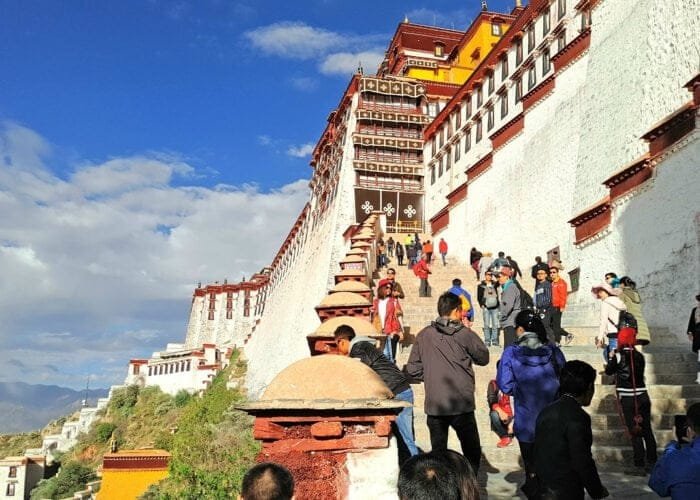
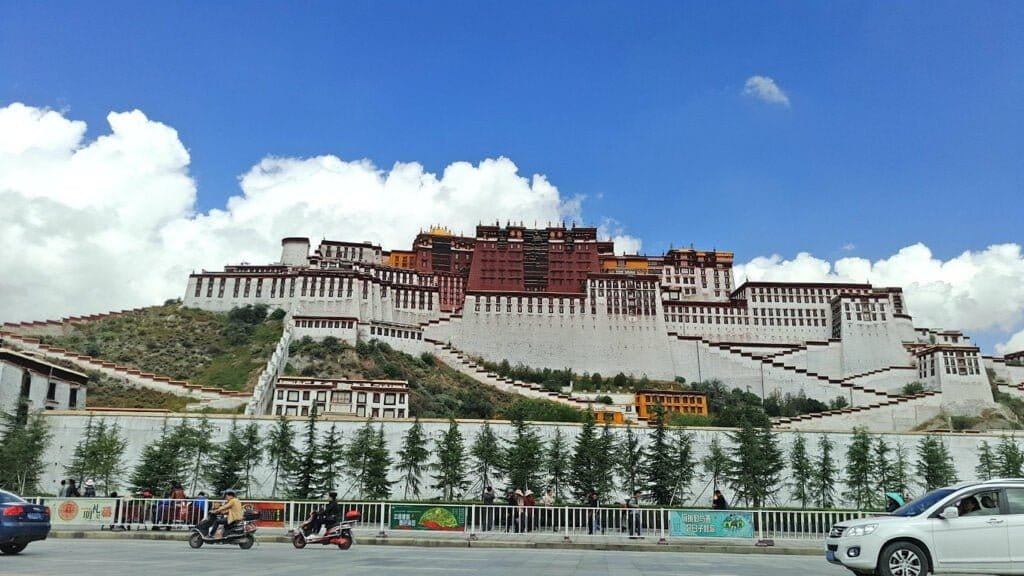
The Potala Palace stands on Red Hill in the center of Lhasa at an altitude of about 3,700 meters. It is the largest and highest ancient palace complex in the world and one of the most iconic landmarks in Tibet.
Originally built in the 7th century during the reign of King Songtsen Gampo, the palace was later expanded in the 17th century and became the winter residence of the Dalai Lamas.
The palace complex covers about 360,000 square meters and consists mainly of two sections:
- The White Palace, used as the administrative and residential area
- The Red Palace, used for religious activities and sacred halls
Inside the palace are magnificent murals, statues, and religious relics, many decorated with gold, pearls, coral, turquoise, and other precious materials.
The White Palace includes important halls where political and religious ceremonies were held. The East Hall, supported by dozens of pillars, is the largest hall of the palace.
The Red Palace contains numerous chapels and the tomb stupas of several Dalai Lamas, including the magnificent stupa of the Fifth Dalai Lama, which is covered with gold and decorated with thousands of jewels.
The palace walls are built from thick granite stones, and traditional materials such as Baima grass and Aga soil were used in its construction. Aga, a special weathered stone used for flooring, was once considered a luxury material reserved for temples and noble residences.

Jokhang Temple
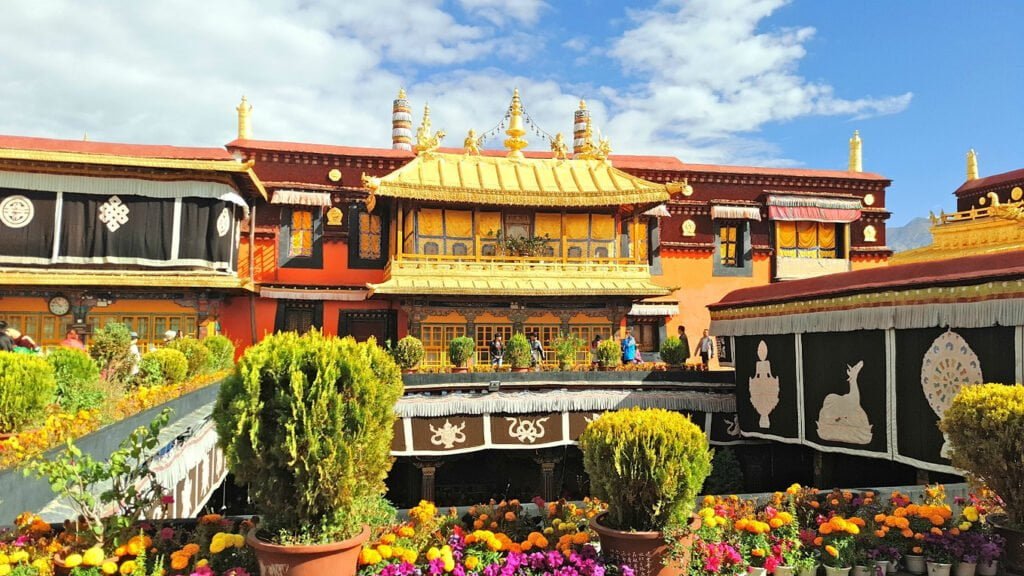
Another important site in Lhasa is Jokhang Temple, the most sacred temple in Tibetan Buddhism. It was originally built by King Songtsen Gampo to house a statue of Sakyamuni Buddha brought by the Nepalese princess.
The temple complex has grown over centuries and represents a unique blend of Tibetan, Tang Chinese, Nepalese, and Indian architectural styles.
Inside the temple is the famous 12-year-old statue of Sakyamuni Buddha, which is considered the most sacred object in Tibetan Buddhism.
Barkhor Street
Surrounding Jokhang Temple is Barkhor Street, one of the most vibrant areas in Lhasa. Pilgrims walk clockwise around the temple along this ancient path, spinning prayer wheels and chanting mantras.
The sacred walking routes around Jokhang Temple are traditionally divided into three circles:
- Nangkhor – the inner circuit around the main temple hall
- Barkhor – the outer circuit around the temple complex
- Lingkhor – the larger pilgrimage path surrounding much of Lhasa
For Tibetan people, these paths are an important part of daily religious life.
Lhasa to Yamdrok Lake, Gyantse, and Shigatse
Leaving Lhasa, the journey continues through high mountain passes and open valleys.
One of the most beautiful highlights is Yamdrok Lake, a stunning turquoise lake surrounded by snow-covered mountains. The view of this sacred lake is one of the most photographed landscapes in Tibet.
After visiting the lake, the route continues through Gyantse and finally reaches Shigatse, the second-largest city in Tibet.
Everest Base Camp
The road then leads toward the Himalayas and eventually reaches Everest Base Camp (5,150 meters) on the Tibetan side.
Travelers stay overnight near the base camp and wake up early to watch Mount Everest glowing pink in the sunrise. Nearby stands Rongbuk Monastery, the highest monastery in the world.
The vast silence of the high plateau, combined with the view of Everest, creates one of the most powerful moments of the entire journey.
From Everest to Namtso Lake
After leaving Everest, the journey continues across northern Tibet toward Damxung and finally reaches Namtso Lake.
Namtso is one of the highest saltwater lakes in the world, located at an altitude of 4,718 meters. The lake is famous for its deep blue water and the magnificent backdrop of the Nyenchen Tangla Mountain Range.
At sunrise or sunset, the snow-covered peaks reflect on the lake surface, creating one of the most memorable scenes in Tibet.
Return to Lhasa
The final day of the journey returns travelers to Lhasa, completing a dramatic route of about 1,200 kilometers across some of the most spectacular landscapes on the Tibetan Plateau.
Preparing for High Altitude in Tibet
One of the most common concerns for travelers is altitude sickness. The high elevation of the Tibetan Plateau requires preparation and patience.
Different locations in Tibet sit at different elevations:
- Nyingchi – about 3,100 meters
- Lhasa – about 3,650 meters
- Shigatse – about 3,836 meters
- Damxung – about 4,200 meters
- Namtso Lake – about 4,718 meters
- Yamdrok Lake – about 4,441 meters
- Everest Base Camp – about 5,200 meters
Some travelers prepare by taking Rhodiola herbal supplements several weeks before arrival. Others bring common medications for headaches or stomach discomfort.
Headaches are the most common symptom at high altitude. Some people may also experience digestive discomfort or fatigue during the first days.
In many cases, symptoms improve after a short period of acclimatization in Lhasa.
Important Travel Tips When Visiting Tibet
There are several things travelers should keep in mind during their trip.
Photography restrictions:
Certain locations, including military facilities and security personnel, should not be photographed.
Public restrooms:
Outside Lhasa city, public toilets often charge a small fee. Travelers should carry small banknotes for convenience.
Temple donations:
Visitors often bring small banknotes when visiting temples to make voluntary offerings.
Respect for pilgrims:
Many Tibetan pilgrims perform full-body prostrations along sacred paths. Visitors should avoid blocking their way and show respect for their religious practices.
Security checks are common at major religious sites such as the Potala Palace and Jokhang Temple, and this is part of normal travel procedures in Lhasa.
A Journey Filled with Culture, Nature, and Spiritual Meaning
A journey through Tibet brings together ancient temples, sacred mountains, pilgrimage traditions, and vast Himalayan landscapes. Travelers experience not only beautiful scenery but also the unique cultural and spiritual atmosphere of the Tibetan Plateau.
For many people, visiting Tibet becomes one of the most meaningful and unforgettable adventures of their lives.