
Diure Temple is a little-known yet deeply significant Tibetan Buddhist monastery located in Xinba Township, Longzi County, Tibet. Sitting at an altitude of 3,940 meters, this ancient temple carries more than 700 years of history, reflecting centuries of religious devotion, architectural evolution, and artistic achievement.
The Tibetan name “Diure” means “the temple built next to the horse pen,” a humble origin that contrasts with the temple’s lasting spiritual importance. Founded in the 13th century by Dza Lotsawa, Diure Temple has witnessed major historical changes while remaining a vital religious site in southern Tibet.
Location and Historical Background of Diure Temple
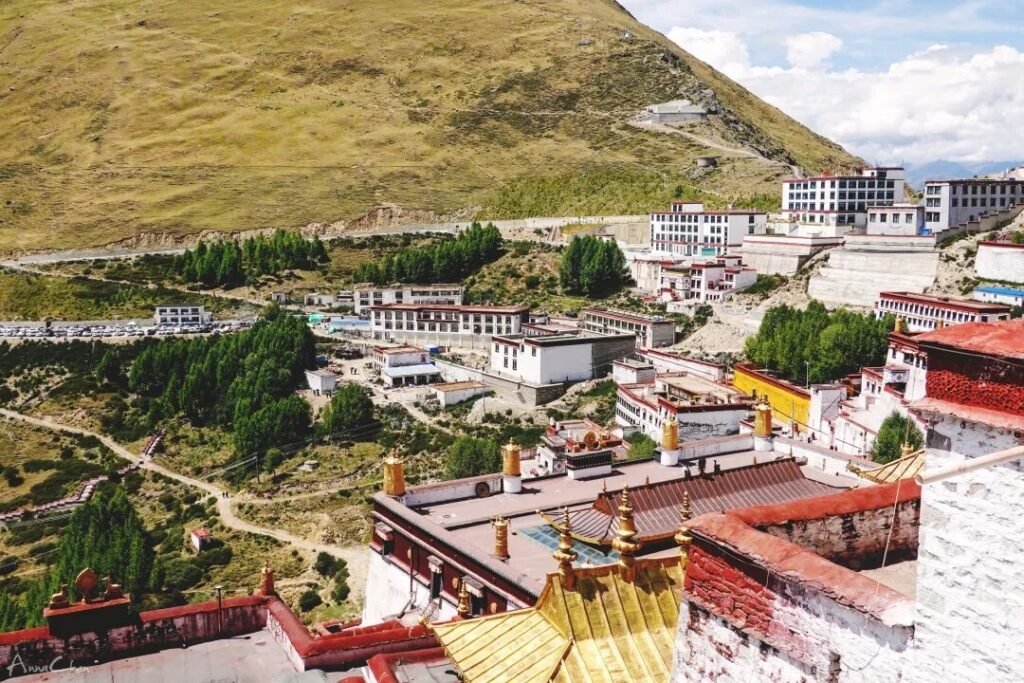
Diure Temple lies in the upper reaches of Longzi County, an area shaped by both natural beauty and historical crossroads. Its early development was closely tied to regional trade routes and monastic networks that flourished during Tibet’s medieval period.
Originally established on the north bank of the Longzi River, the earliest temple structures were destroyed during the Mongolian Dzunggar invasion, forcing the monastery to relocate and rebuild over time. These historical disruptions shaped the layered architectural character seen today.
Architectural Evolution Across Three Periods
The architecture of Diure Temple can be clearly divided into early, middle, and late construction phases, each reflecting different historical conditions.
Early Period Structures
The first buildings stood near the Longzi River but were completely destroyed during warfare, leaving no surviving structures from this phase.
Middle Period Buildings
After relocation, a new complex was built, including the Dukhang Hall and Gonkhang. These mid-period structures eventually collapsed due to age and environmental factors.
Late Period Construction: Tsuklakhang
The surviving heart of the monastery today is Tsuklakhang, representing the late architectural stage of Diure Temple and preserving its religious functions into the present.
Religious Transformation and Monastic Life
Diure Temple was originally affiliated with the Sakya school of Tibetan Buddhism. In the 14th century, it transitioned to the Gelug school, aligning itself with the rising influence of Gelug teachings in central and southern Tibet.
At its height, Diure Temple supported hundreds of monks, serving as an important religious center in the region. Today, the monastery houses 16 monks, guided by the senior master Lobsang Yeshi, continuing daily rituals and religious education.
Tsuklakhang: The Core Structure of Diure Temple
Layout and Construction Features
Tsuklakhang stands on the eastern side of the temple complex and is a two-story stone structure. The ground floor includes the Dukang Hall and the Buddhist Hall, forming the main ritual space.
The building features:
- Thick stone walls
- Round wooden lion decorations under the south eaves
- Eaves finished with traditional edge ma grass
- Twelve wooden brackets projecting from the north eaves, reinforcing the roof corners
Dukhang Hall Design
The Dukhang Hall includes a front porch covering approximately 45 square meters, leading into a square main hall measuring 18.4 by 17.4 meters.
Inside, square wooden columns are arranged in a grid pattern, with spacing of 2 × 2.4 meters. The four central columns support the upper floor, creating a patio-style interior structure commonly seen in traditional Tibetan monastery architecture.
Additional Temple Structures
Buddhist Hall
Located behind the Dukang Hall, the Buddhist Hall covers about 16 square meters and serves as a quieter space for devotion and prayer.
Dharma Protector Temple
Positioned on the eastern side of the complex, the Dharma Protector Temple occupies around 20 square meters and is dedicated to protector deities and ritual practices central to Tibetan Buddhism.
Murals of Diure Temple: A Living Gallery of Tibetan Buddhist Art
The murals of Diure Temple are among its most valuable cultural treasures, preserving religious stories, lineage teachings, and artistic traditions.
Murals Inside the Dukang Hall
South Wall Murals
- West Section: Depicts Vajrayana deities and consorts, shown with flame-shaped halos and mounted on horses
- East Section: Features a goddess riding a mule, a six-armed deity, Yamantaka, and Yama Dharma Protector
West Wall Murals
From south to north, the wall illustrates:
- Chang Xing, a protective deity
- Vairochana Buddha
- An Indian great master
- The “Two Saints and Six Ornaments”, including Atisha and Zhongdunba
- A prominent portrait of Tsongkhapa and the Gelug lineage system
East Wall Murals
- Northern Section: Biography of Sakyamuni Buddha and the Sixteen Arhats
- Middle Section: The Eight Medicine Master Buddhas and their followers
- Southern Section: A three-faced, eight-armed Avalokitesvara (Guanyin) surrounded by attendants, alongside Vajradhara Buddha and Padmasambhava
Among these, the Biography of Sakyamuni Buddha and the Three-Faced, Eight-Armed Avalokitesvara stand out for their refined composition, vivid storytelling, and graceful details.
Porch and Courtyard Murals
Porch Wall Paintings
- North Wall: The Four Heavenly Kings
- South Wall: Guardian deity Jirab, along with Lhamo and Garmaningda, now worshipped as male and female Dharma protectors
Bright Shed Murals
Inside the courtyard shed, murals portray:
- Six-armed deities
- Vajradhara and Hayagriva
- Tsongkhapa with his two main disciples
- The First Dalai Lama, Gendun Drupa
- Tsongkhapa’s disciple Kedrupje
These paintings enrich the spiritual atmosphere of the temple and reflect the artistic maturity of Tibetan mural traditions preserved at Diure Temple.