Tibetan people
Tibetan Customs
Major Festivals in Tibet
Tibetan Language


The world highest mountains are defined by an exclusive group: the 14 independent peaks that soar above the 8,000-meter mark. These monumental mountains are concentrated almost entirely within two of Asia’s important ranges—the Himalayas and the Karakoram.
The Himalaya and Karakoram mountain ranges together form one of the most powerful and influential geological systems on Earth. Stretching across South and Central Asia, these mountains are home to the planet’s highest peaks, vast glacier systems, rich biodiversity, and deeply rooted cultural traditions. Beyond their dramatic landscapes, they play a critical role in global climate regulation, water security, geopolitics, and tourism.
The Himalayas extend for about 2,400 kilometers from northwest to southeast, while the Karakoram range stretches roughly 500 kilometers from Afghanistan toward China and Pakistan. Together, they shape weather patterns, sustain billions of lives downstream, and stand as symbols of spiritual transcendence and natural power.
All 14 of the world’s “Eight-Thousanders” are clustered along the borders of South and Central Asia. They are neatly divided between two distinct mountain systems, with a strong geographical link to Tibet, Nepal, Pakistan, India and Xinjiang, Border region of China.
This incredible concentration makes these areas the undisputed epicenter of the planet’s highest-altitude challenges and is a core characteristic of China’s border geography.
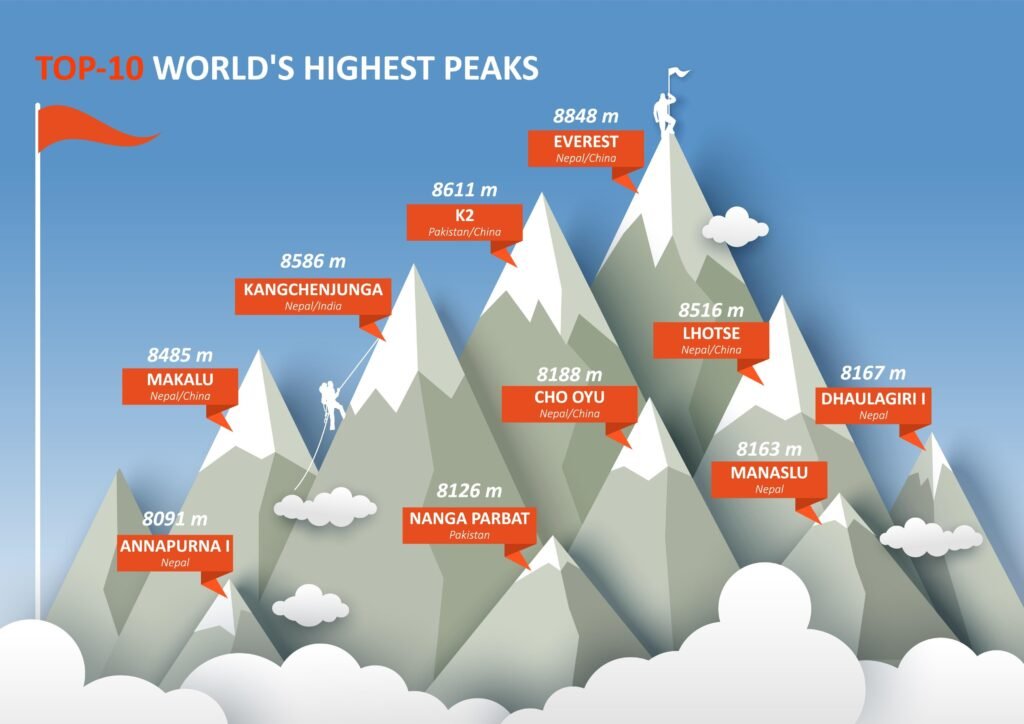
Beyond their sheer height, the names of these mountain ranges hold deep cultural and geographical clues, revealing their fundamental nature.
The Himalayas—a name that immediately conjures images of pristine, snow-capped giants—derives its name from ancient roots. The name comes from the Sanskrit language:
The name “Himalaya” is an Indian (Sanskrit) word. The original Tibetan name is called Riwo Gangchen (རི་བོ་གངས་ཅན), meaning “Snowy Mountain,” therefore, the Himalayan range can called the Riwo Gangchen range.
To the northwest, the Karakoram range presents a contrasting, starkly powerful appearance reflected in its Turkic name. The name is derived from Turkic languages:
The Himalayas and Karakoram are home to all 14 of the world’s eight-thousanders—mountains rising above 8,000 meters. Formed by the collision of the Indian and Eurasian tectonic plates, these ranges feature extreme elevations, vast glaciers, and some of the most challenging terrain on Earth. The Himalayas span Nepal, India, Bhutan, China, and Pakistan, while the nearby Karakoram lies mainly in Pakistan and China.
The Himalayas contain most of the highest peaks and famous trekking routes like Everest Base Camp and the Annapurna Circuit. The Karakoram, though smaller, is renowned for its massive glaciers and four eight-thousanders: K2, Gasherbrum I, Broad Peak, and Gasherbrum II.
Whether climbed, trekked, or admired from afar, these majestic giants showcase the raw power and beauty of Earth’s highest mountains.
Both the Himalayas and the Karakoram were formed around 50 million years ago due to the collision of the Indian and Eurasian tectonic plates. This ongoing convergence continues to uplift the mountains today, making them among the youngest and most dynamic fold mountain systems in the world.
The Himalayas consist of several parallel ranges running west to east:
Geographically, the Himalayas lie between the Tibetan Plateau to the north and the Indo-Gangetic Plain to the south, spanning India, Nepal, Bhutan, China (Tibet), and Pakistan.
The Karakoram range, often considered distinct but closely linked to the Himalayas, lies to the northwest and runs parallel to them. It is sometimes grouped with the Trans-Himalayan system. The Karakoram is known for:
The range also converges with the Hindu Kush, adding further geological complexity.
The Himalaya–Karakoram region is deeply woven into myth, religion, and folklore, revered as a sacred and mysterious realm.
Stories of Shangri-La, a hidden utopian valley, are often associated with the greater Himalayan–Karakoram region. The legend of the Yeti (Abominable Snowman) blends folklore with reported sightings, reflecting the mountains’ isolation and mystery. Such myths have shaped regional art, literature, and spiritual practice for centuries.
The Himalayas and Karakoram are rich in minerals and gemstones, particularly within metamorphic and pegmatite formations.
| Mineral / Gemstone | Main Locations | Notable Features |
|---|---|---|
| Aquamarine (Beryl) | Karakoram, Shigar Valley | High-quality blue-green crystals |
| Tourmaline | Northern Pakistan, Himalayas | Multi-colored varieties |
| Garnet (Hessonite) | Hindu Kush–Himalaya | Abundant in metamorphic rocks |
| Emerald, Ruby, Sapphire | Karakoram zones | High-value but limited deposits |
| Gold, Iron Ore | Greater Himalayas | Supports small-scale mining |
In regions like Ladakh, igneous rocks such as basalt, gabbro, and serpentinite are common. Mining activity has existed for centuries and continues to support local economies on a limited scale.
Biodiversity changes dramatically with altitude:
The Karakoram supports cold- and drought-resistant plants such as edelweiss, adapted to harsh conditions.
The region hosts around 300 mammal species, including:
Birdlife thrives in lower elevations, while high-altitude predators dominate upper zones. The region blends Indo-Malayan and Central Asian ecological influences.
Often called the “Third Pole”, the Himalaya–Karakoram system contains massive glacier reserves that feed major rivers such as:
These rivers provide water to over 1.3 billion people, supporting agriculture, energy production, and daily life.
The ranges provide:
They are central to Hinduism and Buddhism, making them both ecological and spiritual lifelines.
The Himalayas and Karakoram form a strategic frontier where borders of China, India, Pakistan, Afghanistan, and Tajikistan converge.
Climate change is accelerating warming in the region faster than the global average.
Western Himalayas are warming faster than eastern regions, altering snowfall, monsoon patterns, and water availability across Asia.
Tourism is a major economic driver:
While eco-tourism promotes conservation and local income, challenges include overcrowding, waste management, and environmental stress.
The Himalaya and Karakoram mountain ranges are far more than dramatic backdrops of snow and stone. They are living systems that regulate climate, sustain biodiversity, shape civilizations, and influence global geopolitics. As climate change and human pressures intensify, protecting these mountains is not just a regional concern—but a global responsibility.