
Overview of Mangkang (Markham) Yunnan Snub-Nosed Monkey National Nature Reserve
The Mangkang Yunnan Snub-Nosed Monkey National Nature Reserve is one of Tibet’s most important wildlife conservation areas. Located in the Mangkang Mountain region of Mangkang (Markham) County, along the border between the Tibet Autonomous Region and northwest Yunnan. The reserve plays a vital role in protecting one of the world’s most endangered primates—the Yunnan snub-nosed monkey (Rhinopithecus bieti).
Originally established in 1985 as the Honglashan Nature Reserve, the area gained national attention after the discovery of the Yunnan snub-nosed monkey by the Tibet Autonomous Region Rare Wild Animals Survey Team during 1987–1988. In 1992, it was designated as an autonomous region–level reserve and later upgraded to a national-level nature reserve. Nature park officially named the Mangkang Yunnan Snub-Nosed Monkey National Nature Reserve.
Location and Geographic Features
The reserve is situated in Mangkang County (Markham County) of Chamdo Prefecture, stretching along the Yunling Mountain Range between the Lancang (Mekong) River and the Jinsha (Yangtze) River. This region forms part of the greater “Three Parallel Rivers” ecological zone, known for its dramatic terrain and exceptional biodiversity.
Elevation within the reserve generally ranges from 3,500 to 4,500 meters, with the highest peak, Pengbola Mountain, reaching 5,084 meters. Lower valleys descend to approximately 2,300–3,000 meters, creating sharp vertical climate and vegetation zones. The protected area extends over 80 kilometers in length and more than 30 kilometers in width, covering over 2,400 square kilometers.
Forest Coverage and Natural Landscape
With a forest coverage rate of 70–80%, the reserve preserves extensive high-altitude primitive forests. The landscape transitions from warm, humid valley bottoms to forest meadows on mountain slopes, featuring valuable tree species such as Yunnan pine, high-mountain oak, willow, and alpine conifers.
The area also showcases Quaternary glacial landforms, snow-covered ridges, and alpine basins. Cultural landmarks like Zini Monastery and the serene Longdong Lake add religious and historical depth to the natural scenery, blending Tibetan spirituality with wilderness landscapes.
The Yunnan Snub-Nosed Monkey: Flagship Species
The reserve is best known as a stronghold for the Yunnan snub-nosed monkey, a national first-class protected animal and one of the world’s most endangered primates. Locally known as “Zhunzha” or “Zhecha” in Tibetan, this species was once believed extinct in the 1960s.
Today, thanks to long-term conservation efforts, the global population has rebounded to approximately 3,000–3,845 individuals, with 570–790 living in Tibet. Within the Mangkang reserve, there are three major monkey communities, totaling over 700 individuals, typically found at elevations between 3,000 and 4,000 meters.
Appearance and Unique Adaptations
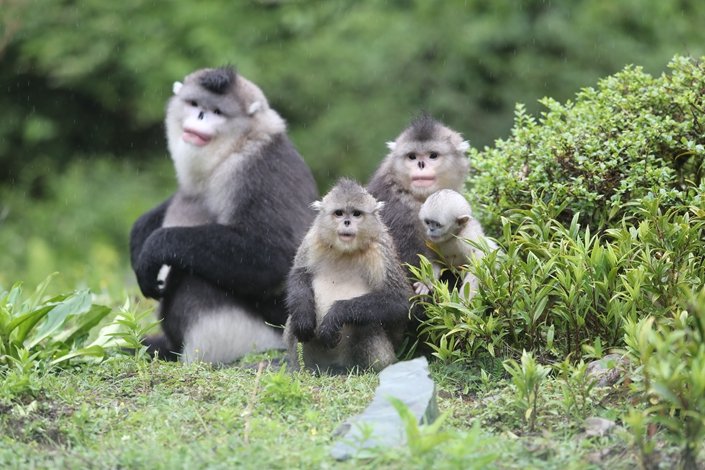
Yunnan snub-nosed monkeys have a striking appearance. Adults measure about 70 centimeters in body length and weigh around 15 kilograms. They are easily recognized by their sky-blue faces, upturned nostrils, and short ears. Noses of them appear swollen and flat, giving them the “snub-nosed” name.
Their fur is thick and glossy—black and gray on the head, neck, upper limbs, and tail, with contrasting white fur on the chest, abdomen, inner limbs, and hips. Their long tails are equal to or longer than their bodies, helping with balance in treetops.
Behavior and Lifestyle in High-Altitude Forests
These monkeys live in large, complex social groups, often numbering over 100 individuals, and sometimes forming multi-level troops of 20 to 500 members. They are uniquely adapted to cold, high-altitude environments, earning them the nickname “Snow Monkeys.”
Unlike most primates, they primarily feed on conifer needles, lichens, bark, and leaves, allowing them to survive in harsh alpine forests where food is scarce. Early spring and late autumn are the best seasons to observe them foraging in the forest canopy.
Other Protected Wildlife and Biodiversity
Beyond the snub-nosed monkey, the reserve shelters a wide range of rare and endangered wildlife. It is home to 12 national first-class protected species, including:
- Tibetan Macaque
- Gray Langur
- Clouded Leopard
- Snow Leopard
- Temminck’s Tragopan
- Green-tailed Sunbird
Additionally, 48 national second-class protected species inhabit the area, such as the Red Panda, Lynx, Sun Bear, Tibetan Partridge, parrots, vultures, as well as mammals like Sambar Deer, Musk Deer, Bharal, and the White Eared Pheasant.
Conservation History and Protection Efforts
The reserve forms part of China’s broader conservation strategy in the Hengduan Mountains and the Three Parallel Rivers World Natural Heritage Site. Since surveys began in 1979, continuous monitoring has documented steady population recovery.
Key conservation measures include:
- Population surveys and GIS habitat mapping
- Habitat restoration, with over 990 hectares added and additional vegetation recovery plans
- Alternative energy programs reducing firewood use for thousands of households
- Community-based patrols and education, involving schools and monasteries such as Dongzhulin Lamasery
- Strict hunting bans and gun collection programs
The reserve is also part of China’s first national wildlife protection network for snub-nosed monkeys, launched in 2019.
Visitor Information and Eco-Tourism
Tourism in the reserve is limited and eco-focused, emphasizing wildlife observation and cultural experiences in Tibetan communities. Due to its location in Tibet, foreign visitors require a Tibet Travel Permit, and travel must usually be arranged through authorized tour operators.
The county town is about 60 kilometers from the reserve, with National Highway 214 providing access. Visitors typically reach the area by rented car, with local rentals costing around 200–300 yuan per day. Guided tours from Chamdo, Deqin, or nearby counties are recommended.
Best Time to Visit and Travel Tips
The best time to visit the reserve is spring and autumn, when weather conditions are milder and wildlife sightings are more frequent. Travelers should prepare for high-altitude conditions, sudden weather changes, and basic accommodation facilities.
Visitors are encouraged to follow sustainable tourism practices, respect local Tibetan customs, and minimize environmental impact while exploring this remote and ecologically sensitive region.
Local Medicinal Resources and Natural Products
The reserve is also rich in traditional medicinal resources. Locally known products include musk, deer antler, bezoar, and snow frog, as well as valuable herbal medicines such as caterpillar fungus, fritillaria, angelica, rhodiola, codonopsis, notoginseng, rhubarb, and picrorhiza kurrooa.
These resources highlight the deep connection between biodiversity, traditional Tibetan medicine, and sustainable use of natural ecosystems within the Mangkang region.