

Introduction to Animal Husbandry in the Tibet Autonomous Region (TAR)
Animal husbandry in the Tibet Autonomous Region (TAR) plays a central role in both the rural economy and the cultural fabric of Tibetan society. At its core, animal husbandry involves the breeding and raising of livestock for food, clothing, transportation, and income. In Tibet’s high-altitude environment, where crop farming options are limited, livestock rearing is not just an agricultural activity—it is a way of life.
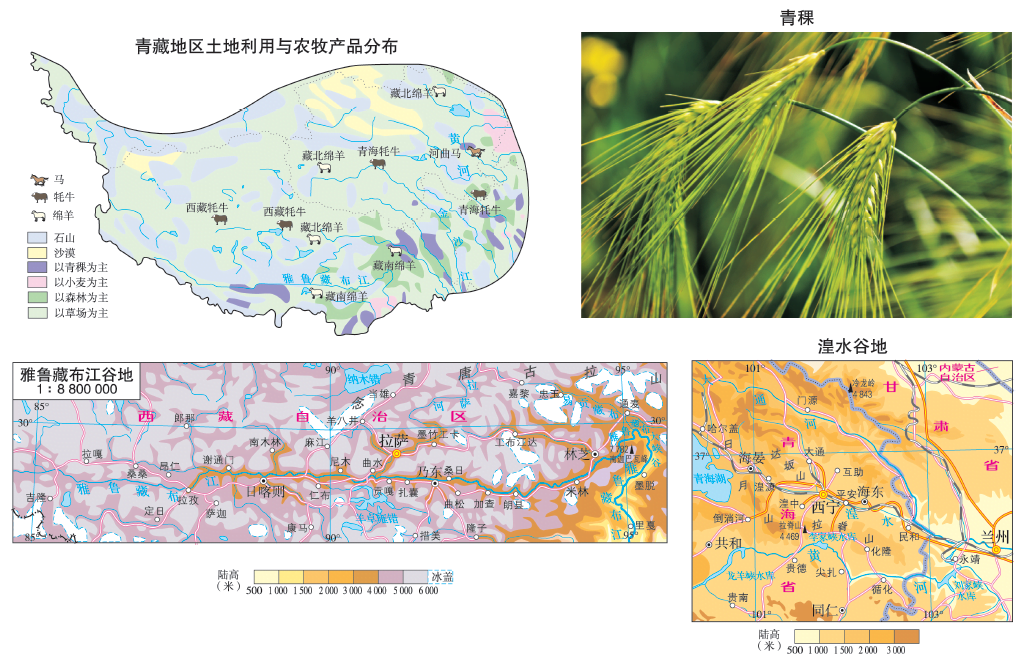
For centuries, Tibetan communities have relied on animals such as yaks, sheep, and goats, which are uniquely adapted to the cold climate, thin air, and rugged terrain of the plateau. These animals provide meat, milk, butter, wool, and hides, while also holding deep symbolic value in rituals, festivals, and daily life. The close relationship between herders and their livestock reflects a long-standing tradition of living in balance with nature.
Even today, animal husbandry remains the backbone of the rural economy in TAR. Most pastoral communities practice transhumance, a seasonal migration system that moves herds between summer and winter pastures. This method supports sustainable grassland use and helps preserve fragile alpine ecosystems. Livestock farming is often closely integrated with small-scale agriculture, as animals provide manure for fertilization, draft power, and a steady source of household income.
Current Economic Impact of Animal Husbandry in TAR
As of December 2025, animal husbandry accounts for approximately 25% of the Gross Domestic Product (GDP) of the Tibet Autonomous Region, highlighting its importance to regional economic stability. More than 80% of the local population is involved in livestock-related activities, making this sector a primary source of income and food security for rural households.
Yak, sheep, and goat farming dominate livestock production in TAR. These animals supply meat, dairy products, wool, and fiber, all of which contribute directly to household earnings. On average, rural families derive about 45% of their annual income from animal husbandry, demonstrating how closely livelihoods are tied to livestock health and productivity.
In recent years, greater attention has been given to sustainable livestock development. Regional initiatives promote improved grazing management, balanced herd sizes, and better animal health practices. By combining traditional knowledge with modern livestock techniques, animal husbandry in TAR is increasingly aligned with environmental protection goals while continuing to support economic growth.
Key Livestock Types and Production in Tibet
The livestock sector in TAR is shaped by animals that thrive in extreme high-altitude conditions. Each species contributes in distinct ways to the local economy and daily life.
Yaks
Yaks are the most iconic and economically important livestock in Tibet, with an estimated population exceeding 1.5 million. Highly adapted to cold temperatures and low oxygen levels, yaks provide milk, meat, wool, and hides. Yak dung is also widely used as fuel in areas with limited vegetation. Annual yak milk production is estimated at around 200 million liters, making it a cornerstone of local diets and dairy processing.
Sheep
Sheep are another vital component of Tibetan animal husbandry, with a population of approximately 3 million. They are raised primarily for mutton, wool, and skins. Each year, sheep production yields roughly 45,000 tons of mutton, supporting both household consumption and regional markets. Tibetan sheep breeds are known for their resilience and ability to graze on sparse alpine grasslands.
Goats
Goats number around 1.2 million in TAR and are valued for both meat and cashmere fiber. Annual goat meat production reaches about 30,000 tons, while cashmere output is estimated at 500 tons per year. Cashmere has become an increasingly important income source for herders, especially in remote pastoral areas.
Horses
Although fewer in number—around 300,000—horses remain culturally and practically significant. They are used for transportation, herding, and ceremonial purposes, especially in nomadic and semi-nomadic communities. Horses continue to symbolize mobility and traditional Tibetan pastoral culture.
Livestock Management Practices in the Tibetan Plateau
Livestock management in TAR reflects generations of experience shaped by environmental constraints. One of the most important practices is transhumant grazing, where herders move livestock seasonally between established pastures. This approach allows grasslands time to regenerate and helps prevent overgrazing in fragile alpine environments.
Breeding strategies focus on resilience and survival. Herders select animals based on traits such as cold tolerance, disease resistance, and reproductive strength. Close daily interaction with livestock enables early detection of health issues, while basic veterinary practices—such as vaccinations and parasite control—are increasingly common to reduce disease risks.
Animal husbandry in Tibet is highly labor-intensive. Herders must manage shelters, forage storage, and animal care under challenging climatic conditions, especially during long winters. Gender roles play an important part in daily operations. Women are often responsible for milking, dairy processing, and household management, while men typically handle long-distance herding and major decisions. In practice, responsibilities frequently overlap, with both men and women contributing to the sustainability of pastoral livelihoods.
Challenges Facing Animal Husbandry in TAR
Despite its importance, animal husbandry in the Tibet Autonomous Region faces a range of ongoing challenges. Climate variability, grassland degradation, and increasing pressure on grazing resources threaten long-term sustainability. Harsh winters, extreme weather events, and changing precipitation patterns can lead to livestock losses and reduced productivity.
Balancing traditional pastoral systems with modern economic demands also remains complex. Market access, veterinary services, and infrastructure limitations continue to affect herders in remote areas. As animal husbandry evolves, addressing these challenges will be essential to safeguarding livelihoods while protecting the fragile ecosystems of the Tibetan Plateau.
Challenges Facing Animal Husbandry in the Tibet Autonomous Region
Animal husbandry in the Tibet Autonomous Region (TAR) faces a range of structural and environmental challenges that directly affect its long-term sustainability. One of the most serious issues is overgrazing, which occurs when livestock numbers exceed the natural carrying capacity of alpine grasslands. Continuous pressure on pastures accelerates land degradation, causes soil erosion, and reduces grassland productivity. Given the fragile nature of Tibet’s high-altitude ecosystem, recovery from such damage can take many years.
Climate Change and Environmental Stress
Climate change has intensified existing pressures on pastoral systems. Rising temperatures, shifting snowfall patterns, and unpredictable rainfall have altered traditional grazing cycles. These changes affect forage availability and water access, placing additional stress on livestock health and increasing the risk of herd losses. Extreme weather events, such as prolonged droughts or severe winters, further threaten food security for herding communities that rely heavily on livestock.
Policy Constraints and Livelihood Pressures
Ecological protection policies introduced to preserve grasslands and biodiversity have also reshaped livestock practices. Grazing restrictions, pasture fencing, and herd reduction measures are designed to restore degraded land, but they can limit access to traditional grazing areas. For many pastoral households, fewer animals translate into reduced income and economic uncertainty. Balancing environmental protection with the livelihoods of herders remains a complex and ongoing challenge.
Government Support and Adaptive Measures
To address these issues, authorities have introduced support programs aimed at stabilizing the animal husbandry sector. These include subsidies for sustainable grazing, training programs for herders, and initiatives to improve animal health and breeding efficiency. Such measures seek to protect both pastoral incomes and the ecological balance of the Tibetan Plateau, emphasizing coexistence between economic resilience and environmental stewardship.
Innovations and Modern Practices in Tibetan Animal Husbandry
In recent years, animal husbandry in TAR has undergone gradual modernization, driven by the need to improve productivity while reducing environmental impact. One major development is the introduction of hybrid livestock breeds that combine traditional hardiness with improved growth rates and disease resistance. These animals are better suited to high-altitude conditions and help increase yields without significantly expanding herd sizes.
Technology in Pasture and Herd Management
Technology is playing an increasingly important role in modern pastoral management. Tools such as drones, mobile applications, and remote sensing technologies allow herders to monitor pasture conditions, livestock movement, and water availability in real time. Geographic Information Systems (GIS) are also being used to design sustainable grazing plans, helping prevent overuse of grasslands and supporting long-term ecological health.
Cooperative Models and Market Access
Another notable trend is the rise of herder cooperatives, which encourage collaboration among pastoral households. Through cooperative structures, herders can share resources, access veterinary services, and negotiate better prices for meat, dairy, and wool products. In areas such as Lhasa and surrounding counties, cooperatives have reduced production costs through collective purchasing of feed and medical supplies, strengthening income stability for members.
These innovations reflect a broader shift toward adaptive animal husbandry—one that integrates modern tools with traditional knowledge to enhance resilience in a challenging environment.
Cultural Significance of Animal Husbandry in Tibet
Animal husbandry in the Tibet Autonomous Region is deeply embedded in Tibetan culture and identity. Livestock, especially yaks, are far more than economic assets; they represent a close relationship between people, land, and spiritual life. Often called the “treasure of the plateau,” the yak provides milk, butter, meat, wool, and fuel, making it central to daily survival in high-altitude regions.
Livestock in Festivals and Rituals
Yaks feature prominently in Tibetan festivals, religious ceremonies, and community events. During important occasions such as Saga Dawa, yaks may appear in ritual contexts, symbolizing abundance, strength, and harmony with nature. Their presence reinforces the spiritual dimensions of pastoral life and highlights the cultural importance of livestock beyond material value.
Symbol of Tibetan Identity and Nomadic Heritage
Animal husbandry also reflects the nomadic and semi-nomadic traditions that have shaped Tibetan society for generations. Seasonal migration with livestock is both a practical grazing strategy and a cultural expression of mobility and adaptation. Yaks appear frequently in Tibetan art, folklore, and oral storytelling, representing resilience, endurance, and the interconnectedness of humans and nature.
This enduring bond between herders and their animals continues to define Tibetan cultural heritage. Even as modernization influences pastoral systems, animal husbandry remains a powerful symbol of identity, tradition, and sustainable coexistence with the natural environment of the Tibetan Plateau.
Government Policies Driving Animal Husbandry Development in Tibet
Under the 14th Five-Year Plan, China has introduced a wide range of policies and support programs aimed at strengthening the animal husbandry industry in the Tibet Autonomous Region (TAR). These measures focus on improving productivity, promoting sustainable livestock practices, and protecting the fragile environment of the Tibetan Plateau.
A core element of these policies is financial support for local herders and pastoral communities. Through direct subsidies, farmers are encouraged to adopt modern animal husbandry techniques while continuing traditional pastoral livelihoods. This balanced approach helps stabilize rural incomes and supports long-term economic development across high-altitude regions of Tibet.
Subsidies Supporting Herders and Pastoral Communities
Government subsidies play a critical role in modernizing Tibet’s livestock sector. Financial assistance is provided for:
- Purchasing high-quality livestock breeds
- Improving veterinary services and animal healthcare
- Developing basic infrastructure such as shelters, feeding systems, and winter enclosures
These subsidies help herders cope with climate variability, harsh weather conditions, and market fluctuations. By reducing financial pressure, pastoral families can invest in better livestock management practices, improving herd health and overall productivity.
At the same time, policies promote modern pastoralism, which integrates traditional nomadic knowledge with contemporary breeding, feeding, and disease-prevention methods. This blended model improves efficiency without disconnecting herders from their cultural roots.
Environmental Protection and Sustainable Pastoral Practices
Environmental conservation is a central pillar of Tibet’s animal husbandry policies. The Tibetan Plateau is one of the world’s most sensitive ecosystems, often referred to as the “Third Pole.” To protect this environment, authorities encourage low-impact and regenerative grazing practices.
Key environmental measures include:
- Controlled grazing to prevent grassland degradation
- Soil restoration programs to improve pasture resilience
- Biodiversity protection initiatives across major grazing areas
These policies aim to reduce the ecological footprint of livestock farming while maintaining the long-term health of grasslands. Regenerative practices that rebuild soil fertility and enhance carbon absorption are especially important as climate change intensifies across the plateau.
Training Programs and Technological Integration
Capacity building is another priority under current support programs. Training initiatives for herders focus on animal health, sustainable grazing, pasture rotation, and emergency response to extreme weather events.
Technology is increasingly integrated into pasture management. Tools such as satellite monitoring, GPS tracking, and data-based grazing analysis help optimize land use and prevent overgrazing. These technologies allow local authorities and herders to monitor pasture conditions in real time, ensuring resources are used responsibly.
Future Outlook for Animal Husbandry in Tibet
By December 2025, Tibet’s animal husbandry industry is expected to experience continued transformation. Advances in breeding techniques, feed management, and veterinary science are projected to increase productivity while lowering environmental stress.
Sustainability remains a defining theme. Improved livestock efficiency means fewer animals can generate higher yields, reducing pressure on grasslands. These changes support both economic growth and ecological preservation, which are critical for the long-term stability of pastoral regions.
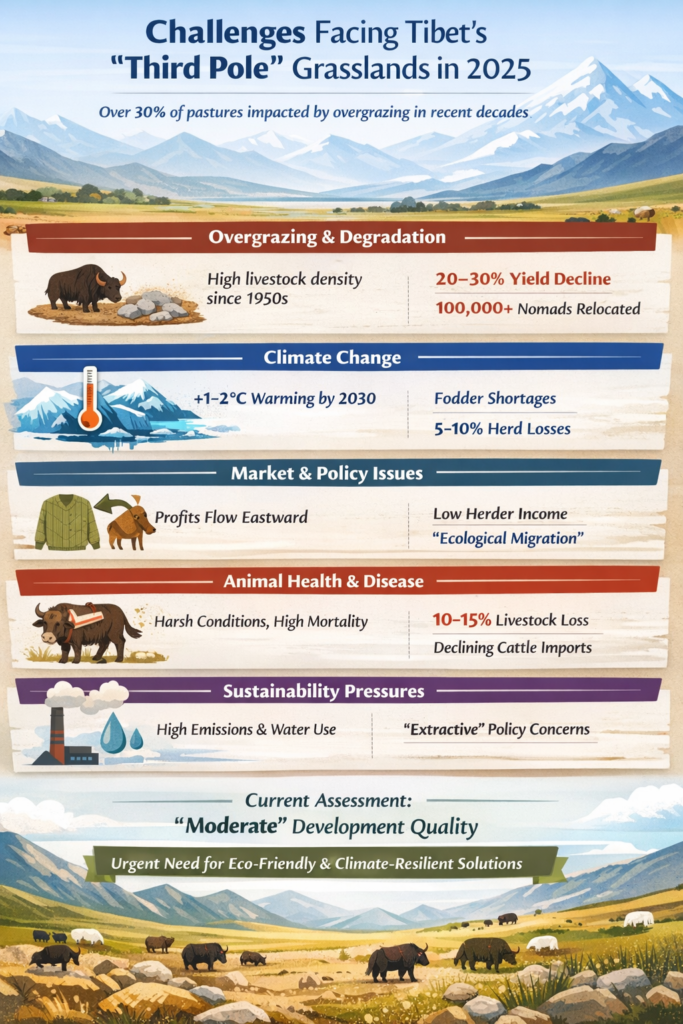
Key Challenges Facing Tibet’s “Third Pole” Grasslands (2025)
| Challenge | Description | Impact (as of 2025) |
|---|---|---|
| Overgrazing & Grassland Degradation | Rapid growth in human and livestock populations since the 1950s; stocking rates exceed 1.5 animal units per hectare in high-pressure areas | 20–30% decline in pasture yields; expanding desertification in Nagqu; relocation of 100,000+ nomads (2003–2020) |
| Climate Change | Glacier retreat, erratic monsoon patterns, frequent snow and hail disasters; projected +1–2°C temperature rise by 2030 | Chronic fodder shortages; high vulnerability across the Qinghai–Tibet Plateau; 5–10% herd losses during extreme weather events (e.g., 2025 hailstorms) |
| Market & Policy Constraints | Low commercialization of local livestock products; value-added processing concentrated outside Tibet (e.g., cashmere in Inner Mongolia) | Annual herder incomes average RMB 15,000–20,000; “ecological migration” policies disrupt traditional pastoral lifestyles |
| Animal Health & Disease | Harsh high-altitude conditions limit animal growth; imported breeds such as Angus face adaptation challenges | Livestock mortality rates of 10–15%; declining cattle imports into TAR projected in 2025 |
| Sustainability Pressures | Greenhouse gas emissions from ruminants; high water use in dairy production | Tensions with national “green development” goals; public and academic critiques describing policies as “extractive” |
Development Assessment
Recent entropy-based studies from neighboring Qinghai Province rate Tibet’s animal husbandry sector at a “moderate” level of high-quality development, highlighting the urgent need for eco-friendly upgrades, improved pasture management, and climate-resilient practices.
Climate Change Risks and Adaptation Strategies
Climate change poses one of the greatest challenges to animal husbandry in TAR. Rising temperatures, erratic monsoons, glacier retreat, and frequent snow disasters threaten pasture quality and water availability.
As grasslands become less predictable, herders face difficulties maintaining herd sizes and ensuring sufficient nutrition. To address these risks, adaptation strategies increasingly focus on:
- Climate-resilient grazing systems
- Improved fodder storage and emergency feed reserves
- Early-warning systems for extreme weather events
These measures help reduce vulnerability and improve the resilience of pastoral communities.
Carbon-Neutral Goals and Green Livestock Development
China’s carbon-neutral commitments are reshaping the future of livestock farming in Tibet. Reducing greenhouse gas emissions from animal husbandry is now a policy priority.
Proposed solutions include:
- Advanced manure management systems
- Efficient feed formulations to lower methane emissions
- Renewable energy use in farm operations, such as solar-powered facilities
By aligning animal husbandry with national green development goals, Tibet’s livestock sector can move toward a more sustainable and environmentally responsible model.
Integration of Animal Husbandry and Eco-Tourism
An emerging trend in Tibet is the integration of animal husbandry with eco-friendly tourism. Traditional pastoral lifestyles, yak herding, and nomadic culture attract travelers seeking authentic Tibetan experiences.
Eco-tourism initiatives provide herders with additional income sources while promoting cultural preservation. When managed responsibly, this synergy strengthens rural economies and raises awareness of the cultural and environmental importance of pastoral life on the Tibetan Plateau.
Key Challenges Facing Tibet’s Animal Husbandry Sector
Despite policy support, significant challenges remain. Overgrazing continues to affect 30–40% of Tibet’s grasslands, driven by population growth and high livestock density in certain areas.
Climate change has intensified fodder shortages and increased livestock mortality during extreme weather events. Market limitations also persist, as many value-added livestock products are processed outside Tibet, limiting local income growth.
Health and disease management remain difficult due to harsh natural conditions, while sustainability concerns—such as greenhouse gas emissions and water use—continue to spark debate around green development strategies.
Recent studies assessing livestock development in neighboring regions like Qinghai classify Tibet’s animal husbandry sector as moderate in overall quality, with clear potential for improvement through eco-friendly upgrades and better resource management.