Tibetan people
Tibetan Customs
Major Festivals in Tibet
Tibetan Language
Biking through the Himalayas from Lhasa to Kyirong is widely considered one of the most adventurous cycling journeys on earth. This 17-day expedition takes riders through the heart of Tibet — past ancient monasteries, sacred lakes, high-altitude passes, and the base of the world’s tallest mountain — before descending to the Nepal border. It is not just a physical challenge. It is a direct, unfiltered encounter with one of the most remote and beautiful landscapes on the planet.
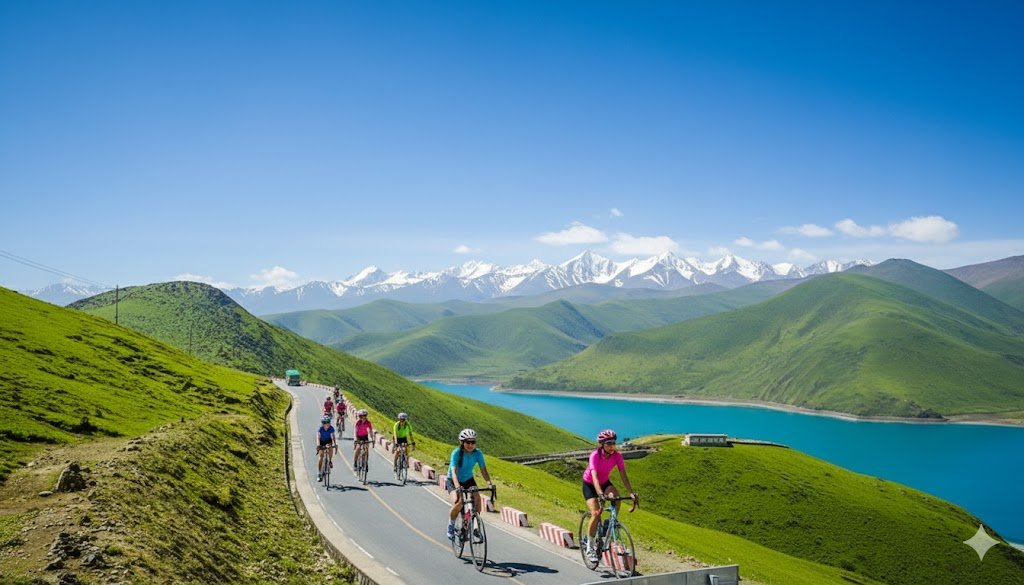
June through September is the best time to take this tour, with July and August offering the most reliable conditions of the entire year. At Namtso Lake’s elevation of around 4,700 meters, daytime temperatures typically reach a comfortable 15–22°C. The grasslands are green, wildflowers are in bloom, and nomadic herders move across the plateau with their yaks and sheep.
The lake’s deep blue waters reflect the open sky with exceptional clarity, and both road access and weather stability are at their peak. In Lhasa, temperatures is warm with long sunny days — ideal conditions for sightseeing at Potala Palace, Jokhang Temple, and the city’s monasteries. Summer also brings many of Tibet’s most vibrant festivals and cultural events.
Altitude: 3,650 meters
Lhasa serves as both the starting point and the cultural foundation of this expedition. Arriving at this altitude — where oxygen levels are considerably lower than most cyclists are accustomed to — makes proper acclimatization essential before a single pedal stroke is taken. During the first days, drink plenty of water, avoid alcohol and caffeine, rest well, and move slowly. Medication such as acetazolamide can help manage symptoms if needed.
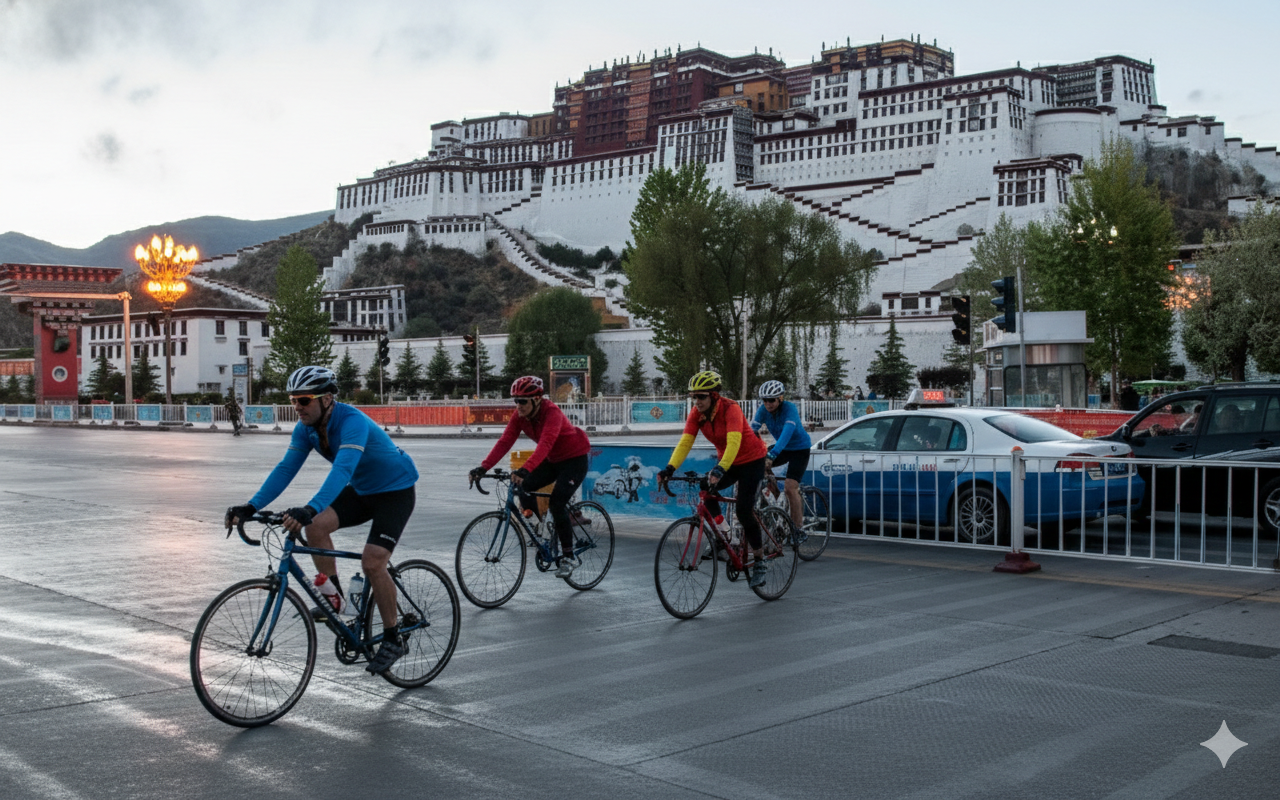
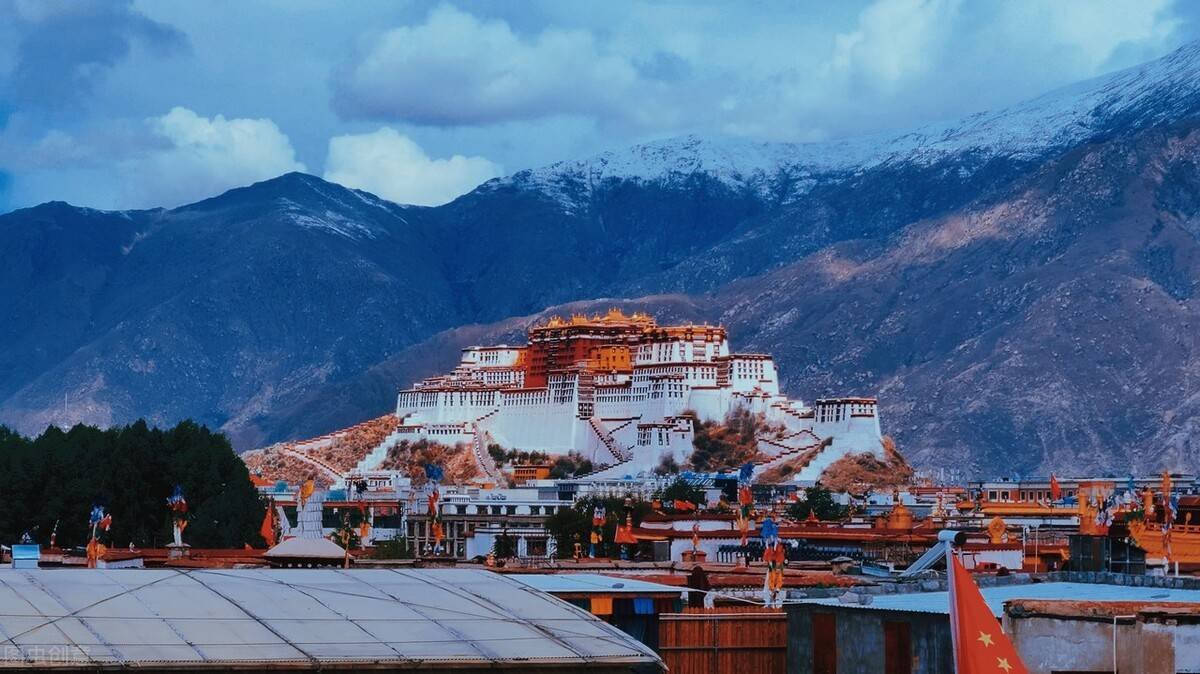
The days in Lhasa are well spent exploring four of the city’s most significant landmarks. Potala Palace is the former residence of the Dalai Lamas and a UNESCO World Heritage Site — a vast white and red complex perched on a hill above the city, immediately recognizable and deeply significant to Tibetan history.
Jokhang Temple is the spiritual heart of Tibetan Buddhism, also UNESCO-listed, housing the most revered image of Buddha in Tibet — the Jowo Rinpoche. Its golden roofs, intricate carvings, and colourful murals make it one of the most visually striking temples in Asia. Barkhor Street, the lively market route surrounding Jokhang Temple, is the ideal place to experience local Lhasa culture up close. Prayer flags, thangkas, jewellery, carpets, and yak wool products fill the stalls, while momos, butter tea, tsampa, and yak meat offer a proper introduction to Tibetan food.
Norbulingka, the summer palace of the Dalai Lamas and another UNESCO World Heritage Site, provides a calmer, garden-filled contrast to the city’s busier sites.
Route: Lhasa (3,650 m) → Quxu Bridge (3,593 m) Distance: 71 km · approximately 4 hours
The expedition officially begins after breakfast. The first day on the bike is intentionally manageable — 71 kilometres over around four hours — giving riders a chance to find their rhythm and assess how their bodies are responding to altitude and exertion together.
After setting up camp at Quxu, a stroll to the Yarlung Zangbo River rewards the effort of the day with a spectacular sunset over one of the world’s great waterways. Accommodation is available at Quxu Hotel or in tents depending on preference.
Route: Quxu Bridge (3,593 m) → Kampala Pass (4,793 m) → Nagartse (4,450 m)
Distance: 84 km · approximately 6 hours
The terrain becomes more demanding as the route climbs to Kampala Pass at 4,793 meters. Along the way, traditional Tibetan villages appear against the mountain backdrop, and the shimmering expanse of Yamdrok Lake eventually comes into view — one of the most celebrated natural sights in all of Tibet. The turquoise waters stretching across the high-altitude basin are a powerful visual reward for the climb.
The day ends in Nagartse village, where camp is set up amid genuinely serene surroundings.
Route: Nagartse (4,450 m)- Karo La (5,110 m)- Gyantse (4,025 m)
Distance: 104 km · approximately 6–7 hours
This is one of the most physically demanding days of the entire expedition. The route climbs to Karo La — the first pass above 5,000 meters — before descending through highland barley fields on the approach to Gyantse. The contrast between the raw altitude of the pass and the cultivated valley below is striking.
In Gyantse, Palkor Chorten Monastery offers a meaningful cultural stop before the night in a comfortable hotel — a welcome rest after a long day in the saddle.
Route: Gyantse (4,025 m) → Bainang → Shigatse (3,836 m) Distance: 96 km · approximately 6 hours
The road from Gyantse to Shigatse is sealed and well-maintained, making for a comparatively smooth day of riding. Shigatse is Tibet’s second-largest city and home to Tashilunpo Monastery — the seat of the Panchen Lama and one of the most architecturally impressive religious complexes in Tibet. A visit here is one of the cultural highlights of the entire route. Accommodation for the night is in a comfortable hotel in Shigatse.
Route: Shigatse (3,836 m) → Tso La (4,534 m) → Lhatse (4,023 m) Distance: 150 km · approximately 8 hours
After a leisurely morning exploring Shigatse, the afternoon riding toward Giding County begins. Over these two days, the route climbs over Tso La Pass at 4,534 meters, offering Himalayan views before the descent into Lhatse. Camping is available en route, with an overnight stay in a local hotel in Lhatse.
Route: Lhatse (4,023 m) → Gyamtso La (5,252 m) → Baiba (4,393 m)
Distance: 86 km · approximately 5 hours
Day 10 delivers the expedition’s highest point — Gyamtso La Pass at 5,252 meters. The climb is substantial, but the descent offers something extraordinary in return: clear views of Mount Everest emerging against the horizon. Tibetan settlements appear along the road as the route drops toward Baiba village, where camp is set for the night.
Route: Baiba (4,393 m) → Zhaxizong Village (4,161 m) Distance: 64 km · approximately 4 hours
The route leaves the main road and turns directly toward Everest Base Camp. This is a shorter riding day by distance, allowing riders to pace themselves through stunning high-altitude landscapes before setting up camp in Zhaxizong village — the last stop before Base Camp itself.
Route: Tashi Dzong (4,164 m) – Mt. Everest Base Camp (5,020 m)
Distance: 49 km · approximately 5 hours
The ride to Everest Base Camp passes Rongbuk Monastery — recognized as the highest monastery in the world at 4,987 meters — before reaching Base Camp at 5,020 meters. The views of Everest’s north face from this point are extraordinary and unlike anything seen from a distance on the road. Rest and acclimatization at Base Camp allow riders to fully absorb what they have achieved to reach this point.
A full rest day at Mount Everest Base Camp. With no riding scheduled, the focus shifts to recovery, reflection, and simply being in one of the most remarkable places on earth. Sunrise over the summit and the shifting light of sunset across the Himalayas are experiences that define the entire expedition.
Route: Mt. Everest Base Camp- Longjiang La Pass → Tingri (4,327 m) Distance: 74 km · approximately 7 hours
Leaving Base Camp, the route descends toward Tingri via Longjiang La Pass, with continuous views of Everest and neighbouring Cho Oyu throughout the ride. Camp is set up overnight in Tingri.
Route: Tingri- Gucuo Village → Menbu County
Distance: 62 km · approximately 4 hours
A shorter and more relaxed day, the ride from Tingri to Menbu County follows a route flanked by Himalayan peaks and lakeside scenery. Camp is set at a pristine site, offering a calm and visually beautiful evening before the longest riding day of the tour.
Route: Menbu County- Kyirong (2,414 m)
Distance: 123 km · approximately 7 hours
The final riding day is also the most dramatic in terms of descent. From La Lung La Pass at 5,017 meters, the route drops all the way to Kyirong at just 2,414 meters — one of the sharpest altitude drops of the entire expedition. En route, Pakpa Temple offers a final cultural stop before arriving in Kyirong, a small town on the Tibet-Nepal border. The night is spent in a local hotel.
The expedition concludes with a smooth transfer to Kyirong Bridge, where the tour guide bids farewell. For those continuing onward to Kathmandu, Days 9 through 11 of the extended route cover the cross-border journey from Gyirong Port through Rasuwa Gadhi to Dhulikhel, ending with a 35 km ride into Kathmandu.
This is arguably the most adventurous cycling route a mountain biker can take anywhere in the world. The 17-day journey from Lhasa to Kyirong is not a standard sightseeing tour with a bike attached — it is a full immersion into one of earth’s most remote and dramatic environments, experienced entirely from the saddle.
What sets this expedition apart is its extraordinary range. The route crosses five major passes above 4,500 meters, including the expedition’s highest point at Gyamtso La at 5,252 meters. It passes through ancient Tibetan cities, sacred monasteries, turquoise high-altitude lakes, and nomadic grasslands. It reaches Mount Everest Base Camp at 5,020 meters — one of the most iconic destinations on the planet — and then continues south through the Himalayas all the way to the Tibet-Nepal border at Kyirong, sitting at just 2,414 meters.
No other cycling route in Tibet combines this level of altitude, distance, cultural depth, and natural variety in a single journey. Riders experience firsthand the rugged Himalayan landscape, the rhythms of Tibetan village life, and the raw scale of the world’s highest mountain range — not from a bus window, but from the road itself.
Here are our contact options for your convenience:
Feel free to reach out anytime!
Yes, you have the option to cancel your tailor-made tour. However, be aware that cancellation charges will be applied as per the Tour Tibet cancellation policy. For detailed information, please review our Terms and Conditions.
Arranging a tour in Tibet independently is not possible due to the mandatory Tibet Travel Permit. This essential document is a requirement for all foreign visitors traveling to the region and can only be obtained through a local travel agency authorized by the Tibet Tourism Bureau.
Absolutely! We encourage you to visit our office and discuss your travel plans directly with our experienced travel consultants. Together, we can create a tailor-made Tibet tour that suits your preferences and requirements.
After confirming your tour arrangements, a deposit of 20% of the total trip cost is required to secure your booking. This deposit can be made via PayPal, Credit Card, Western Union, or Wire Transfer. The remaining balance is due at the start of your tour.