Dive into the saga of Phakpa Rinpoche, the spiritual luminary who scripted history with wisdom and ink, and carved a dynasty from the heart of Tibet. Unravel the mystique of Drogon Choegyal Phakpa, whose divine diplomacy and sacred scripts bridged empires, and whose teachings echo through the corridors of time.
Early Life and Education of Drogon Choegyal Phakpa
Drogon Choegyal Phakpa, also Known by name Lobsang Gyamtso, when he was young. He was a pivotal figure in Tibetan history. Born in 1235, Phakpa Rinpoche was the fifth patriarch of the Sakya sect of Tibetan Buddhism and the founder of the Sakya Dynasty in Tibet. His journey began under the guidance of his uncle, Sakya Pandita Kunga Gyeltsen. From a young age, Phakpa Rinpoche showed a deep interest in Buddhist teachings and practices.
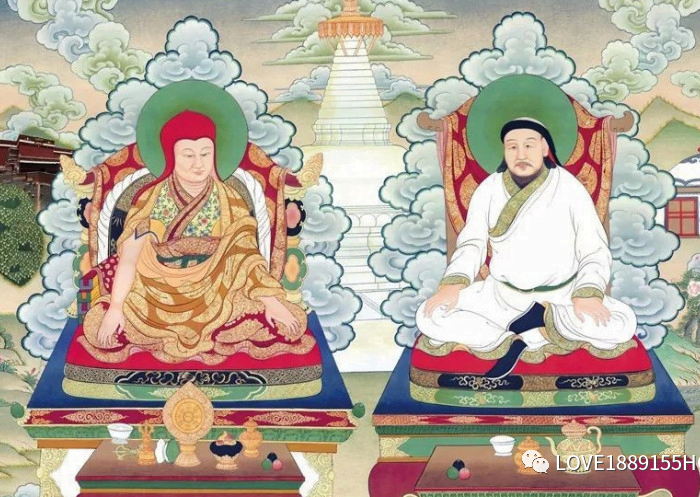
Drogon Chogyal Phakpa’s influence expanded further when he met Kublai Khan in 1253. During their encounter, he performed an important empowerment ceremony for Kublai Khan and became his spiritual advisor. This relationship proved pivotal when Kublai Khan ascended the throne. Phakpa rinpoche was appointed as the National Preceptor, granting him oversight of all Buddhists in the Yuan Dynasty.
Contributions to Religion and Politics
Drogon Choegyal Phakpa’s responsibilities grew as he took charge of the Bureau of Buddhist and Tibetan Affairs in 1264. His role extended beyond spiritual matters to include military and political aspects in Tibet. Notably, in 1268, he developed a new script for the Mongolian language, which was officially adopted by the Yuan court a year later.
Lama Phakpa’s influence reached its peak when he was honored with the titles of Imperial Preceptor and Great Precious Dharma King. Returning to Sakya in 1276, he governed over a vast region, encompassing 130,000 households in Tibet.
Remembering a Tibetan Legend
Drogon Choegyal Phakpa’s life story is not just a tale of religious leadership; it is a narrative of cultural and political significance. His interactions with key historical figures like Kublai Khan and his role in the shaping of Tibetan and Mongolian history make him a fascinating subject for both scholars and history enthusiasts. His legacy continues to inspire and inform our understanding of this crucial period in Tibetan and Asian history.

The Remarkable Journey of Drogon Choegyal Phakpa
A Prodigy in the Making
Born into the influential Khön family on March 6, 1235, in Tibet’s Lhokha region, Drogon Choegyal Phakpa, known simply as “Pakpa,” was destined for greatness. The Khön family was instrumental in establishing the Sakya Monastery and the Sakya sect in the early 8th century. Recognized for his exceptional talents from a tender age, Pakpa was able to recite mantras and practice rituals by the age of three. His profound wisdom earned him the name “Pakpa,” which means “Sublime Wisdom” in Tibetan.
Early Encounters with the Mongol Empire
During Pakpa’s early years, the Mongol Empire was rapidly expanding its territories. In 1239, the Mongol military campaign turned its focus towards Tibet. A year later, Koden, son of Mongol Khan Ögedei, launched an invasion of Tibet, then known as Tubo, to establish Mongolian rule.
The Pivotal Liangzhou Conference
In a significant turn of events in 1244, Koden invited Sakya Pandita Kunga Gyeltsen, Pakpa’s uncle and the head of the Sakya sect, to Liangzhou (now Wuwei in Gansu) to discuss Tibet’s governance. Despite his age and frail health, Sakya Pandita embarked on this journey with his nephews, ten-year-old Pakpa and six-year-old Chagna Dorje. This delegation symbolized the future leadership of the Sakya sect and the Khön family.
In 1246, they reached Liangzhou, and in January 1247, met with Koden. This meeting, known as the Liangzhou Conference, marked a critical point in Tibetan history, formally bringing ever lasting Tibet and Mongol Relations. Sakya Pandita became Koden’s spiritual teacher and stayed in Liangzhou, with Pakpa continuing his studies under his guidance.
Pakpa’s Role in Cultural and Political Integration
Pakpa was not only a religious leader but also a cultural and political figure. He authored several works, including the “Manifestation of Awareness.” His influence extended to the selection, design, and planning of Dadu (the Great Capital, now Beijing). His efforts significantly contributed to integrating Tibet with the rest of China, creating the Mongolian script, spreading Buddhism to Inner Mongolia and North China, and the flourishing of the Sakya sect in Tibet. These contributions fostered cultural exchanges between Tibet and other parts of China.
Legacy of a Visionary Leader
Drogon Choegyal Phakpa’s life story is a testament to his visionary leadership and the profound impact he had on the cultural and political landscapes of his time. His extraordinary abilities and strategic diplomacy played a pivotal role in shaping the course of Tibetan and Mongolian history, leaving a legacy that continues to be celebrated and studied.

The Rise of Drogon Choegyal Phakpa as a Diplomat and Leader
Ascending to Leadership
In 1251, a pivotal moment in Tibetan history occurred when Sakya Pandita passed away in Liangzhou. At just 17, Drogon Choegyal Phakpa, known as “Pakpa,” stepped into a significant role, becoming the second head of the Huanhua Temple in Liangzhou and inheriting the leadership of the Sakya sect. His expertise in the “Five Sciences” earned him the title “Pandita,” denoting his status as a highly learned scholar.
The Tibetan Census and Feudal System Implementation
The following year, under the directives of Mongke Khan, a census was conducted in Tibet. Phakpa delegated Geshi Dorji and Geshi Sonam to assist the imperial envoys in this task. Additionally, Mongke Khan introduced a feudal system in Tibet, with the Sakya monastery and its lands remaining under the patronage of Phakpa Rinpoche, cementing the Sakya and Mongol influence in the region.
Kublai Khan’s Military Campaign and Meeting with Pakpa
In the summer of 1253, as Kublai Khan, Mongke Khan’s brother, pushed his military campaign to Liupan Mountain and Lintao, Phakpa was invited to meet him. This meeting would prove crucial for Tibet’s future.
Diplomatic Discussions with Kublai Khan
During their encounter, Kublai Khan inquired about Tibetan history and Sakya Pandita’s situation. He then revealed his plans to levy troops and collect treasures from Tibet. Phakpa, understanding Tibet’s remote and impoverished condition, pleaded against such burdens. Initially, Kublai Khan was unresponsive to Pakpa’s arguments. Pakpa, standing firm, requested to return home if Tibetan monks were to be overburdened. This prompted Kublai Khan’s principal wife, Chabi, to intervene, praising Pakpa’s wisdom and virtues, leading to his retention for further discussions.
In their subsequent conversation, Phakpa enlightened Kublai Khan about his ancestors’ significant spiritual roles across various regions, including Han, Western Xia, and Tibet. This discussion shed light on the rich and complex history of Tibetan Buddhism and its influence.
Addressing Tibetan History with Kublai Khan
Kublai Khan, unfamiliar with the nuances of Tibetan history, questioned the existence of Tibetan kings, suggesting it contradicted Buddhist scriptures. Pakpa skillfully recounted the history of Tibetan kings, their conflicts, alliances and rivalries with the Han, and the arrival of Princess Wencheng with sacred statues. He emphasized that these historical events, though not in Buddhist texts, were recorded in other historical documents.
Pakpa’s Influence and Diplomacy
This series of events highlights Drogon Choegyal Phakpa’s remarkable diplomatic skills and deep understanding of the political and cultural landscapes of his time. His interactions with influential leaders like Kublai Khan not only shaped the course of Tibetan history but also exemplified his role as a bridge between different cultures and political entities. Pakpa’s legacy as a leader, scholar, and diplomat continues to be a significant part of Tibetan and Mongolian history.

Drogon Choegyal Phakpa: A Spiritual Guide in the Yuan Dynasty
Drogon Choegyal Phakpa emerged as one of the most influential spiritual figures of the Yuan Dynasty, shaping the relationship between Tibetan Buddhism and imperial power. As the trusted religious mentor of Kublai Khan, Phakpa played a decisive role in transforming Tibetan Buddhism into a central pillar of Yuan governance and culture.
Establishing a Spiritual Bond with Kublai Khan
During early discussions with Kublai Khan, Drogon Choegyal Phakpa demonstrated a deep understanding of historical events, which the khan verified through Chinese records. Impressed by Phakpa’s scholarship and spiritual insight, Kublai Khan requested the Vajrakilaya empowerment, a powerful esoteric ritual in Tibetan Buddhism.
Phakpa agreed to perform the empowerment but insisted that Kublai Khan observe the traditional protocol of reverence toward a spiritual master. To balance religious custom with imperial dignity, Empress Chabi proposed a compromise for formal court settings. This agreement marked a turning point, firmly establishing Phakpa as Kublai Khan’s spiritual teacher and paving the way for Tibetan Buddhism to gain state support.
This spiritual alliance ultimately led to the formation of the Imperial Preceptor (Dishi) system, which institutionalized the role of Tibetan Buddhist masters within Yuan administration.
Esoteric Initiations of the Royal Family
Drogon Choegyal Phakpa extended esoteric Buddhist teachings beyond the emperor himself. He initiated twenty-five members of the royal family into advanced tantric practices, deepening the Mongol elite’s commitment to Tibetan Buddhism.
In recognition of these empowerments, Kublai Khan offered Phakpa valuable treasures. These offerings symbolized not only gratitude but also the strengthening bond between the Yuan royal house and the Sakya school of Tibetan Buddhism.
A Sudden Change in Phakpa’s Monastic Plans
While Kublai Khan continued his southern military campaign against Dali, Phakpa returned toward Ü-Tsang, intending to receive full monastic ordination from the renowned master Wu Yuba. However, upon learning of Wu Yuba’s death, Phakpa was forced to abandon this plan and turn back, marking a brief but significant interruption in his spiritual journey.
Reunion at Techi and a Protective Imperial Edict
In 1254, Drogon Choegyal Phakpa reunited with Kublai Khan at Techi, as the khan returned from Yunnan. Shortly afterward, Kublai Khan issued a landmark edict protecting monasteries, instructing monks to avoid pursuing official posts or misusing imperial decrees.
The edict emphasized reverence toward heaven and prayers for the empire’s stability, reflecting the growing influence of Tibetan Buddhist ethics in state governance.
Monastic Ordination and Expanding Religious Influence
In 1255, Phakpa traveled to Hezhou, where he finally received full monastic ordination from esteemed masters including Netangba Drakpa Sangpo, Chaba Chekhyi Sangpo, and Yalongba Lama Jonang.
Following his ordination, Phakpa journeyed to Shangdu (modern-day Xilin Gol, Inner Mongolia), participating in major religious activities and further strengthening his role as a leading Buddhist authority within the Yuan realm.
Pilgrimage to Mount Wutai and Literary Works
In 1257, Drogon Choegyal Phakpa visited Mount Wutai, one of the most sacred Buddhist sites in East Asia and traditionally associated with Manjushri, the bodhisattva of wisdom.
Inspired by the sacred landscape, Phakpa composed important literary works, including Praises to Manjushri, Praises to Manjushri’s Firm Dharma Wheel, and the Extensive Record of Hearing the Dharma. These writings reflect his profound spiritual insight and his contribution to Buddhist literature across cultural boundaries.
The Great Religious Debate of 1258
One of the most defining moments in Phakpa’s career occurred during the Great Debate of 1258, hosted by Kublai Khan under the authority of Möngke Khan at Kaiping. Seventeen representatives from Buddhism and Daoism debated the authenticity of the Daoist text Laozi Huahu Jing.
When Daoist participants cited the Records of the Grand Historian to challenge Buddhism, Phakpa identified contradictions in their arguments. The debate concluded with a Buddhist victory, resulting in the conversion of seventeen Daoist practitioners, including Fan Zhiying, and the conversion of several Daoist temples into Buddhist monasteries.
That same year, Phakpa authored Mirror of the Dharma and Fruit, articulating Sakya doctrinal perspectives.
Supporting Kublai Khan During the Succession Crisis
After Möngke Khan’s death in 1260, a power struggle erupted between Kublai Khan and his brother Ariq Böke. Throughout this turbulent period, Drogon Choegyal Phakpa remained firmly aligned with Kublai Khan.
Following Kublai Khan’s initial victory in December 1260, Phakpa was appointed National Preceptor at the age of twenty-two. He received a jade seal and authority over all Buddhist affairs across the Mongol domains, elevating his political and religious influence to an unprecedented level.
Opening the Qinghai–Tibet Plateau Route
To strengthen communication between the Yuan court and Tibet, Kublai Khan initiated the construction of a route across the Qinghai–Tibet Plateau. With Phakpa’s support, a network connecting Qinghai to Sakya was established.
Phakpa issued a decree urging Tibetan Buddhist communities to assist with the project. As a result, twenty-seven major post stations were constructed, dramatically improving travel, communication, and administrative coordination between Tibet and the Yuan capital.
Head of the Bureau of Buddhist and Tibetan Affairs
In 1264, after relocating the capital to Dadu (present-day Beijing), Kublai Khan established the Bureau of Buddhist and Tibetan Affairs. Drogon Choegyal Phakpa was appointed as its head, formally placing him in charge of Buddhist institutions and Tibetan governance. That same year, Kublai Khan issued an edict acknowledging his initiation by Phakpa, further affirming Phakpa’s authority within the empire.
Phakpa’s brother Chagna Dorje was appointed King of Bailan, and together they were tasked with implementing a structured administrative system in Tibet. In 1265, Phakpa arrived in Lhasa, offering New Year greetings at the Jokhang Temple before traveling to Sakya.
There, he oversaw extensive renovations, commissioned statues and stupas, transcribed Buddhist texts, and studied diverse doctrines and Tibetan sciences under more than twenty masters.
Creation of the New Mongolian Script
During his three-year stay in Tibet, Phakpa also fulfilled one of Kublai Khan’s most ambitious requests: the creation of a new Mongolian script. Based on the Tibetan alphabet, the script consisted of forty-one letters.
In 1269, Phakpa presented this script—later known as the ’Phags-pa script—to Kublai Khan, who immediately adopted it for official imperial use.
Promotion to Imperial Preceptor and State Rituals
In 1270, after conducting a second major esoteric initiation for Kublai Khan, Phakpa was promoted to Imperial Preceptor and received a new jade seal. His expanded responsibilities included teaching the emperor, empress, and crown prince, conducting longevity prayers, and leading major Buddhist ceremonies.
He presided over a seven-day ritual at the Imperial Ancestral Temple and installed a protective white parasol adorned with gold Sanskrit inscriptions in the imperial throne room, symbolizing peace and protection for the empire.
Governance of Ü-Tsang and Return to Sakya
Kublai Khan placed 130,000 households in the Ü-Tsang region under Phakpa’s patronage. By the end of 1273, Phakpa returned to Sakya, where he formally assumed the title of Sakya Trizin, head of the Sakya sect.
He appointed Panchen Shakya Sangpo to administer the region, reinforcing the Sakya sect’s religious-political governance across Tibet.
Cultural Exchange and the Chumi Assembly
Under Phakpa’s leadership, cultural exchange flourished. Tibetan art was introduced to the mainland, while printing techniques and theatrical traditions reached Tibet.
In January 1277, Phakpa organized the grand Chumi Assembly near Natang Monastery, drawing nearly 70,000 monks. Sponsored in Kublai Khan’s name, the assembly resolved disputes, strengthened administrative unity, and expanded Sakya influence throughout western Tibet.
Political Tensions and Yuan Intervention
Administrative reforms and official reappointments in Ü-Tsang led to local dissatisfaction after the withdrawal of Crown Prince Zhenjin’s escort army. According to the Han-Tibet History Collection, Panchen Gongkor Sangpo betrayed the Sakya sect and appealed to the Yuan court.
To safeguard the critical Sakya–Yuan alliance, Kublai Khan dispatched minister Sangge with an army of 100,000 Mongol troops. The uprising was swiftly suppressed, Gongkor Sangpo was executed, and the army later met with Drogon Choegyal Phakpa before returning, reinforcing Sakya authority and Yuan control.
The Legacy of Drogon Choegyal Phakpa: Sage, Scholar, and Imperial Preceptor
Drogon Choegyal Phakpa stands as one of the most influential figures in Tibetan Buddhist history and the political landscape of the Yuan Dynasty. As a spiritual master of the Sakya sect, a trusted advisor to Kublai Khan, and the creator of a unifying imperial script, Phakpa’s life bridged religion, governance, and culture across Tibet and the Mongol Empire.
The Passing of a Visionary Leader
Drogon Choegyal Phakpa passed away on November 22, 1280, at the age of 46, within the sacred Lhakang of Sakya Monastery. His death marked the end of a remarkable life that had reshaped Tibetan–Mongolian relations and elevated Tibetan Buddhism to an unprecedented position within imperial governance.
Historical sources offer differing accounts regarding the cause of his death. Some Tibetan and Chinese records suggest he may have been poisoned by attendants, while others remain silent on the circumstances. Regardless of the cause, his passing was widely mourned, reflecting the deep respect he commanded across both religious and political spheres.
Posthumous Honors Bestowed by Kublai Khan
Following Phakpa’s death, Kublai Khan conferred upon him one of the longest and most exalted posthumous titles in Yuan history. The title praised Phakpa as a supreme spiritual authority, a protector of the state, and an enlightened master of wisdom and virtue.
This extraordinary honor underscored Phakpa’s dual role as both Imperial Preceptor (Dishi) and spiritual guide to the emperor. It also reflected how deeply Buddhism, under Phakpa’s guidance, had become intertwined with the governance and legitimacy of the Yuan Dynasty.
Commemorating Phakpa’s Life and Achievements
To preserve his legacy, Imperial Scholar Wang Pan and other court historians were tasked with composing Phakpa’s official biography. These writings ensured that future generations would understand his contributions to religion, statecraft, and cultural integration.
In 1320, Emperor Renzong of Yuan ordered the construction of Imperial Preceptor Phakpa Halls throughout the empire. These halls served not only as memorials but also as centers for Buddhist ritual and state-sponsored religious activity.
Four years later, in 1324, the Yuan court commissioned eleven official portraits of Drogon Choegyal Phakpa. These portraits were distributed across various provinces, where they were enshrined and venerated, demonstrating the enduring reverence for Phakpa long after his death.
Continuation of the Imperial Preceptor System
One of Phakpa’s most enduring legacies was the Imperial Preceptor system, which institutionalized the relationship between Tibetan Buddhism and the Yuan state. After his passing, the role was successively held by prominent monks of the Sakya sect, including his half-brother Renchin Gyamtso and his nephew Dampa Paljor.
This continuity ensured that Sakya masters continued to guide both the spiritual life of the court and the political administration of Tibet. The system remained in place until the fall of the Yuan Dynasty, shaping centuries of Tibetan–Chinese relations.
Establishing Sakya Authority and Governing Tibet
Phakpa’s influence expanded dramatically after his historic meeting with Kublai Khan in 1253 at Liupan Mountain. This encounter laid the foundation for a close alliance between the Mongol rulers and Tibetan Buddhism.
In 1258, during a major religious debate at the Mongol court, Phakpa successfully challenged Daoist leaders, questioning the authenticity of the Laozi Huahu Jing and defending Buddhist doctrine. His victory significantly strengthened Buddhism’s standing within the empire.
By 1264, Phakpa was appointed head of the Bureau of Buddhist and Tibetan Affairs, placing him in charge of Buddhist institutions and the military-political administration of Tibet. Upon returning to Sakya in 1265, he implemented new systems of governance in Ü-Tsang, blending religious authority with secular administration.
The introduction of the Labrang and Panchen systems in 1267 formalized this dual structure, ensuring stable governance rooted in Buddhist principles. A grand religious assembly held in 1277 further consolidated Sakya authority across western Tibet.
Creation of the ‘Phags-pa Script
At Kublai Khan’s request, Phakpa undertook one of his most innovative projects: the creation of a unified writing system for the multilingual Yuan Empire. The result was the ‘Phags-pa script, officially introduced in 1269.
Based on the Tibetan alphabet, the script was designed to transcribe Mongolian, Chinese, Tibetan, Uyghur, and even Sanskrit. Its adoption for imperial edicts, seals, and official documents helped streamline administration and symbolized cultural unity under Yuan rule.
Although the ‘Phags-pa script gradually fell out of use after the collapse of the Yuan Dynasty, it remains a critical resource for historians studying imperial governance, linguistics, and cross-cultural exchange.
Intellectual Mastery and Literary Contributions
Drogon Choegyal Phakpa was widely praised for his mastery of the Five Sciences, encompassing logic, medicine, arts, linguistics, and Buddhist philosophy. His scholarly reputation extended far beyond Tibet.
Among his most notable works are:
- The Ritual of Full Ordination for the Sarvāstivāda School (1270)
- The Abridged Method of Practice for the Sarvāstivāda School (1271)
- Manifestation of Awareness (1274), composed for Crown Prince Zhenjin
These texts remain important references within Tibetan Buddhist studies and monastic education.
Anecdotes, Name Translations, and Sacred Memory
The name Phakpa, meaning “noble,” “holy,” or “sage,” appears in various translated forms in Chinese historical records. His life is also surrounded by legends, including auspicious signs at his birth and premonitions of his death, adding a mystical dimension to his historical image.
In Tibetan Buddhism, Phakpa’s Parinirvana Day is observed annually, commemorating his passing and honoring his spiritual achievements.
Commemoration in Historical Sources and Cultural Memory
Beyond Tibet and China, Phakpa’s image traveled across Asia. In Japanese classical literature, he appears as a wise and strategic advisor, reflecting how his reputation as a scholar-diplomat resonated across cultures.
His role in shaping the political theology of the Yuan Dynasty, advancing Buddhist governance, and fostering cultural integration continues to attract scholarly attention today.
A Multifaceted and Enduring Legacy
Drogon Choegyal Phakpa’s legacy encompasses religious leadership, administrative innovation, linguistic creativity, and diplomatic skill. As the spiritual architect of Sakya rule in Tibet and a central figure in Yuan imperial policy, his influence reshaped the course of Tibetan Buddhist history and the governance of a vast empire.
His life and works remain a vital subject of study, offering deep insight into how faith, power, and culture intersected at one of the most pivotal moments in Asian history.