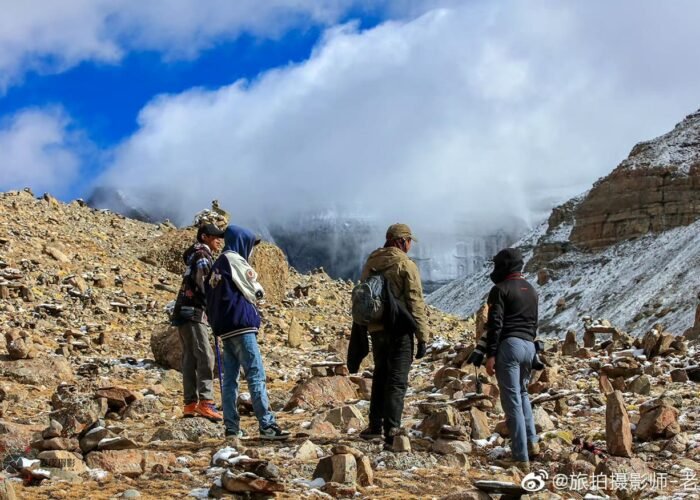
Lhari Tse’nga, meaning “The Five Sacred Peaks” in Tibetan, is one of the most revered sacred mountains in Qüxü County, located on the southern bank of the Lhasa River in central Tibet. Rising gently from the fertile Yarlung Zangbo River Valley, Lhari Tse’nga is not a single summit but a continuous group of five spiritually significant peaks, deeply woven into local belief, livelihood, and landscape.
For centuries, this sacred mountain has been regarded as the “Wutai Mountain of Tibet”, blending Bon and Buddhist cosmology with everyday agricultural and pastoral life. Today, it remains a powerful symbol of harmony between humans, nature, and the sacred.
Location and Geographic Setting
Lhari Tse’nga is situated in Cainai (Tsalna) Township of Qüxü County, approximately 15 kilometers from Qüxü County town and about 30 kilometers from Lhasa city. It lies close to the airport expressway and is easily accessible for visitors traveling between Lhasa and Gonggar Airport.
Geographically, the area belongs to the middle reaches of the Yarlung Zangbo River and the lower basin of the Lhasa River. Elevations range from about 3,500 meters in the river valley to over 5,800 meters along surrounding ridgelines. The terrain is gentle rather than extreme, making it ideal for pilgrimage circuits (kora), farming, and grazing.
The region enjoys a semi-arid plateau monsoon climate, with nearly 3,000 hours of sunshine annually, average precipitation of around 440 mm, and a mean annual temperature close to 6°C.
Origin of the Name and Sacred Meaning
The name Lhari Tse’nga literally translates to “Five Sacred Mountain Peaks.” According to Tibetan oral tradition, when Princess Wencheng traveled to Tibet during the Tubo (Tibetan Empire) period, she passed through this area and saw five peaks standing side by side, resembling five celestial maidens descending from the sky. From that time on, the mountain was revered as a sacred place.
In local belief, the five peaks correspond to five Wisdom Dakinis and each peak governs a specific aspect of human life. Together, they form a complete spiritual and worldly protection system closely tied to farming, herding, health, and prosperity.

The Five Sacred Peaks and Their Spiritual Roles
From right to left, the five peaks of Lhari Tse’nga are traditionally understood as follows:
1. Wisdom Peak (Shérab Ri – ཤེས་རབ་རི།)
The tallest and most commanding peak, regarded as the spiritual leader of the five. It governs all sentient beings in the human and underground realms and symbolizes wisdom, insight, and foresight. Devotees see it as a spiritual compass for understanding life and karma.
2. Longevity and Well-being Peak (Dekyi Ri – བདེ་སྐྱིད་རི།)
This peak is rounded and gentle in shape, symbolizing health and happiness. It governs peace, well-being, and long life, and is the most popular site for prayers related to health and longevity, especially during major religious festivals.
3. Agriculture Peak (Nangtung Ri – ནང་འཐུང་རི།)
With broad slopes and open foothills, this peak governs farming and craftsmanship. It is closely associated with local cultivation of highland barley, wheat, and rapeseed, reflecting the agricultural heart of Qüxü County.
4. Wealth Peak (Nortrul Ri – ནོར་འཁྲུལ་རི།)
Characterized by rugged rock formations, this peak symbolizes hidden treasures. It governs material wealth and protection of property, and local herders often pray here for prosperity and the safety of their livestock.
5. Pastoral Peak (Namsik Ri – རྣམས་རིགས་རི།)
Connected to vast natural pastures, this peak governs animal husbandry and grazing. It is deeply linked to yak and hybrid cattle herding, forming the spiritual backbone of pastoral life in the region.
Together, the five peaks appear like celestial figures descending into the valley, embodying a sacred geography inseparable from local livelihoods.
Agriculture and Pastoral Life Around Lhari Tse’nga
The foothills of Lhari Tse’nga showcase one of the best examples of Tibet’s agro-pastoral economy. Fertile alluvial soils support fields of highland barley, the staple food used to make tsampa, as well as wheat and rapeseed. In spring and early summer, blooming rapeseed fields paint the valley in bright yellow.
Beyond the farmland lie expansive natural grasslands, where yaks, sheep, goats, and hybrid cattle graze seasonally. This dual system of farming and herding reflects centuries of adaptation to high-altitude life and makes Qüxü County an important grain-producing area in Tibet.
Medicinal and Natural Resources
Lhari Tse’nga is also rich in traditional medicinal resources. The surrounding grasslands produce Cordyceps sinensis, a highly valued medicinal fungus in Tibetan and Chinese medicine. The mountains were historically known for musk deer habitats, and today the region still yields a variety of medicinal herbs.
In addition, nearby rivers provide fish, while orchards produce apples and walnuts, supporting both household needs and small-scale local economies. These natural resources attract eco-tourists, herbal medicine researchers, and travelers interested in Tibet’s biodiversity.
Religious Traditions and Pilgrimage
Every year during the fourth month of the Tibetan calendar, the sacred festival of Saga Dawa, local believers perform kora (ritual circumambulation) around Lhari Tse’nga. This pilgrimage is believed to accumulate merit, purify karma, and bring blessings related to health, harvests, wealth, and livestock.
The sacred mountain is also associated with Guru Padmasambhava, who is said to have practiced meditation here, further strengthening its religious importance. Nearby monasteries such as Nietang Monastery (linked to Atiśa) and Tabaling Monastery add depth to the spiritual landscape.
Cultural Landscape and Living Heritage
Often called the “Five-Peak Sacred Mountain of Tibet,” Lhari Tse’nga is not only a religious site but also a living cultural center. Traditional festivals, horse racing, stone lifting, and seasonal rituals are still practiced, reflecting a deep bond between sacred belief and daily life.
The mountain’s setting—where farmland, pasture, medicinal resources, and pilgrimage routes intersect—embodies the Tibetan ideal of coexistence between humans and nature. As Qüxü County continues to develop, Lhari Tse’nga stands as a powerful reminder of Tibet’s enduring spiritual geography and ecological wisdom.