
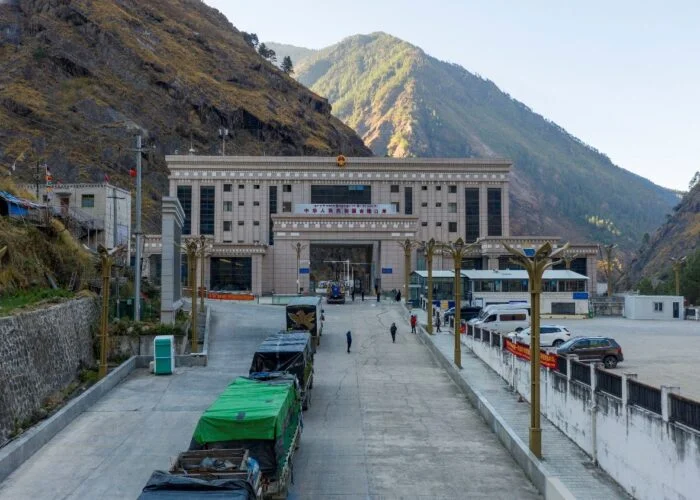
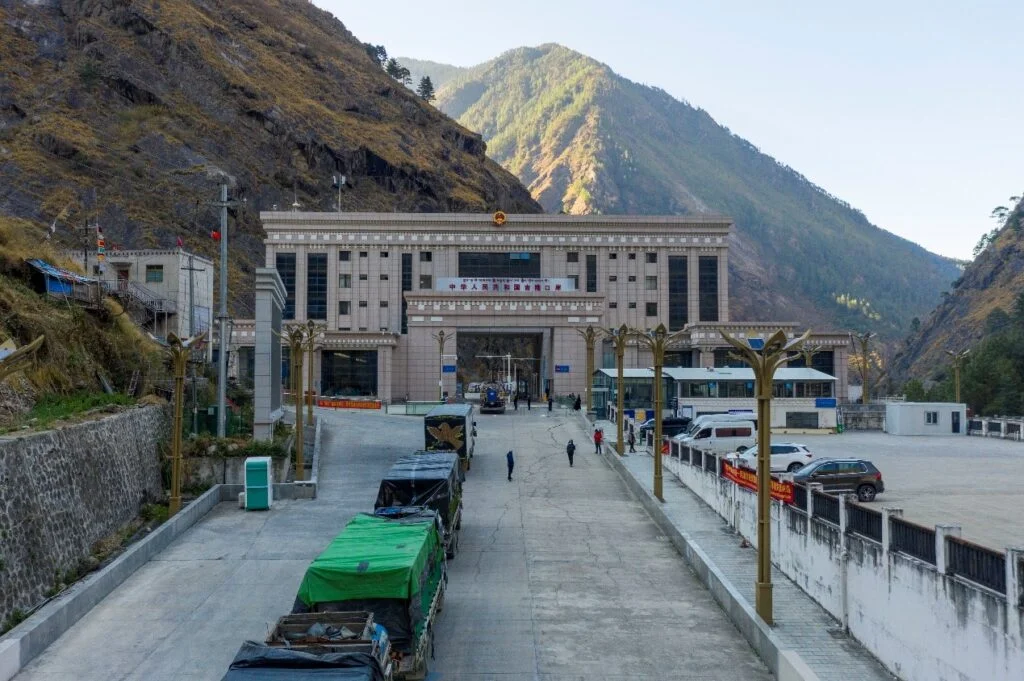
A cold wind is whipping through the southern foothills of the Himalayas. The scene at the Gyirong border crossing, which should be bustling with long convoys of container trucks loaded with EV cars and general merchandise. Five months have passed since the devastating disaster, and the vital link spanning the Rasuwa Bridge remains out of commission.
To the outside world, constructing a temporary truss bridge seems like a standard engineering task, typically measured in days. Between Gyirong’s Rasawok Village and Nepal’s Rasuwa, this project has become a nearly half-year-long struggle. It is not merely the rebuilding of a bridge; it is a fierce contest between human engineering capability and the extreme geological challenges of the Himalayas.
The Bridge’s Crucial History
To understand the significance of the Rasuwa Bridge, one must look back at its history. This location is the core segment of the ancient “Tibet Nepal Ancient Road” a key route for cultural exchange. Notably used by many of great Tibetan master on their pilgrim to India and by Princess Bhrikuti on her journey to Tibet.
This crossing has seen four generations of bridges, each reflecting its era:
| Generation | Type of Bridge | Era and Significance |
| First | Wooden Plank Suspension Bridge & Cable Slider | The era of porter transport; every crossing was a life-or-death challenge. |
| Second | Steel Cable Bridge | Built with the rise of small-scale border trade; unsuitable for modern vehicles. |
| Third | Concrete Highway Bridge | Built during the port’s official upgrade, severely damaged and made unsafe by the 2015 Nepal Earthquake. |
| Fourth | High-Standard Double-Lane Bridge | A flagship Belt and Road Initiative (BRI) project completed around 2019; the one destroyed in the recent flood. |
This fourth-generation bridge—the modern “artery” of Sino-Nepal trade—was torn out by a catastrophic Glacial Lake Outburst Flood (GLOF) and debris flow on July 8, 2025, its force exceeding the bridge’s structural design limits.
The Long Delay: Three Core Obstacles
Why has the reconstruction taken so long? The popular notion that “a temporary Bailey bridge uses pre-fabricated steel components and can just be assembled from the riverbank” is a misconception here. The July 8 flood was not a simple surge of water; it was a devastating torrent of debris with immense cutting power.
Obstacle 1: The “Hollowed-Out” Foundation (July–August)
After the flood, Chinese engineering teams found that the solid rock and roadbeds on both banks, which were meant to support the bridge, had been completely “hollowed out” (掏空).
- The riverbed of the Dònglín Zàngbù River was lowered by several meters, leaving the riverbanks dangerously unstable.
- Directly setting up a Bailey bridge on the original site was impossible, as the soft banks could not withstand the weight of fully loaded heavy trucks without the risk of a secondary collapse.
Therefore, the first two months (July to August) were dedicated almost entirely to reinforcing the roadbed and stabilizing the banks—a challenging task akin to trying to lay piles on sand.
Obstacle 2: The Constraint of the Monsoon “Window Period” (September)
The Himalayas’ southern slopes typically experience a relentless monsoon season until mid-to-late September.
- During this period, the Gyirong Gorge is shrouded in fog, with near-constant rainfall.
- For canyon operations, rain means a constant threat of landslides and rockfalls. Before September, the operation of heavy machinery was severely restricted, leading to work being frequently interrupted—a key objective geographical reason for the initial slow progress.
Obstacle 3: The Critical “Technical Failure” (October–November)
While weather and foundation issues were the prelude, the technical failure that occurred in the autumn window period is the core reason for the delay extending into December.
To restore traffic quickly, the Chinese side proceeded with the construction of a military-grade steel truss bridge (Bailey bridge). However, the river valley’s span is substantial (approaching 100 meters).
- According to Nepali customs and administrative officials in November, the initially assembled Bailey bridge exhibited severe “deflection” or “sagging” during attempted closure or preliminary testing.
- The bridge body bent downwards significantly due to its self-weight and excessive span, indicating insufficient rigidity to safely support heavy trucks carrying cargo.
This presented an extremely difficult engineering problem. Bailey bridges over such spans often require temporary piers in the middle of the river. However, driving piles into the fast-flowing Dònglín Zàngbù River, whose bed was drastically deformed by the flood, proved exceptionally difficult.
The engineering team was forced to make a difficult decision:
halt operations and conduct technical rework.
- This necessitated a full redesign, either involving the frantic construction of support piers in the river or significantly strengthening the bridge structure (e.g., adding strengthening chord members or double layers).
- This rework directly consumed the precious “golden period” for autumn construction, pushing the completion date from the original target of October to the end of the year.
The Unfinished Link: Why the Gyirong Border Bridge Reconstruction Has Taken Five Months
A bridge is never an isolated entity; it is useless without connecting roads. While China’s side of the National Highway 216 showed strong repair capacity despite the damage, the situation across the river in Nepal was entirely different.
The Weakest Link: Nepal’s Infrastructure Challenge
The Syaphrubesi-Rasuwagadhi road on the Nepali side, which leads to the Rasuwa Bridge, is already prone to geological instability. The July flood did more than just destroy the bridge; it caused widespread roadbed collapse on the Nepali access roads.
- Delayed Access: Until October, the Nepali side had not fully cleared a path capable of handling the heavy construction equipment required to install the bridge materials.
- “One-Sided Push”: Consequently, Chinese heavy machinery had to first assist Nepal in repairing its access roads before the bridge components could even be delivered to the riverbank. This “one-sided push” model severely dragged down the overall project schedule.
The Crippling Impact on Sino-Nepal Trade
This five-month disruption has severely impacted Sino-Nepal trade. The Gyirong port is the “artery” of land trade, responsible for over 70\% of all overland cargo volume between the two nations.
- Missed Festival Season: The period from September to November is Nepal’s crucial festival season (Dashain and Tihar), equivalent to China’s Lunar New Year. In previous years, millions of dollars worth of Chinese clothing, apples, electronics, and livestock would have flooded into Kathmandu via the Rasuwa Bridge.
- Cargo Backlogs: This year, due to the bridge collapse, massive amounts of goods were stranded in warehouses in Gyirong and Lhasa. Subsequent shipments were forced to reroute via the distant Zhangmu (Tatopani) port, the only other major land crossing.
The Situation at Zhangmu Port
Unfortunately, the detour to Zhangmu offered little relief:
- Intermittent Operation: Zhangmu port has been operating only intermittently due to its own vulnerability to geological hazards.
- Severe Congestion: Even when open, restrictions (including a containerized aerial ropeway system) and other bottlenecks mean only a limited volume of goods can pass daily.
- Staggering Delay: By the November count, nearly 900 containers had been stuck on the Chinese side of Zhangmu for over three months.
The interruption of the Sino-Nepal trade artery has caused heavy losses for merchants and logistics providers, leading directly to commodity shortages and soaring prices in the Nepali market. The protracted delay in rebuilding the single bridge has escalated from a mere engineering problem into a social issue affecting the livelihoods and economic stability of Nepal.
The Future of the “Golden Channel”
Natural disasters are an annual reality in the region. The susceptibility of Sino-Nepal land routes to such disruptions mirrors the fragility of Nepali politics in a given September.
Confidence is often said to be more valuable than gold. But if this “golden channel” of land trade is perpetually vulnerable and fails to reliably deliver value, where can the confidence in the future of Sino-Nepal trade come from?
A Sign of Hope in the Cold
The good news is that, following targeted reinforcement and technical adjustments, the main structure of the temporary Bailey bridge at the Rasuwa crossing is substantially complete.
According to the latest reports from the site, the project has entered the final stages of deck paving and dynamic load-bearing testing.
- Expected Reopening: Barring any unforeseen issues, this hard-won steel temporary bridge is expected to be ready for traffic by mid-to-late December.
Though it is only a “temporary” structure and may only allow for alternating one-way traffic, to the Chinese and Nepali merchants and border residents who have waited through this cold winter, this bridge is a potent symbol of hope.
In the face of the vast Himalayas, humanity may appear small. But this bridge, five months in the making, proves that regardless of the scale of the disaster or the technical barriers encountered, the fundamental desire for connection will ultimately overcome geographical isolation.