
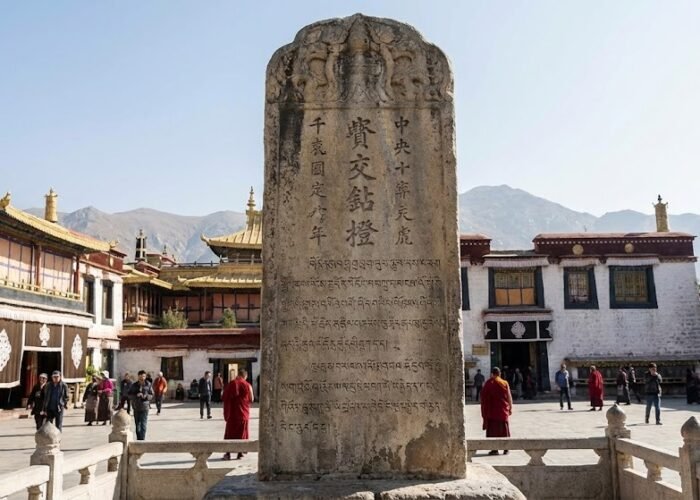
The Changqing Treaty, signed between the Tang Dynasty and the Tibetan Empire (Tubo) in the early 9th century, represents a monumental effort to establish lasting peace and define the relationship between these two powerful polities. The treaty ended almost 200 years of on-and-off warfare (since the 660s) that had seen Tibetan armies occupy Chang’an itself in 763. It is one of the earliest fully bilingual state treaties in world history and remains a landmark in both Chinese and Tibetan historiography.
The Initiative for Alliance (821 CE)
In April 821 CE (the first year of the Changqing era of the Tang Dynasty), the Tibetan Empire dispatched an envoy, Zhang Chiyi duosi, to the Tang capital with an official state letter. The message expressed Tibet’s long-standing desire to hold a major peace summit with the Tang court.
Following multiple rounds of negotiations, both sides reached a consensus to proceed with the alliance. Tibet subsequently sent a higher-ranking official, Lün Neluo, who was recorded in Chinese histories as the Minister of Rites (Lǐbù Shàngshū). Lün Neluo traveled to Chang’an bearing the official Covenant Document (Mengshu), which had been ratified by the Tibetan Emperor (Tri Ralpachen), the monk-regent Pelgyi Yönten (བྲན་ཀ་དཔལ་གྱི་ཡོན་ཏན།), and Chief Minister Zhang Trishir (ཞང་ཁྲི་བཞེར་སྟག་སྣང་།?)

The Grand Ceremony in Chang’an
Tang Emperor Muzong attached immense importance to this event. On the 10th day of the 10th lunar month, a magnificent alliance ceremony was held in the western suburbs of Chang’an between the Tang officials and the Tibetan delegation.
The Tang delegation included a remarkable assembly of high-ranking officials, signifying the weight the Tang court placed on the treaty:
- Chancellors: Cui Zhi, Wang Bo, Du Yuanying
- Ministers: Han Gao, Niu Sengru, Li Jiang, Xiao Mian, Yang Yuling, Wei Shou, Zhao Zongru, Pei Wu
- Other Dignitaries: Liu Gongchuo (Prefect of Jingzhao), Guo Zong, and several alliance envoys.
The Covenant’s Core Principles
The text of the covenant signed in Chang’an primarily expressed the mutual desire for friendly coexistence:
“The Central Plain is governed by the Great Tang; the Western Region is ruled by the Great Tubo. Henceforth, we shall abandon weapons and armies, and all old grievances and past evils shall be eliminated. We shall uphold the relationship of maternal uncle and nephew… Border defenses shall remove their alarms, and signal fires shall extinguish their smoke. We shall assist each other in distress, and acts of violence and plunder shall cease. Border strongholds shall remain as they were, and cross-border aggression shall be entirely stopped. They shall not deceive us, nor shall we harbor suspicions of them…”
The Tibetan section of the covenant further stipulated:
“The two nations, Tibet and Han, shall each guard their existing respective borders. Neither shall conquer, nor campaign, nor act as an enemy of the other, nor encroach upon the territory. If doubts arise, or if a person must be captured for questioning, they shall be released with clothing and provisions.”
Although the treaty did not explicitly redraw the border, the Tibetan stipulations clearly advocated for maintaining the status quo, marking a major step towards peace between the two powers. Seventeen Tang officials affixed their names to this document.
The Lhasa Summit (822 CE)
In 822 CE, the Tang Dynasty reciprocated the visit by appointing Liu Yuanding (Minister of the Court of Judicial Review) as the envoy for the Western Tibetan alliance, with Liu Shilao (Secretary of the Board of War) as his deputy. They journeyed to Tibet alongside the Tibetan envoy, Lün Neluo.
- Imperial Reception: On April 24th, the young Tibetan Emperor, Tri Ralpachen received Liu Yuanding’s delegation in his heavily guarded yet magnificent golden tent, treating them with great hospitality.
- The Second Ceremony: On May 6th, a grand alliance ceremony was held in Lhasa. The Tibetans constructed an alliance altar, ten paces wide and two feet high.
Seventeen high-ranking Tibetan officials participated in the Lhasa summit, including:
- Monk-Regent: Ba Changa Yundan (Pelgyi Yönten)
- Chief Minister and Commander: Shang Chishin’er
- Other Chief Ministers and Secretaries: Lün Jiduo Si, Lün Jizan Bore, Zhang Qilizan Kuning Sidang, Zhang Qilire Tantong, and Lün Jiazang Nu Xigong.
This two-part treaty, signed in both Chang’an and Lhasa, solidified the terms of the peace. It is most famously commemorated by the Lhasa Treaty Pillar erected outside the Jokhang Temple.
The finalization of the Sino-Tibetan Treaty of 821–822 involved the public declaration of fidelity by high-ranking officials. The erection of monumental stone pillars, ensuring the covenant’s influence would endure for generations.
Formalizing the Oath and Command
The integrity and binding nature of the alliance were underscored by the requirement that senior officials from both nations personally attend and sign the oath.
- Tang Signatories: The number of officials signing on the Tang side of the treaty pillar in Lhasa was eighteen. This group included the officials who attended the Chang’an meeting, the four envoys who traveled to Tibet, and the addition of Li Fengji (Minister of the Secretariat, Chief Minister), who was listed first among the Tang officials.
- Tibetan Dissemination: After the treaty was finalized, the Tibetan General-in-Chief Shang Chishin’er personally traveled to Daxia Chuan (Great Xia River) to gather over one hundred Tibetan generals. He relayed the contents of the Tang-Tubo alliance and commanded them to strictly abide by its terms.
The Monumental Treaty Pillars
In February 823 CE (the third year of the Changqing era), the official Treaty Stone Pillar was erected in Lhasa. Tang officials attended the dedication ceremony. A corresponding treaty pillar was also erected in Chang’an.
The Lhasa Treaty Pillar
The pillar erected in Lhasa is the world-famous Sino-Tibetan Treaty Pillar (known locally as the Jokhang Temple Treaty Pillar) .
- Endurance: Having withstood a millennium of exposure, this pillar still stands prominently in front of the Jokhang Temple, recognized worldwide as a paramount Asian historical monument.
- Inscription: The pillar’s front side is inscribed with the covenant text in both Tibetan and Chinese.
The content largely mirrors the treaty signed in Chang’an, emphasizing:
- The purpose of the “Great Alliance” is for the peace of the people, long-term harmony, and the security of both nations.
- Boundaries: The Great Tang in the East and the Great Tubo in the West will respect the existing administrative borders, cease all military action, and release captives with provisions.
- Trade and Travel: Communications will follow the established old routes. Horse markets will be held in the designated Jiāngjūn Gǔ (General’s Valley) buffer zone. The Tang Dynasty will manage and supply traffic east of Suíróng Zhà, and Tibet will manage travel west of Qīngshuǐ Xiàn.
- Enforcement: If one party violates the oath, the other party has the right to take reciprocal action.
Officer Signatures
- Right Side (Tibetan Officials): Listed the names of the seventeen Tibetan officials, in both Tibetan and Han script.
- Left Side (Tang Officials): Listed the names of the eighteen Tang officials, in both Han and Tibetan script.
- Reverse Side (Tibetan Content): The entire back side is inscribed in Tibetan script, narrating the history of Tang-Tubo friendship and the details and timing of the current alliance.
Notably, the Tibetan Emperor Tri Ralpachen adopted the Chinese reign title “Yitai” (彝泰), meaning “Long-lasting Peace and Security,” a unique occurrence among all Tibetan Emperors.
Historical Significance and Aftermath
The Changqing Treaty was the largest and final grand alliance in the history of Tang-Tubo relations.
- Symbol of Friendship: It remains a brilliant chapter in the history of their relationship and a lasting symbol of friendship between the Han and Tibetan peoples.
- Mitigation of Conflict: Although not all conflicts ceased immediately (Tibet attacked Lingwu and Yanzhou in June 822 CE). The treaty largely achieved its goal: there were no major wars or large-scale Tibetan military campaigns against the Tang thereafter.
- Benefiting the People: This reduction in conflict provided much-needed respite for the war-weary border populations, alleviating burdens and preventing needless deaths.
The Changqing Treaty essentially marked the fundamental end of large-scale military disputes between the Tang Dynasty and the Tibetan Empire. It fulfilled the shared desire for peace among both Chinese and Tibetan people.
The Three Surviving Inscriptions (the treaty still exists in stone!)
- Lhasa Treaty Pillar (in front of Jokhang Temple) – the best preserved; written in both Tibetan and Chinese.
- Chang’an Treaty Pillar – originally at the Tang capital; fragments survive in the Xi’an Beilin Museum.
- Gugu Meru Border Pillar – discovered in 1979; now in the Qinghai Provincial Museum.
The Lhasa pillar is especially famous and still stands today.