
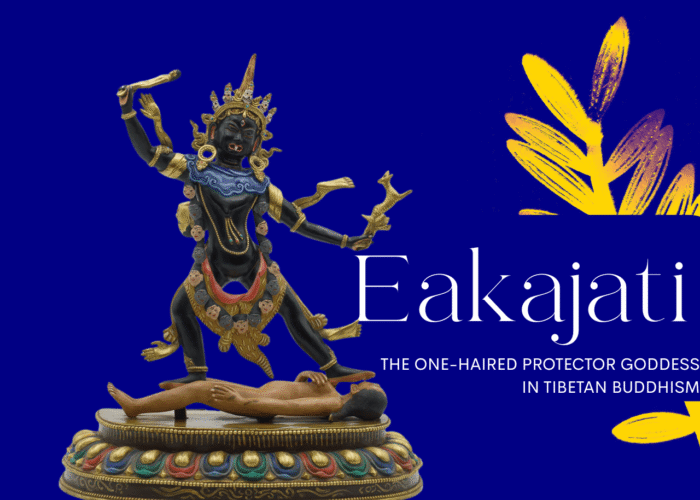
Ekajati: A Unique Deity of Protection in Buddhism
Ekajati, widely known as the “One-Haired Mother”, is one of the most mysterious and powerful protector goddesses in Buddhist tradition. Originating in Indian Buddhism, she is revered as a principal guardian deity and is often presented alongside two important longevity goddesses: Ushnishavijaya and White Tara.
Together, these three deities represent different dimensions of spiritual time and experience:
- Ushnishavijaya embodies daytime practices and longevity
- Ekajati symbolizes the night, secrecy, and hidden wisdom
- White Tara bridges day and night, uniting compassion and longevity
This triadic relationship highlights Ekajati’s association with mystical, nocturnal, and esoteric aspects of Buddhist practice.
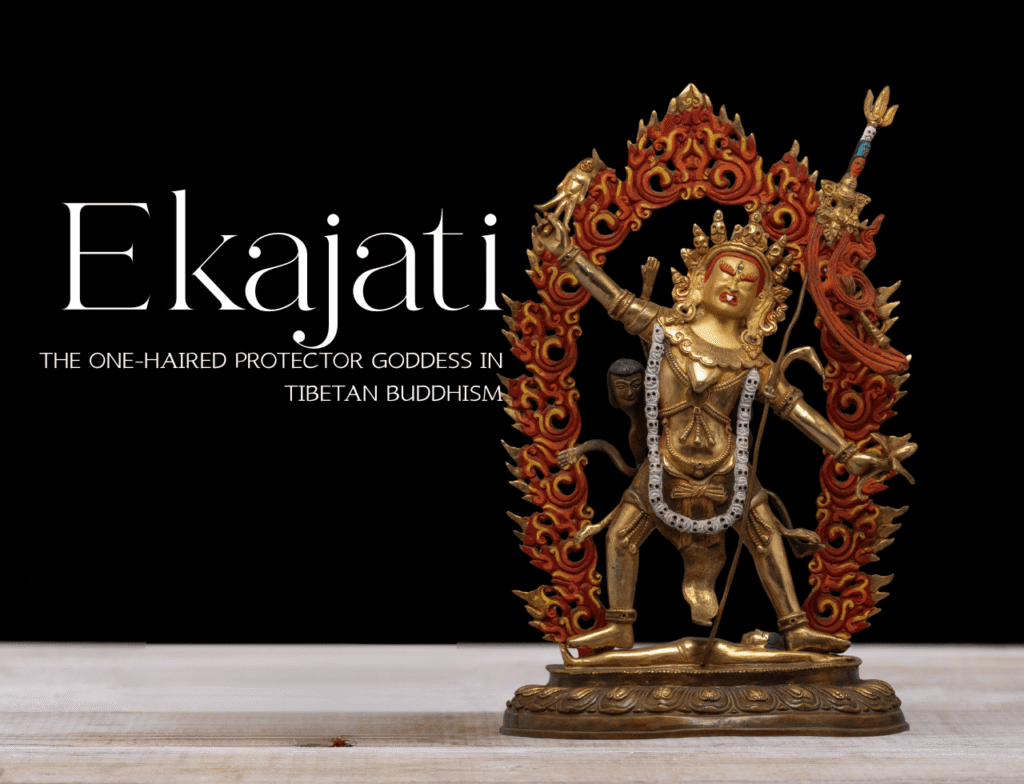
Ekajati’s Significance in Tibetan Buddhism
In Tibetan Buddhism, Ekajati is primarily recognized as a fierce protector deity rather than a longevity goddess. She is frequently depicted alongside Rahu, the deity associated with solar eclipses.
- Rahu represents solar (daytime) eclipses
- Ekajati represents lunar (nighttime) eclipses
In Vajrayana Buddhism, natural phenomena such as eclipses are considered spiritually potent moments. Solar and lunar eclipses are believed to amplify karmic effects, meditation outcomes, and ritual power. Ekajati’s connection with lunar eclipses links her to hidden energies, secrecy, and profound transformation.
She is revered across all schools of Tibetan Buddhism, including Nyingma, Kagyu, Sakya, and Gelug traditions. However, her most prominent role is within the Nyingma school, where she is honored as a chief guardian of the terma (hidden treasure) teachings revealed by great tertöns.
Ekajati as the Supreme Guardian of Terma Teachings
Within the Nyingma tradition, Ekajati is considered one of the Three Principal Protectors of the Dharma, entrusted with safeguarding the most secret and profound tantric transmissions. These include Dzogchen teachings, which emphasize direct realization of the nature of mind.
Ekajati’s role as a protector is not merely external. She is believed to:
- Guard practitioners from spiritual obstacles and distractions
- Punish those who violate samaya (sacred vows)
- Protect the purity of tantric lineages
Her fearsome appearance symbolizes unyielding commitment to truth and realization, not malice.
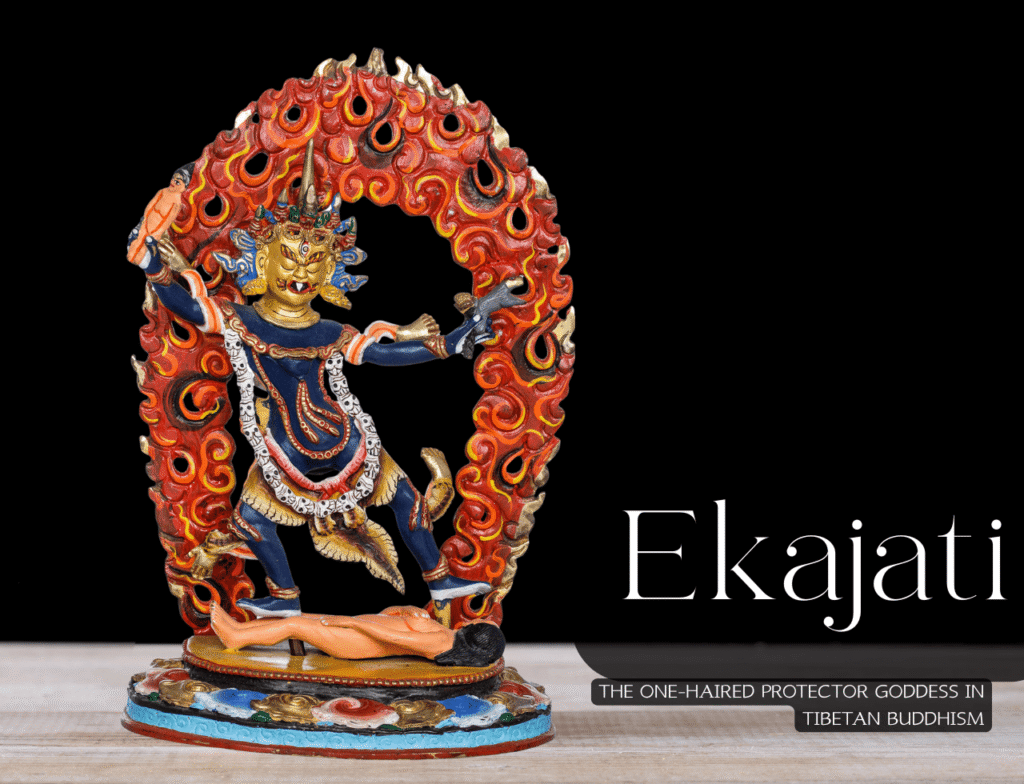
Ekajati in Thangka Art: Manifestation of Non-Dual Wisdom
In Tibetan Thangka paintings, Ekajati is described as a manifestation of Samantabhadri, the female counterpart of Samantabhadra, the primordial Buddha of the Nyingma school. This association emphasizes her embodiment of non-dual reality, beyond conceptual distinctions.
Her iconography is intentionally striking and unconventional, reflecting the raw, uncompromising nature of ultimate truth.
She is depicted with:
- One hair tuft
- One eye in the center of her forehead
- One breast
- One protruding white fang, biting her lower lip
These singular features give rise to her title, “One-Haired Mother”, symbolizing oneness, indivisibility, and the absence of duality.
Physical Appearance and Symbolic Colors
Ekajati’s body is typically painted dark brown, symbolizing the earth element, stability, and raw primordial power. Her yellow hair flies upward, twisting into a single braid at the tip, representing uncontrolled wisdom energy and fierce awareness.
Her expression is wrathful yet purposeful, conveying her role as a guardian of profound realization rather than a worldly protector.
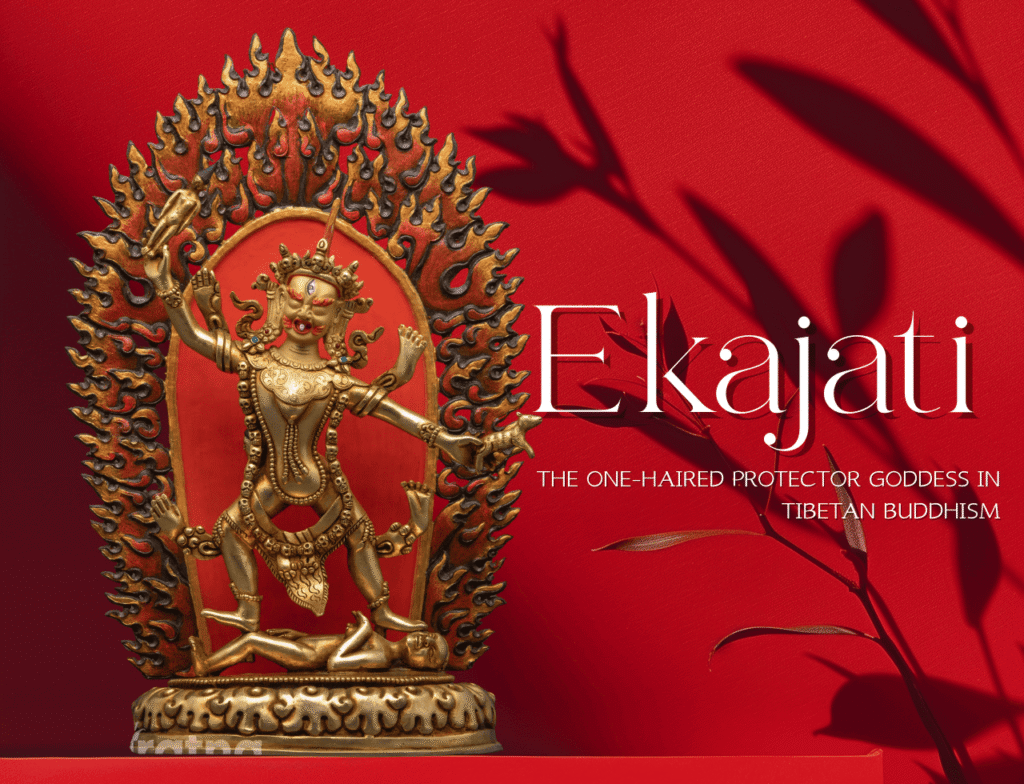
Sacred Attributes Held by Ekajati
Corpse Staff: Swift Realization in One Lifetime
Ekajati’s right hand, raised high, holds a staff made of a corpse. This powerful symbol represents the belief that enlightenment can be achieved within a single lifetime, particularly through practices connected with lunar energy and nocturnal meditation.
The corpse staff signifies:
- The impermanence of physical existence
- Mastery over death and fear
- Transformation through direct realization
Skull Bowl Filled with Blood: Fearless Consumption of Samsara
Her left hand, held near her chest, carries a skull bowl filled with blood. This does not signify violence but represents her ability to draw nourishment from forces that terrify ordinary beings.
Symbolically, it expresses:
- Fearless engagement with samsara
- Transformation of negative energies into wisdom
- Consumption of ego and ignorance
Ekajati as the Night Protector of the Dharma
Ekajati’s association with night, secrecy, and lunar power makes her a guardian of practices performed in isolation, darkness, and deep contemplation. She protects practitioners during:
- Advanced tantric retreats
- Dzogchen meditation
- Secret mantra practices
Her presence is believed to be especially strong during nighttime rituals, new moons, and lunar eclipses, moments when the boundary between ordinary perception and ultimate reality becomes thin.
Ekajati’s Enduring Role in Tibetan Buddhist Practice
Through her fierce form, singular features, and unwavering commitment to Dharma, Ekajati remains one of the most awe-inspiring protector goddesses in Tibetan Buddhism. Her imagery and practice emphasize discipline, secrecy, non-duality, and fearless realization, making her indispensable in Vajrayana iconography and spiritual life.