China is home to some of the world’s most profound spiritual landscapes, but none are more revered than the Four Sacred Buddhist Mountains. Rising from mist-filled valleys, coastal islands, dense forests, and lotus-shaped peaks, these mountains have drawn pilgrims, monks, emperors, and seekers for over a thousand years.
Each mountain is dedicated to a great bodhisattva and represents one of the four essential virtues of Mahayana Buddhism:
- Mount Wutai — Wisdom (Manjushri)
- Mount Putuo — Compassion (Guanyin / Avalokiteshvara)
- Mount Emei — Practice (Samantabhadra)
- Mount Jiuhua — Vow (Kṣitigarbha)
Together, they form a spiritual compass for Buddhist practitioners — a symbolic journey from understanding truth to living it, serving others, and fulfilling great vows.
Today, these sacred peaks are not only pilgrimage destinations but also UNESCO sites, biodiversity reserves, and cultural treasures that reveal how Buddhism adapted and flourished within Chinese civilization while maintaining deep connections with Tibetan and broader Asian traditions.
This comprehensive guide explores the history, legends, temples, ecology, cultural importance, and pilgrimage traditions of each mountain, beginning with the legendary Mount Wutai and continuing across seas to the luminous island of Mount Putuo.

Understanding the Four Sacred Buddhist Mountains
Before exploring each mountain in detail, it helps to understand their shared spiritual framework.
In Mahayana thought, enlightenment is not achieved through a single quality but through the cultivation of multiple virtues. The Four Sacred Mountains symbolize a complete path:
| Sacred Mountain | Bodhisattva | Core Virtue | Symbolic Meaning |
|---|---|---|---|
| Mount Wutai | Manjushri | Wisdom | Seeing reality clearly |
| Mount Putuo | Guanyin | Compassion | Responding to suffering |
| Mount Emei | Samantabhadra | Practice | Transforming insight into action |
| Mount Jiuhua | Kṣitigarbha | Vow | Saving all beings without exception |
Spiritual Insight:
Many pilgrims historically attempted to visit all four mountains during their lifetime, believing the journey itself mirrored the path toward awakening.
Mount Wutai — The Bodhimanda of Manjushri (Great Wisdom)
Location: Xinzhou City, Shanxi Province
Highest Peak: North Terrace (3,061 meters)
UNESCO Status: World Heritage Site (2009)
Mount Wutai is widely regarded as the most intellectually significant Buddhist mountain in China. With its cool climate, vast alpine meadows, and temple-dotted terraces, it has long served as a sanctuary for meditation and scholarship.
Why Is It Called “Five Terrace Mountain”?
The name Wutai literally means “Five Platforms.” Unlike sharp mountain ridges, its peaks are broad and flat — resembling giant stone altars rising above the clouds.
The Five Terraces
| Terrace | Chinese Name | Notable Feature |
|---|---|---|
| East | Wanghai Peak | Famous for sunrise views |
| West | Guayue Peak | Ideal for moon watching |
| South | Jinxiu Peak | Known for wildflowers |
| North | Yedou Peak | Highest point in North China |
| Central | Cuiyan Peak | Spiritual heart of the mountain |
Because temperatures remain cool even in summer, Mount Wutai earned another poetic name:
“Qingliang Shan” — The Cool Mountain.
For centuries, monks considered this climate perfect for deep contemplation.
Sacred Origins in Buddhist Scripture
Mount Wutai’s reputation is rooted in the Avatamsaka Sutra (Huayan Jing), which describes Manjushri teaching the Dharma on a five-peaked mountain in the northeast.
Chinese Buddhists quickly identified this description with Mount Wutai.
Key Historical Milestones
- 68 CE (Eastern Han Dynasty): First temples established
- Northern Wei–Tang Period: Buddhism flourished dramatically
- Tang Dynasty: International monks traveled here for study
- Peak Era: Over 360 temples once stood on the mountain
The famous monk Xuanzang, known for his pilgrimage to India, studied philosophy connected with Mount Wutai’s traditions.
By the medieval era, the mountain had become a global Buddhist center.
Manjushri Bodhisattva — Embodiment of Supreme Wisdom
Manjushri, known in Chinese as Wenshu Shili, represents transcendent insight — the wisdom that cuts through illusion.
He is typically depicted:
- Holding a flaming sword that destroys ignorance
- Carrying a scripture symbolizing knowledge
- Riding a lion, representing fearless intellect
Mount Wutai uniquely venerates the Five Directional Manjushris, each guiding practitioners toward enlightenment through different aspects of wisdom.
Pilgrimage Tradition:
Devotees often complete the “Chaotai” trek, circling all five terraces — a demanding journey seen as a metaphor for overcoming mental obstacles.
A Rare Harmony: Han and Tibetan Buddhism
Mount Wutai is the only sacred mountain in China where Han Buddhist temples and Tibetan monasteries coexist on a large scale.
Historically:
- Tibetan Buddhism arrived during the Yuan dynasty
- Flourished in the Ming and Qing eras
- Received strong imperial support
Notable highlights include:
- Pusading Temple — the largest Tibetan monastery on the mountain
- Visits from Emperors Kangxi and Qianlong
- Significant influence from the Gelug school
This fusion transformed Mount Wutai into a spiritual meeting ground between cultures.
Architectural Treasures
Among China’s oldest surviving wooden buildings:
- Foguang Temple — Tang dynasty masterpiece
- Nanchan Temple — one of the oldest timber structures in Asia
Together, they make Mount Wutai a living museum of Buddhist architecture.
Mount Putuo — The Bodhimanda of Guanyin (Great Compassion)
Location: Zhoushan Archipelago, Zhejiang Province
Area: 12.5 square kilometers
Landscape: Island surrounded by the East China Sea
If Mount Wutai represents clarity of mind, Mount Putuo embodies the warmth of compassion.
Often called the “Buddhist Kingdom of Sea and Sky,” the island appears to float between ocean mist and temple bells.
From Potalaka to Putuo
The name derives from the Sanskrit Potalaka, the mythical abode of Avalokiteshvara. Interestingly, the word “Potala” — as in Lhasa’s Potala Palace — shares the same origin, symbolizing a sacred dwelling of the bodhisattva.
The Legend That Founded a Pilgrimage Center
In 863 CE, a Japanese monk named Huì È attempted to carry a sacred Guanyin statue back to Japan. Violent storms blocked his voyage. Believing the bodhisattva wished to remain, he enshrined the statue near Chaoyin Cave, creating the famous: “Unwilling-to-Leave Guanyin Temple.” This moment marked the birth of Mount Putuo as a major pilgrimage destination.
Rise to Spiritual Prominence
- Song Dynasty: Official imperial recognition
- Ming Dynasty: Golden age of temple construction
- Historical Record:
“Five hundred monasteries, three thousand monastics.”
A beloved saying still captures Guanyin’s mercy: “Wherever prayers are offered, there she responds.”
Guanyin — The One Who Hears the World
Avalokiteshvara was shortened to Guanyin to avoid a naming taboo tied to Emperor Taizong. Over centuries, the bodhisattva’s image evolved in China from masculine to the graceful feminine form widely adored today.
Major Forms Worshiped on Mount Putuo
- Sacred Guanyin
- Thousand-Armed Guanyin
- Eleven-Faced Guanyin
- Water-Moon Guanyin
Each form reflects limitless compassion.
The Three Great Temples
| Temple | Position | Highlights |
|---|---|---|
| Puji Temple | Front | Spiritual gateway |
| Fayu Temple | Rear | Elegant architecture |
| Huiji Temple | Summit | Panoramic sea views |
Across the island, 88 hermitages dot cliffs and forests.
Mystical Coastal Landscapes
Mount Putuo offers a rare fusion of spirituality and marine beauty. Famous natural sites include:
- Chaoyin Cave — echoing tides resemble chanting
- Fanyin Cave — said to amplify prayers
- Beaches where temples seem to merge with the horizon
Few Buddhist destinations feel so open and luminous.
Shared Devotion with Tibetan Buddhism
Because Avalokiteshvara is deeply revered in Tibetan tradition, Mount Putuo naturally became a cross-cultural bridge. Historical connections include:
- Tibetan pilgrims visiting the island
- Qing-era monks practicing here
- Symbolic links to the Potala Palace
Compassion, after all, transcends geography.
Mount Emei — The Bodhimanda of Samantabhadra (Great Practice)
Location: Sichuan Province
Highest Peak: Wanfo Peak (3,099 meters)
Reputation: “Most Elegant Under Heaven”
Mount Emei is where philosophy becomes action — a mountain that teaches practitioners to live the Dharma rather than merely understand it.
A Mountain of Grace and Grandeur
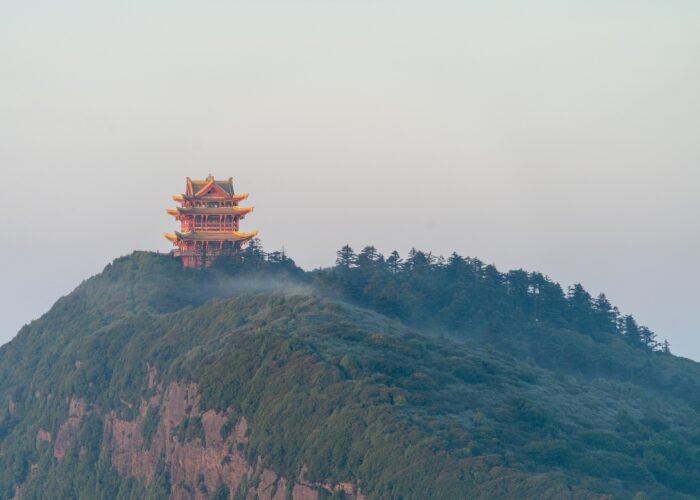
Stretching 23 kilometers and covering 154 square kilometers, Emei’s silhouette resembles a maiden’s eyebrow — the origin of its poetic name. The mountain combines:
- Dramatic cliffs
- Dense forests
- Ancient monasteries
- Cloud oceans
It is both spiritually and visually overwhelming.
Sacred Beginnings
- Eastern Han Dynasty: First temple established
- Tang Dynasty: Recognized as Samantabhadra’s bodhimanda
Legends describe the bodhisattva ascending the mountain atop a six-tusked white elephant. Even the Tibetan epic King Gesar compares the mountain to a resting celestial elephant.
Samantabhadra — The Bodhisattva of Living Virtue
Samantabhadra means “Universal Goodness.” While Manjushri symbolizes insight, Samantabhadra represents practice — the discipline required to embody wisdom. He is associated with the Ten Great Vows, guiding Buddhists toward compassionate action. Iconography typically shows him riding the white elephant, symbolizing strength and unwavering commitment.
Golden Peak’s Four Natural Wonders
Visitors often ascend before dawn to witness phenomena that feel almost supernatural:
- Radiant sunrises
- Endless seas of clouds
- The circular “Buddhist halo”
- Flickering Sacred Lamps
These spectacles have inspired pilgrims for centuries.
Architectural and Cultural Marvels
Key sites include:
- Wannian Temple — beamless brick hall
- Baoguo Temple
- Fuhu Temple
The bronze Samantabhadra statue at Wannian Temple, dating to the Northern Song dynasty, is considered a national treasure.
Birthplace of the Emei Martial Arts Tradition
Mount Emei is one of China’s three great martial arts centers alongside Shaolin and Wudang.
Its style emphasizes agility, internal strength, and spiritual discipline — echoing Buddhist principles of balance.
Connections with Tibetan Buddhism
Tibetan pilgrims from western Sichuan frequently journeyed to Mount Emei. Historical exchanges included:
- Tibetan monasteries built during the Qing era
- Shared reverence for Samantabhadra as a protector
- Cultural blending along pilgrimage routes
Together with Manjushri, Samantabhadra is seen as safeguarding Buddhist teachings.
Mount Jiuhua — The Bodhimanda of Kṣitigarbha (Great Vow)
Location: Anhui Province
Highest Peak: Shiwang Peak (1,342 meters)
Nickname: Lotus Buddhist Realm
Mount Jiuhua is quieter than the other sacred mountains — yet deeply moving. It represents the power of vows and the determination to save all beings.
Poetry That Named a Mountain
Originally called Jiuzishan (Nine Peaks Mountain), it was renamed after the Tang poet Li Bai, who wrote: “Like nine radiant lotus blossoms rising into the sky.” Today, the mountain contains 99 peaks, reinforcing its lotus symbolism.
Kim Gyo-gak — The Prince Who Became a Bodhisattva
In 719 CE, a Silla prince from Korea journeyed to China and practiced asceticism on Mount Jiuhua for 75 years. He died at age 99 — yet his body reportedly did not decay. Believers declared him an incarnation of Kṣitigarbha, and the Hall of the Flesh Body was built to enshrine him. A beloved legend tells that when he requested land equal only to the size of his robe, it miraculously covered the entire mountain.

Kṣitigarbha — Lord of Great Vows
His name carries profound meaning:
- Steadfast as the earth
- Deep as a hidden treasury
He is guided by one of Buddhism’s most powerful pledges: “Until the hells are empty, I will not become a Buddha.”
Iconography
- Monk’s staff to open hell’s gates
- Wish-fulfilling jewel
- Companion creature Diting, able to discern truth
Kṣitigarbha symbolizes boundless compassion expressed through unwavering commitment.
A Living Museum of “Flesh-Body Bodhisattvas”
Mount Jiuhua is famous for naturally preserved monk bodies — revered as proof of extraordinary spiritual attainment. Notable figures include:
- Master Wuxia
- Monk Daxing
This tradition makes the mountain uniquely sacred.
Major Sacred Sites
- Huacheng Temple — founding temple
- Numerous meditation hermitages
- Granite–limestone formations recognized by UNESCO Global Geopark (2019)
The geological drama mirrors the mountain’s spiritual gravity.
Interaction with Tibetan Buddhism
Though primarily a Han Buddhist center, Mount Jiuhua experienced meaningful exchange:
- Tibetan monks practiced here
- Some temples feature Tibetan architectural elements
- Ascetic traditions resonate with Vajrayana discipline
The mountain also fostered connections with Buddhist communities in Japan and Korea.
Core Comparison of China’s Four Sacred Buddhist Mountains
| Mountain | Bodhisattva | Core Spirit | Nickname | Distinctive Features | Tibetan Connection |
|---|---|---|---|---|---|
| Mount Wutai | Manjushri | Great Wisdom | Cool Mountain | Five terraces, ancient temples | Strong Gelug influence |
| Mount Putuo | Guanyin | Great Compassion | Sea-and-Sky Kingdom | Island pilgrimage | Symbolic link to Potala |
| Mount Emei | Samantabhadra | Great Practice | Most Elegant Under Heaven | Golden Peak radiance | Pilgrimage site |
| Mount Jiuhua | Kṣitigarbha | Great Vow | Lotus Realm | Flesh-body bodhisattvas | Cultural exchange |
Spiritual Geography: A Symbolic Buddhist Path
Seen together, the four mountains form more than a geographic grouping — they represent a complete spiritual progression:
- Mount Wutai — Learn wisdom
- Mount Putuo — Open the heart
- Mount Emei — Put teachings into action
- Mount Jiuhua — Commit to saving all beings
For many believers, visiting these peaks is equivalent to walking the path toward enlightenment itself.
Pilgrimage Then and Now
Historically, pilgrims endured months — even years — of travel by foot. Today, improved infrastructure allows travelers to reach these sacred sites more easily while still preserving their contemplative atmosphere. Modern visitors include:
- Devout Buddhists
- Cultural travelers
- Scholars
- Nature lovers
Yet the purpose remains unchanged: to encounter something greater than oneself.
Why the Four Sacred Mountains Still Matter
These mountains are not relics of the past. They continue to function as:
- Living monasteries
- Centers of Buddhist learning
- Ecological sanctuaries
- Cultural bridges across Asia
They demonstrate how spirituality can coexist with nature, architecture, scholarship, and community. Most importantly, they remind us that enlightenment is not distant — it rises quietly, like a mountain, within reach of those willing to climb.