
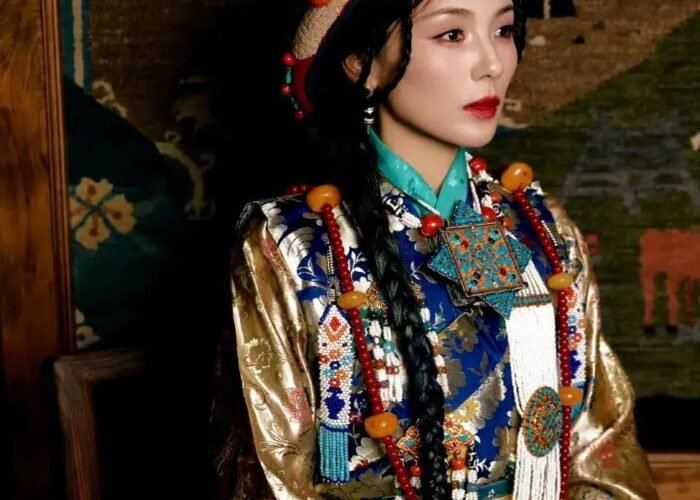
Western Tibet holds some of the most distinctive and historically rich clothing traditions in the world. From the pearl-crowned women of Shigatse to the ancient ritual dancers of Nagri these garments are far more than decoration — they are living records of empire, faith, and cultural identity.
Shigatse and the Ü-Tsang Cultural World
Shigatse, located in what is today the Tibet Autonomous Region, sits at the heart of the greater Ü-Tsang cultural sphere. Its clothing traditions share deep roots with Lhasa and Shannan, yet Shigatse developed its own visual identity — most notably in the ornamental styles worn by women.
Further west, Nagri Prefecture preserved even older layers of Tibetan dress. Geographically remote, this plateau valley surrounded by the Kunlun, Karakoram, and Himalaya mountain ranges became a sanctuary for ancient Tubo cultural practices that had faded elsewhere in Tibet.
Lhasa vs. Shigatse: Two Pearl Crowns, Two Identities
One of the most striking differences between Lhasa and Shigatse women’s fashion lies in their pearl crowns.
In Lhasa, women wear a fork-shaped pearl crown known as the Batruk. In Shigatse, the equivalent is the Bakuo — also called the Balang — which takes a graceful bow shape. While both express prestige and regional identity within the broader Ü-Tsang world, their structures are quite different.
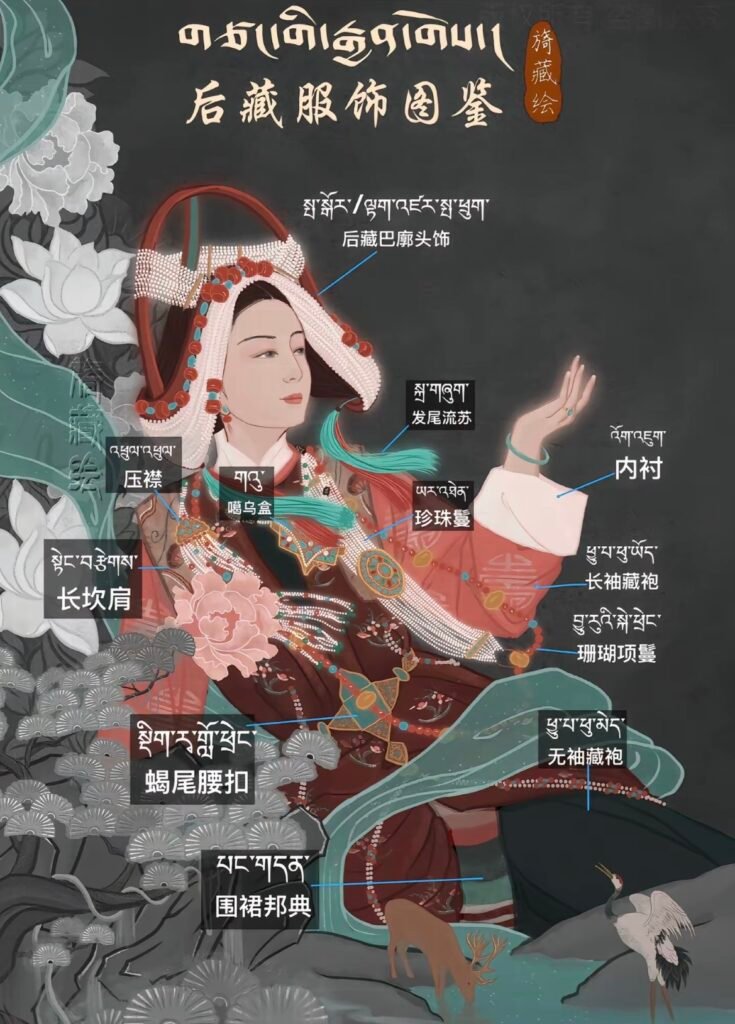
The Structure of the Shigatse Bakuo (སྤ་སྒོར།) Crown
The Shigatse pearl crown is made up of three distinct components. The first is the Balong, a circular base ring wrapped in red wool or cloth and richly inlaid with coral, turquoise, and agate. The second is a curved bamboo bow frame, also wrapped in red fabric and decorated with coral and precious stones. The third is the Tada, a string of pearls wrapped around the frame.
Together, these elements create a layered ornament that reflects both material wealth and spiritual symbolism. Coral, turquoise, pearls, and agate have long carried deep meaning in Tibetan culture — signifying status, protection, and devotion.
From Crown to Necklace: A Versatile Ornament
During singing, dancing, or festive celebrations, women sometimes adapt their headdress for ease of movement. They may remove the Zhada pearl strands and wear only the circular Balong base, hanging the pearl strands around the neck as a necklace. This alternative style is called Zangmu Batruk — a practical yet elegant solution that shows the creative flexibility embedded in Tibetan fashion traditions.
Silver Waist Ornaments in Sakya, Angren, and Lhatse
In the Shigatse counties of Sakya, Angren, and Lhatse, women often wear a colorful strip of Pulu wool cloth tied around the waist. This decorative belt is fastened with a finely crafted silver plaque that accentuates the waistline and doubles as an apron-like garment.
Craftsmanship and social status are both on display here. Some women attach small silver bells beneath the plaque, and as they walk, the bells produce a soft, rhythmic sound — turning everyday movement into something musical. These waist ornaments demonstrate that Tibetan fashion has always balanced beauty with meaning.
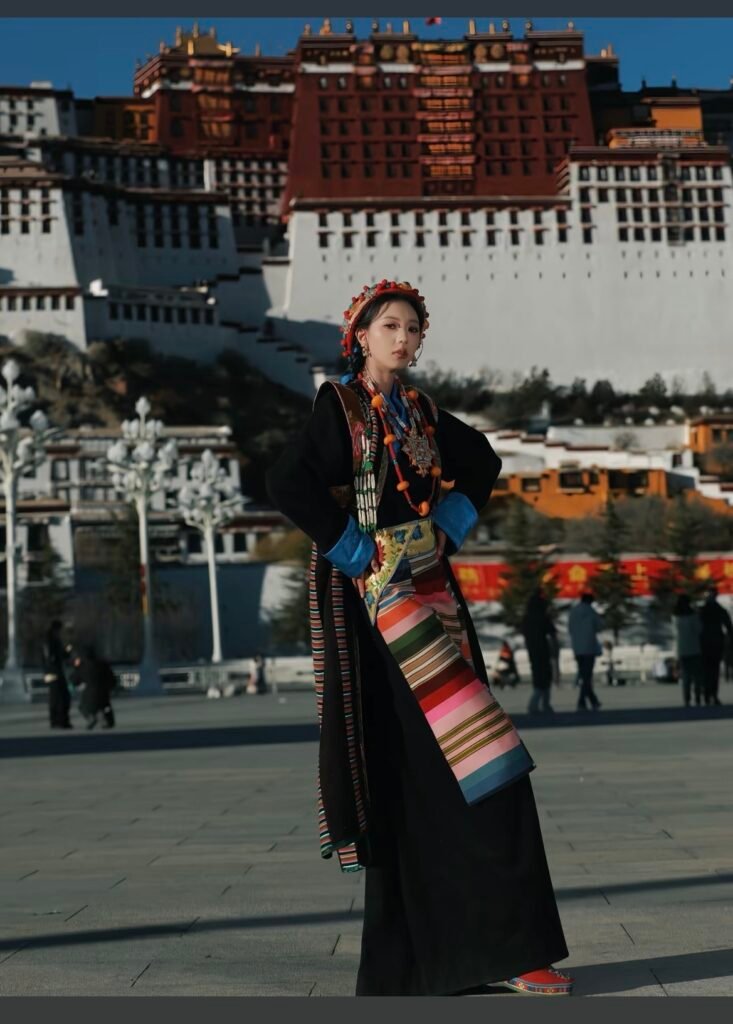
Nagri Prefecture: A Living Museum of Tubo Culture
In the mid-10th century, descendants of the Tubo royal lineage migrated westward and established several kingdoms in what is now Nagri Prefecture, including the Guge Kingdom and the Purang Kingdom. These kingdoms preserved many elements of ancient Tubo civilization, earning Nagri the name “the Three Enclosures of Nagri”
Among the most remarkable cultural treasures that survived in Nagri is an ancient ritual song and dance called Xuan. This performance tradition was lost in central Ü-Tsang but has continued to thrive in Nagri communities, and it offers scholars a rare window into what Tubo-era clothing may have looked like.
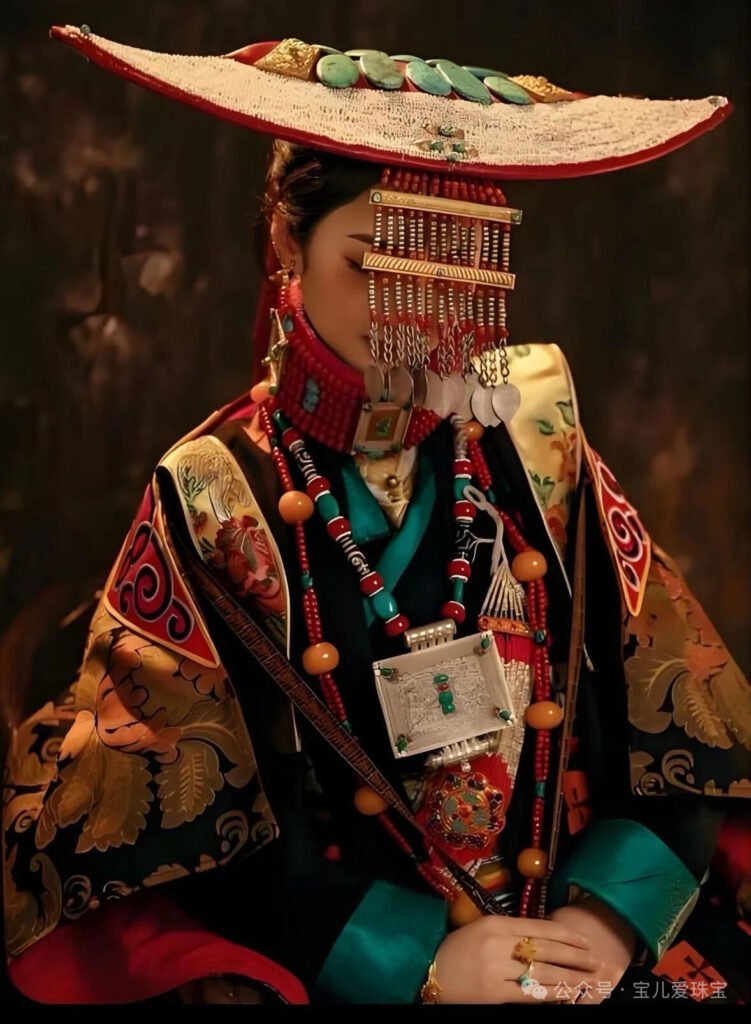
The Xuan Dance: A Glimpse into Tubo Fashion
The costumes worn during the Xuan ritual dance are considered by many scholars to closely resemble clothing from the Tubo period, making them one of the most valuable living records of ancient Tibetan dress.
Men performing the Xuan wear ancient warrior armor and military-style attire recalling Tubo soldiers. Women’s costumes are even more layered and elaborate.
A Xuan dancer wears a long Pulu wool robe over five inner shirts in red, yellow, blue, green, and white, with sleeves layered so that each color is visible in sequence. A satin cape is draped behind. The front of the body is covered in dense layers of jewelry — coral, turquoise, amber, and beeswax resin — with short necklaces falling to the chest and longer strands extending all the way to the knees.
Around the neck, women wear a wide collar necklace three to four inches broad, crafted from coral and turquoise. On the chest hang two or more Gawu amulet boxes — portable Buddhist shrines made of gold and jade filigree that carry protective images or sacred relics.
The headdress is equally remarkable. Rather than the bow or fork shapes seen in Shigatse and Lhasa, it resembles royal crowns from the Sui and Tang periods of China. Pearl strands hang four to five inches down from the forehead, partially covering the face and eyes.
Many scholars regard this Nagri costume as a living fossil of Tubo women’s dress — preserved not in a museum, but in the living practice of a community.
Pastoral and Agricultural Dress in Nagri
Not all clothing in Nagri carries this ancient ceremonial weight. In pastoral areas, people wear thick sheepskin robes, practical boots, and layered wool garments similar to those worn by northern Tibetan nomads. In agricultural areas, dress resembles that of central Ü-Tsang, reflecting shared environmental and cultural patterns across the Tibetan plateau.
Regional Diversity Within a Shared Cultural Heritage
What the clothing traditions of Shigatse and Nagri reveal together is a Tibetan fashion history that evolved regionally while maintaining shared foundations. Pearl crowns express local identity within the broader Ü-Tsang world. Silver waist ornaments demonstrate craftsmanship and social symbolism. The Xuan dance costume preserves ancient Tubo aesthetics that have otherwise been lost to time.
Turquoise, coral, and layered jewelry connect wearers to spiritual devotion and ancestral status across all these regions. From Shigatse’s bow-shaped Bakuo crowns to Nagri’s ritual warrior attire, these garments carry echoes of empire, migration, and faith.
In remote valleys where ancient dances are still performed, the legacy of the Tubo Empire continues — not only in stone ruins and manuscripts, but in garments still worn, layered, and alive.