Phuntsok Ling Monastery: Jonang Heritage and Gelug Legacy
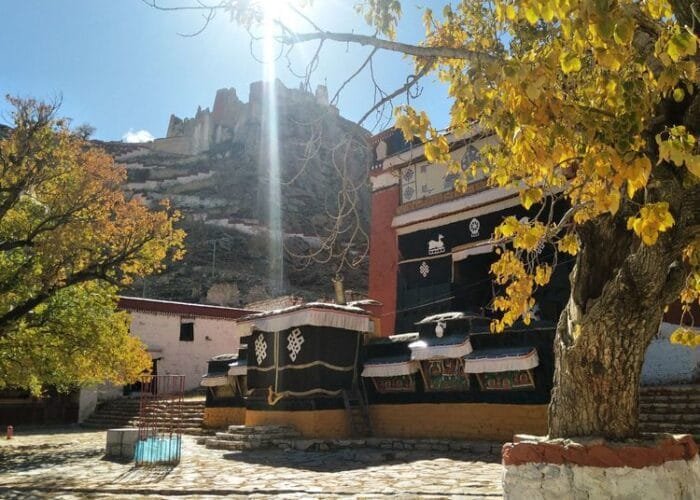
Phuntsok Ling Monastery—also known as Ganden Phuntsok Ling—is a historic Tibetan Buddhist monastery located in Phuntsok Ling Township, Lhatse County, Shigatse, on the southern bank of the majestic Yarlung Tsangpo River. Sitting at an elevation of about 4,100 meters (13,450 feet), the monastery is celebrated for its extraordinary murals, sacred statues, and layered religious history.
Recognized as a National Key Cultural Relics Protection Unit in 2006, Phuntsok Ling is one of the rare monasteries where the traditions of the Jonang and Gelug schools intersect, offering scholars and travelers a unique window into the evolution of Tibetan Buddhism.

Historical Evolution of Phuntsok Ling Monastery
Foundation and Early Development
Phuntsok Ling Monastery was founded in 1615, with the support of Desi Tsangpa Phuntsok Namgyal and under the direction of the eminent Jonang master Jetsun Taranatha. Originally named “Dadan Phuntsok Ling,” meaning “Island of Eternal Dharma and Perfect Joy”. During its early years, the monastery served as an important center for Jonang teachings, which are known for their philosophical depth and unique interpretation of Buddhist emptiness.
Construction progressed steadily:
- 1628: Main structures were completed.
- 1634: The monastery’s sacred representations of body, speech, and mind were fully established, marking the spiritual completion of the complex after nearly two decades of work.
Conversion to the Gelug School
Between 1649 and 1658, during the rule of the Fifth Dalai Lama, the monastery was converted to the Gelug tradition and renamed Ganden Phuntsok Ling. It became one of the 13 monasteries that formally changed sectarian affiliation, reflecting the shifting religious landscape of Tibet in the 17th century. This transition marked a pivotal moment in the monastery’s history, blending earlier doctrinal influences with Gelug scholastic practices.
At its peak, the monastery featured:
- 35 temple halls
- A grand chanting hall
- Around 3,300 monks
- A total area of approximately 37,800 square meters
Today, it remains both a protected heritage site and a powerful symbol of Tibet’s spiritual continuity.
The Founder: Jetsun Taranatha (1575–1634)
Jetsun Taranatha, born Kunga Nyingpo, was a distinguished Jonang scholar, historian, and Sanskrit expert. Believed to be descended from the famous translator lineage, he played a pivotal role in preserving Buddhist knowledge and expanding cross-cultural exchanges.
Key Moments in His Life
| Age / Year | Milestone |
|---|---|
| Age 4 | Enthroned at a Jonang monastery |
| Age 8 | Ordained as a novice monk |
| 1604 | Received full monastic vows and studied under leading masters in Ü-Tsang |
| 1614–1615 | Oversaw the construction of Phuntsok Ling and began teaching disciples |
| Academic Work | Authored History of Buddhism in India and regional chronicles |
| Cultural Exchange | Invited 20 Nepalese artisans to cast Buddhist statues |
| 1624 | Traveled to Outer Mongolia at the invitation of the Khalkha Mongols and was honored as the First Jebtsundamba Khutuktu |
Taranatha’s intellectual contributions and international outlook helped shape the monastery’s artistic and architectural identity.
Architectural Layout: A Mountain Monastery of Grandeur
Phuntsok Ling is divided into upper and lower complexes, facing west to east and rising dramatically against the Tibetan landscape.
Main Structures
- Assembly Hall (Tsuglagkhang):
The spiritual core of the monastery, this three-story building covers about 635 square meters. Each level features elaborate murals—from the ground-floor porch and scripture hall to the upper Buddha shrine. - Lhakang Dondrub:
A chapel dedicated to important sacred images. - Outer Scriptural College:
Once served as a center for study, chanting, and philosophical training. - Dzong Government Ruins:
Evidence that the monastery historically functioned as both a religious and administrative hub. - Monks’ Residences:
Many survive today, offering insight into monastic life.
Auxiliary Structures
The monastery once included a nine-story residential tower with 94 rooms at the mountaintop, though much of it is now in ruins. Meditation caves and small stupas scattered nearby hint at centuries of retreat practice.
Architecturally, the complex blends traditional Tibetan design with Nepalese and Indian influences, reflecting Taranatha’s engagement with the broader Buddhist world.
Scale and Architectural Grandeur
At its height, Phuntsok Ling Monastery was an expansive religious complex. Historical records note that it once included:
- 35 temples
- A large chanting hall
- Housing for approximately 3,300 monks
- 94 residential rooms
- Multi-level structures reaching up to nine stories
Today, the monastery still impresses visitors with its vast layout, covering roughly 37,800 square meters.
Layout and Design
The monastery is organized around the assembly hall, which forms the spiritual and architectural heart of the complex. Surrounding it are 16 smaller chapels (Lakang) along with essential facilities such as a printing house and monks’ residences.
The buildings are carefully arranged across mountain slopes and sub-mountain terraces, demonstrating traditional Tibetan architectural strategies that harmonize with rugged terrain while maintaining spiritual symbolism.
Main Structures of Phuntsok Ling Monastery
The monastery faces west to east, a directional choice often associated with ritual significance in Tibetan Buddhism. It is divided into main buildings and ancillary structures, each serving distinct religious and administrative purposes.
The Assembly Hall
The assembly hall, spanning about 1,700 square meters, rises across three floors and functions as the monastery’s central gathering space for ceremonies, debates, and prayers. Nearby, you’ll find:
- A traditional debate courtyard, where monks once engaged in philosophical discussions
- Former Dzong government sites, reflecting the monastery’s historical administrative role
- Rows of monks’ quarters
Together, these structures reveal how monasteries in Tibet often operated as both spiritual centers and community hubs.
Recognized Cultural Treasure
Phuntsok Ling Monastery has received significant recognition for its heritage value.
- In 1996, it was designated as an Autonomous Region–level Cultural Relics Protection Unit.
- Later, in 2006, the State Council included it in the sixth batch of National Key Cultural Relics Protection Units, affirming its importance within China’s protected historical sites.
These honors highlight ongoing efforts to safeguard the monastery’s architecture, murals, and cultural legacy for future generations.
Sacred Statues and Religious Art
Phuntsok Ling houses 164 precious gilded bronze statues, many crafted by Nepalese artisans. These sculptures represent a wide range of Buddhist figures and traditions.
Major Categories of Statues
| Category | Representative Figures | Features |
|---|---|---|
| Tantric Deities | Kalachakra, Chakrasamvara, and other yidams | Powerful imagery and refined craftsmanship |
| Buddhas & Bodhisattvas | Three Buddhas, Five Dhyani Buddhas, Maitreya, Avalokiteshvara | Elegant forms with well-preserved gilding |
| Lineage Masters | Taranatha, Dolpopa, Tsongkhapa | Reflect both Jonang and Gelug heritage |
| Special Figures | Daye Lata and Tubwa Sherab Gyeltsen | Linked to the monastery’s sacred treasures |
The monastery also preserves numerous thangka paintings, depicting Buddha’s life stories, bodhisattva legends, and protective deities—some dating back to Taranatha’s era and showing clear Indian and Nepalese stylistic influence.
Murals: The Artistic Treasure of Phuntsok Ling
The murals of Phuntsok Ling are widely regarded as masterpieces of 16th–17th century Tibetan painting. Scholars often highlight their fusion of Tibetan, Han Chinese, Nepalese Newar, and Indian artistic traditions.
Where to See Them
- Third floor of the assembly hall
- Second-floor circumambulation corridor
- Ground-floor porch
- Main scripture hall
Themes and Subjects
- Life of Shakyamuni:
A detailed visual narrative featuring 125 episodes, including rare scenes such as the story of Princess Sunghara’s devotion. - Buddhist Scriptures:
Murals illustrating the Tathagatagarbha Sutras, expressing the Jonang philosophical view known as “other-emptiness.” - Protective Deities:
The Four Heavenly Kings, regional guardians, and the Eight Dragon Kings rendered in vibrant color. - Historical Figures:
Portraits of Taranatha and Tsangpa rulers provide valuable historical documentation.
Artistic Characteristics
- Color: Mineral pigments remain striking after nearly 400 years.
- Linework: Smooth, precise outlines bring lifelike movement to figures.
- Composition: Strong spatial layering influenced by classical Chinese landscape painting.
- Style: A unique “Phuntsok Ling style” born from multiple artistic traditions.
The Four Sacred Treasures of the Monastery
Phuntsok Ling preserves four revered relics, each carrying profound spiritual symbolism.
| Treasure | Description | Significance |
|---|---|---|
| Staff of Tubwa Sherab Gyeltsen | Wooden staff about one meter long with carved patterns | Represents Jonang lineage transmission |
| Taranatha’s Walking Stick | Believed to free beings from suffering upon hearing its sound | One of the monastery’s holiest artifacts |
| Taranatha’s Ritual Cymbals | Bronze with a distinctive tone | Witness to early ceremonies |
| Pair of Natural Gemstones | One white with wheel-like patterns; one radiant red | Said to symbolize purity and sacred power |
Legend holds that Taranatha brought these gemstones from Bodh Gaya in India.
Religious Importance and Doctrinal Transformation
Jonang Period (1615–1658)
During this era, Phuntsok Ling was the largest Jonang center in the Tsang region, promoting the philosophical doctrine of “other-emptiness,” which teaches that the ultimate nature of reality is permanent and luminous.
Taranatha trained numerous disciples here, translated Sanskrit texts, and produced influential writings that elevated the Jonang school’s prestige.
Gelug Period (1658–Present)
After conversion, the monastery adopted the teachings of Tsongkhapa, emphasizing dependent origination and emptiness. Yet traces of Jonang tradition remain visible in certain rituals and mural themes, making the monastery a rare example of sectarian integration in Tibetan Buddhism.
Traditional Festivals at Phuntsok Ling
The monastery continues to host vibrant religious festivals blending Jonang heritage with Gelug practices.
| Festival | Tibetan Date | Highlights |
|---|---|---|
| Cham Dance Festival | 27th day of the 12th lunar month | Masked vajra dances to dispel negativity |
| Tara Pilgrimage Day | 8th day of the 10th lunar month | Devotees pray for protection and blessings |
| Butter Lamp Festival | 25th day of the 10th lunar month | Thousands of lamps honor Tsongkhapa |
| Great Prayer Festival | First lunar month | Chanting, debates, and sacred processions |
These events attract pilgrims from surrounding regions and sustain centuries-old spiritual traditions.
How to Visit Phuntsok Ling Monastery
Located about 40 km from the G318 Highway, the monastery is relatively accessible compared to many remote Tibetan sites.
Travel Routes
- Shigatse → Lhatse → Phuntsok Ling:
Take a bus from Shigatse to Lhatse (around 2 hours), then continue by local transport or private vehicle for about 1.5 hours. - Self-Drive:
Follow G318 to Lhatse, then connect to G349 toward the township while enjoying sweeping views of the Yarlung Tsangpo. - Hiking:
Adventurous travelers can trek from nearby villages for a deeper cultural experience.
Travel Tips
- Prepare for high altitude (4,100 m)—carry oxygen and medication if needed.
- Respect monastery etiquette: remove hats, speak softly, and confirm photography rules.
- Best time to visit: April to October, when weather conditions are more favorable.
Cultural Fusion and Living Legends
Phuntsok Ling is often described as a “living museum of Tibetan mural art.” It is one of the few Gelug monasteries that still preserves extensive Jonang artwork, offering rare insight into the evolution of Tibetan religious culture.
Fascinating Stories
- Choosing the Sacred Site:
Legend says Taranatha selected the location after seeing snow mountains behind it and the Yarlung Tsangpo flowing before it—an ideal setting for the flourishing of Dharma. - Nepalese Master Craftsmen:
Twenty elite artisans were invited to cast statues over five years, influencing later Tibetan metalwork traditions. - The Glowing Gemstone:
One red jewel is believed to emit a faint light at night and is regarded as a protective treasure of the monastery. - The Circumambulation Miracle:
Devotees claim that completing 108 circuits along the mural-lined corridor may bring a visionary connection with the Buddha.
The Yarlung Tsangpo: Sacred River Beside the Monastery
Flowing from west to east, the Yarlung Tsangpo River—one of the highest major rivers on Earth—has nurtured Tibetan civilization for centuries.
The monastery’s riverside setting creates a symbolic harmony between spiritual life and the natural world, echoing Tibetan Buddhist ideals of coexistence with nature. Nearby villages and ancient ferry crossings still preserve elements of traditional Tibetan culture, enriching the journey for visitors seeking authenticity.
Visiting Phuntsok Ling Monastery Today
Located in the vast landscapes of Lhatse County, the monastery offers travelers a chance to experience a quieter side of Tibetan spirituality—far from the more frequently visited monasteries near Lhasa.
Visitors are often struck by:
- The sweeping mountain views surrounding the complex
- The sense of history embedded in its ancient walls
- The layered religious heritage shaped by both Jonang and Gelug traditions
For those exploring western Tibet or traveling toward Mount Kailash, Phuntsok Ling provides a meaningful cultural stop that combines history, art, and high-altitude serenity.