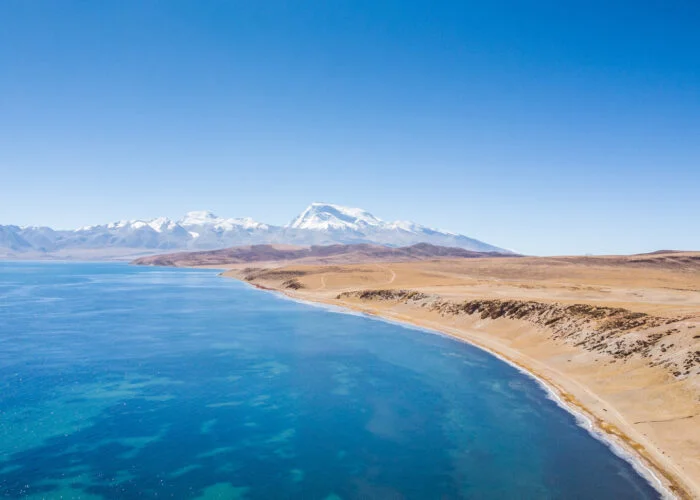
Traveling from Lhasa to Namtso Lake along China National Highway 109, visitors pass one of the most impressive viewpoints on the Tibetan Plateau—the Nyenchen Tangla Mountain Observation Deck. Located at an altitude of 4,640 meters, this roadside stop offers one of the best places to admire the magnificent Nyenchen Tangla Mountain, whose highest peak rises to about 7,111 meters above sea level.
Situated about 100 kilometers north of Lhasa, the viewpoint is a popular stop for travelers heading toward the sacred Namtso Lake. From this location, visitors can enjoy a wide panoramic view of the snow-covered mountains that dominate the northern skyline of central Tibet.
A Simple Roadside Stop with Spectacular Views
The Nyenchen Tangla Mountain Observation Deck is not a large tourist facility. In reality, it is a simple roadside stop along the highway. A small row of ordinary buildings stands nearby, including a commissary, restroom facilities, and a modest parking area where travelers can pause during the journey.
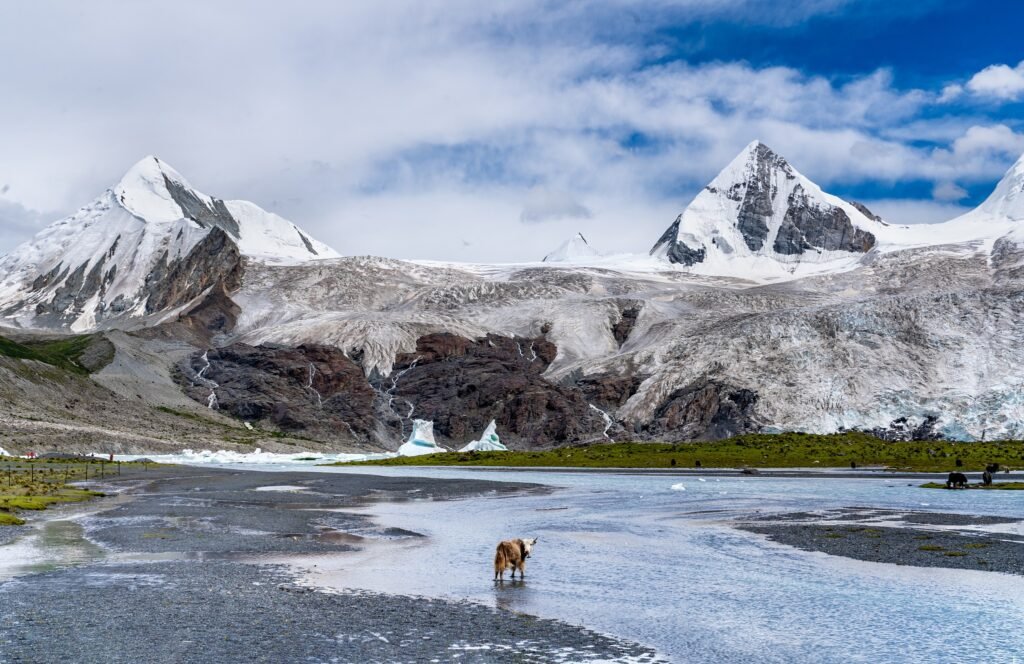
Despite its simplicity, the location offers a powerful visual experience. Along the roadside, colorful prayer flags flutter in the wind, adding movement and color to the landscape. In the distance, the towering snow-covered peaks of the Nyenchen Tangla Mountains rise dramatically against the sky.
The scenery here forms a striking natural picture. Deep blue skies, drifting white clouds, bright snow-capped mountains, black-and-white yaks grazing on the grasslands, and vibrant prayer flags dancing in the wind combine to create an unforgettable view of the Tibetan Plateau.
The Nyenchen Tangla Mountains: A Sacred Mountain Range of Tibet
The Nyenchen Tangla Mountains, officially known as the Nyainqêntanglha Mountains, are one of the most famous and sacred mountain ranges in Tibet. The range forms part of the Transhimalaya mountain system, running roughly parallel to the Himalayas.
Stretching for about 700 kilometers across the Tibet Autonomous Region, the mountain range extends from areas west of Lhasa toward eastern Tibet. The average elevation of the range is between 5,000 and 6,000 meters, and it contains more than 240 peaks exceeding 6,000 meters.
The highest peak, Mount Nyenchen Tanglha, reaches an elevation of about 7,162 meters, located in Damxung County, northwest of Lhasa. The peak was first successfully climbed by a Japanese expedition team in 1986.
Geography and Natural Landscape
The Nyenchen Tangla Mountains play an important role in the geography of the Tibetan Plateau. The range acts as a natural watershed, separating the Yarlung Tsangpo River valley to the south from the Changtang Plateau in northern Tibet.
Thousands of glaciers are found within this mountain system, covering an estimated 7,000 square kilometers in some areas. These glaciers contribute to the region’s complex river systems and help shape the dramatic landscape surrounding Lhasa and Namtso.
Nyenchen Tangla and Namtso: Sacred Mountain and Holy Lake
About 100 kilometers north of Lhasa, the majestic Nyenchen Tangla Snow Mountain rises above the surrounding grasslands and valleys. The northern edge of the range lies close to Namtso Lake, one of the highest and most sacred lakes in Tibet.
The mountain peaks remain snow-covered throughout the year, often surrounded by clouds, mist, thunder, and lightning. The powerful presence of the mountains gives the landscape a mysterious and majestic atmosphere.
In Tibetan tradition and folklore, Nyenchen Tangla Mountain and Namtso Lake are closely connected. They are often described as sacred lovers or a divine couple, symbolizing a deep spiritual relationship between the mountain and the lake.
According to local legends and folk songs of shepherds and hunters, the mountain becomes even more majestic with the presence of Namtso Lake, while the lake appears more beautiful because it reflects the snowy peaks of Nyenchen Tangla.
This spiritual relationship has made the region one of the most important religious and pilgrimage landscapes in Tibet, attracting countless pilgrims, believers, and travelers every year.
The Mythical Image of Nyenchen Tangla
In Tibetan mythology and traditional beliefs connected to Bon and Tibetan Buddhism, Nyenchen Tangla is not simply a mountain. It is believed to be the dwelling place of a powerful mountain deity.
Local legends describe the sacred mountain as the home of a mysterious crystal palace hidden among the snowy peaks. According to folklore, the palace doors are decorated with precious jewels, shining brightly across the mountain landscape.
Inside the mythical palace lies a sea of nectar, while colorful rainbow mist surrounds the palace halls. White clouds float above the palace roof, and jewel-like rain occasionally falls across the mountain slopes. Around the palace, vibrant flowers bloom in many colors.
The surrounding peaks are imagined as crystal towers protecting the sacred mountain, forming a majestic natural fortress.
The Guardian Deity of Nyenchen Tangla
In traditional Tibetan stories, the deity of Nyenchen Tangla appears as a powerful god riding a horse like a swan. The horse carries a saddle decorated with precious gemstones.
The deity is described as having white skin, a smiling face, and three shining eyes. His long white hair is wrapped around a high topknot. In his right hand he holds a five-stranded vajra whip, and in his left hand he carries a crystal rosary.
This powerful guardian figure represents the spiritual protector of the mountain and is believed to safeguard the sacred region surrounding Namtso Lake and the Tibetan Plateau.
A Memorable Viewpoint on the Journey to Namtso
For travelers heading from Lhasa to Namtso Lake, the Nyenchen Tangla Mountain Observation Deck provides one of the most memorable scenic stops along the route. From this high-altitude viewpoint, visitors can witness the impressive snow peaks of the Nyenchen Tangla range rising above the vast grasslands of northern Tibet.
The combination of snow mountains, prayer flags, yaks, blue skies, and open plateau landscapes creates a dramatic scene that captures the natural beauty and spiritual atmosphere of Tibet.