

Baiyu (Pelyül): Hidden Wonders in Kham
Baiyu County, known in Tibetan as Pelyül (དཔལ་ཡུལ་རྫོང), is often described as a sacred land and the “heart of nuns” in eastern Tibet. Located along the Sichuan–Tibet middle route, it forms part of a deeply spiritual journey across Kham, sometimes referred to as the “Women’s Kingdom” of western Sichuan.
In Tibetan, Pelyul means “land of auspicious virtue,” is a region with a clear historical lineage, diverse landscapes, and a rich cultural identity. Located in the northern section of the Hengduan Mountains, it stands as an important cultural and ecological area in eastern Tibet.
One of the most remote areas in Garzê Prefecture, Baiyu has gradually become more accessible. Today, the route connecting Ganzi to Baiyu—known as the Ganbai Road—is considered one of the most scenic drives along the Sichuan–Tibet journey.
Historical Evolution of Baiyu County
Baiyu’s history reflects continuous cultural exchange and administrative transformation across different dynasties.
Early age, the area was inhabited by tribal groups. During the pre Tibet Empire, it was part of the Bailang tribal region and It belonged to the Biyao tribe under affiliated frontier administration. The name “Baiyu” is believed to have originated during this period.
Baiyu was incorporated into the Tibetan Empire and later became part of the Ling Kingdom. During the early Sakya dynasty, the region came under imperial administration, with local governance structures established in areas such as Shama and Hepo, forming part of a regional chieftain system.
Later administrative offices were set up in Changtai under the Dotsang Command. By Ganden Phodrang period, Baiyu gradually came under the control of the Derge chieftain. During the late period of Qing, the traditional tusi system was replaced by direct administration. In 1909, the Malong Administrative Office was established, followed by the creation of Baiyu Prefecture in 1910. In 1913, it was renamed Baiyu County under the Sichuan Frontier Special Administrative Region. Between 1918 and 1932, the area experienced a period of Ganden Phodrang control before being incorporated into Xikang Province.
In modern times, Baiyu became part of Garzê Tibetan Autonomous Prefecture in 1955. In 2020, it was officially removed from the list of poverty-stricken counties, and in 2021, it was designated as a key county for national rural revitalization support.
Administrative Divisions
Baiyu County is administered from Jianshe Town, located at an altitude of 3,050 meters. The county covers a total area of 10,591 square kilometers.
The administrative structure includes:
- 4 towns
- 12 townships
- 130 administrative villages
- 2 communities
Towns
| Name (English) | Simplified Chinese | Hanyu Pinyin | Tibetan |
|---|---|---|---|
| Zugzhün Town (Jianshe) | 建设镇 | Jiànshè Zhèn | འཛུགས་སྐྲུན་གྲོང་རྡལ། |
| Acab Town (Acha) | 阿察镇 | Āchá Zhèn | ཨ་ཚབ་གྲོང་རྡལ། |
| Horbo Town (Hepo) | 河坡镇 | Hépō Zhèn | ཧོར་སྤོ་གྲོང་རྡལ། |
| Gajê Town (Gaiyu) | 盖玉镇 | Gàiyù Zhèn | སྒ་རྗེ་གྲོང་རྡལ། |
Townships
| Name (English) | Simplified Chinese | Hanyu Pinyin | Tibetan |
|---|---|---|---|
| Zhi’gyü Township (Jinsha) | 金沙乡 | Jīnshā Xiāng | འབྲི་རྒྱུད་ཤང་། |
| Ronggêb Township (Ronggai) | 绒盖乡 | Rónggài Xiāng | རོང་འགེབས་ཤང་། |
| Zangdo Township (Zhangdu) | 章都乡 | Zhāngdū Xiāng | གཙང་མདོ་ཤང་། |
| Barong Township (Marong) | 麻绒乡 | Máróng Xiāng | འབར་རོང་ཤང་། |
| Ragkyab Township (Rejia) | 热加乡 | Rèjiā Xiāng | རག་ཁྱབ་ཤང་། |
| Dêrlung Township (Denglong) | 登龙乡 | Dēnglóng Xiāng | གཏེར་ལུང་ཤང་། |
| Zinkog Township (Zengke) | 赠科乡 | Zèngkē Xiāng | འཛིན་ཁོག་ཤང་། |
| Barqung Township (Maqiong) | 麻邛乡 | Máqióng Xiāng | འབར་ཆུང་ཤང་། |
| Nyamgyi Township (Liaoxi) | 辽西乡 | Liáoxī Xiāng | མཉམ་སྐྱིད་ཤང་། |
| Damtar Township (Nata) | 纳塔乡 | Nàtǎ Xiāng | འདམ་ཐར་ཤང་། |
| Anzi Township | 安孜乡 | Ānzī Xiāng | ཨ་འཛི་ཤང་། |
| Samar Township (Shama) | 沙马乡 | Shāmǎ Xiāng | ས་དམར་ཤང་། |
Geographic Coordinates and Location
Baiyu County extends between longitude 98°36′ to 99°56′ east and latitude 30°22′ to 31°40′ north. The county seat is Jianshe Town. Geographically, Baiyu lies in the northern Hengduan Mountains on the eastern bank of the upper Jinsha River. It borders Xinlong County to the east, Batang and Litang to the south, and faces Gonjo and Jiangda in Tibet across the Jinsha River to the west. To the north, it connects with Ganzi and Derge counties.
Terrain and Climate
The terrain of Baiyu slopes from west to east. The western region is dominated by high mountains and deep valleys, while the eastern part features rolling highland plateaus.
The highest peak reaches 5,725 meters at Magongga Mountain, while the lowest point lies in the Jinsha River valley at 2,640 meters, creating an elevation difference of over 3,000 meters.
Landforms are mainly composed of:
- Extreme high mountains (13%)
- High mountains (35%)
- Plateaus and hilly uplands (45%)
Baiyu has a continental plateau monsoon climate. The average annual temperature is around 8.0°C, with extremes ranging from -18.9°C to 29.5°C. Annual precipitation is approximately 627 mm, mainly concentrated between May and September.
The region enjoys abundant sunshine, large day–night temperature differences, and a short frost-free period of about 100 days.
Economy and Key Industries
In 2024, Baiyu County achieved a GDP of 2.507 billion RMB, growing by 5.6%, with the service sector playing a leading role in the local economy. Agriculture and pastoralism remain the foundation, with key products such as Changtai yak (a geographical indication product), highland barley, wheat, and quinoa. The region supports a yak population of around 290,000, strengthened by integrated industrial parks and the growing reputation of the “Organic Baiyu” brand.
The secondary industry focuses on clean energy, mining, and traditional crafts. Major projects include the Yebatan Hydropower Station, Boro Hydropower Station, as well as solar and pumped-storage developments. Mining activities are centered on the Xiacun polymetallic mine, producing silver, copper, lead, and zinc, while traditional craftsmanship—such as Hepo Tibetan knives, ritual metal objects, and horse gear—reflects the legacy of the “Gesar weapon tradition.” The tertiary sector, driven by tourism, continues to expand with attractions like Katok Monastery, Yarchen Gar, Lalong Lake, Changqing chongdu Nature Reserve, and Shanyan traditional villages. In the first three quarters of 2025, Baiyu welcomed 28.5000 visitors, generating tourism revenue of 315 million RMB.
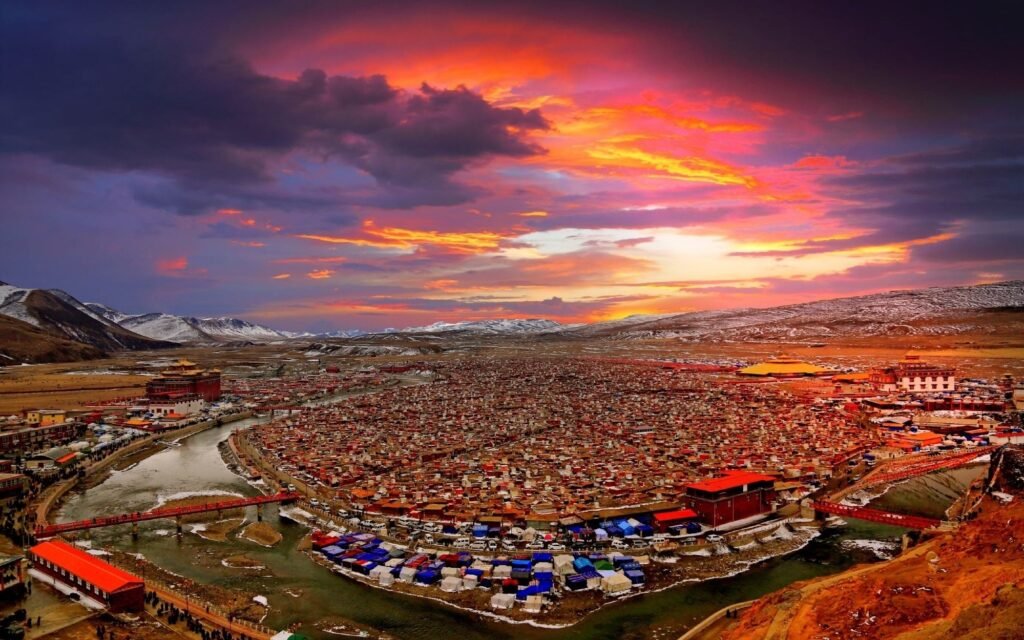
Yarchen Gar (Yaqing Monastery): The City of Nuns in Baiyu
Yarchen Gar, officially known as ཡ་ཆེན་ཨོ་རྒྱན་བསམ་གདན་གླིང་།, has gradually grown into a vast monastic settlement often called the “City of Nuns.” Located in Baiyu County, this remarkable place is one of the most unique spiritual destinations in Kham.
Founded in 1985, Yarchen Gar does not share the centuries-old history of many Tibetan monasteries. Yet, driven purely by faith, it has rapidly developed into a large and powerful spiritual community. What draws travelers here is not only its association with the teachings of Dzogchen master, but more deeply, the devoted and simple lives of the nuns who live and practice here.
A Landscape of Devotion and Simplicity
Yarchen Gar is set on a flat highland wetland. At its center lies a small island densely covered with simple wooden huts, where practitioners live and meditate. The Changqu River flows around the island, forming a natural circular boundary. In Tibetan Buddhist tradition, such a river-encircled landscape is considered especially sacred.
Despite its spiritual importance, living conditions here are basic. There are no well-developed roads, no modern housing, and limited infrastructure. Transportation is difficult, and resources are scarce. Most daily work—from carrying supplies to constructing huts—is done by the nuns themselves, reflecting a life of discipline and dedication.
Palyul Monastery
Baiyu Monastery, (དཔལ་ཡུལ་དགོན་པ།) officially known as “Palyul Namgyal Jangchub Choling Monastery” is one of the most important Nyingma monasteries in Kham. It was founded in 1675, by the master Khenchen Sherab Özer. Arriving in Baiyu County town (Jianshe Town), visitors can first explore Baiyu Monastery, located on a hillside north of the town.
Historically, it was one of the five major monasteries supported by the Derge Kingdom. Like Derge’s Gonchen Monastery, Palyul Monastery holds a significant place in the religious landscape of the region.
Perched on the hillside, the monastery offers wide views over the town. At sunrise and sunset, the golden light enhances its peaceful atmosphere. Daily chanting and ritual sounds fill the air, creating a quiet yet powerful spiritual presence.
Katok Monastery: A Center of Nyingma Tradition
Located about 51 kilometers north of Baiyu County in Hepo Township, Katok Monastery is one of the most influential monasteries of the Nyingma school.
Founded in 1159, by the master Dampa Deshek, the monastery takes its name from a natural Tibetan letter “Ka” formed in the white rock cliffs behind it.
Inside the monastery, visitors are often struck by the large mandala structure at its center. The roof is decorated with over 100 kilograms of gold and surrounded by detailed sculptures. Within the mandala are statues of King Gesar and various Buddhas, all finely crafted.
Katok Monastery also houses a rich collection of historical artifacts, including weapons and imperial gifts from the Yuan, Ming, and Qing dynasties.
Hepo Township and Tibetan Craftsmanship
The journey to Katok Monastery passes through dramatic landscapes, including the Jinsha River and Zhenqu River valleys. Along the way lies Hepo Township, known for its long tradition of weapon-making.
Since the Tang dynasty, this area has been associated with craftsmanship. With the establishment of Katok Monastery, skilled artisans from inland China further developed local techniques. Historically, many Tibetan firearms used in Derge and Chamdo were produced here.
Today, Hepo Township is best known for forging traditional Tibetan knives. However, fewer artisans continue this craft, as many residents now turn to collecting caterpillar fungus for income.
Changqing chongdu White-Lipped Deer Nature Reserve
Set within the Hengduan Mountains, the Changqingchongdu National Nature Reserve is a unique ecological area combining forests, wetlands, and alpine meadows.
It is the first national-level reserve in China named after the white-lipped deer and is home to over 1,200 individuals of this species. Visitors may witness herds gathering near rivers, especially in quieter areas.
The reserve also includes the Magongga Glacier, the second-largest glacier in Garzê Prefecture, along with scattered highland lakes and grasslands. At an average altitude of around 4,400 meters, it supports more than 50 protected animal species, including leopards, black-necked cranes, and blue sheep.
Located about 40 kilometers from Baiyu County town, access to the reserve is carefully managed. Tourism activities are limited to designated experimental zones. The best time to visit is between June and September, when the landscape is most vibrant.
Lansong Lake: A Hidden Highland Gem
Lansong Lake lies deep within Baba Valley in Baiyu County. Its striking color comes from dissolved calcium carbonate minerals, which give the water a vivid, almost surreal blue under sunlight.
The journey to the lake passes through dense forests and rugged peaks. When the lake finally appears, it reflects snow mountains and trees like a mirror, creating a powerful visual impact.
This remote destination remains largely untouched, offering a sense of pure quiet. Visitors can relax by the lakeside, enjoy a simple picnic, or explore the water by kayak.
Due to the rough mountain roads, a four-wheel-drive vehicle is recommended. The altitude is around 3,700 meters, and mobile signal is weak, so preparation is essential. Travelers are advised to carry offline maps, sufficient supplies, and take all waste back to preserve the natural environment.
Local Specialties
Baiyu is known for a wide range of traditional and high-altitude products. Hepo Tibetan knives are a nationally recognized geographical indication product, known for their durability and craftsmanship developed over centuries.
- Changtai yak products include dried yak meat, fresh meat, and dairy products, all certified as organic.
- Quinoa and snow chrysanthemum grown in the region are valued for their nutritional and medicinal properties.
- Highland barley is processed into tsampa, barley wine, pastries, and fermented drinks.
- The region also produces medicinal herbs such as cordyceps and fritillaria, along with wild mushrooms like matsutake and Sarcodon.
- Traditional crafts include Tibetan metal ritual items, horse gear, carpets, and incense.
Transportation Overview
Road travel is the only way to access Baiyu County. Major routes include G215 and S314 (Ganbai Road), which is considered one of the most scenic county roads in China. The distance from Baiyu to Gesar Airport is about 120 kilometers via S458, while distances to Kangding and Chengdu are approximately 622 km and 998 km respectively. Travelers should be cautious, as winter roads can be icy and landslides may occur during the rainy season.