

Guandi Temple, known locally as Gesar Lhakhang (格萨尔拉康), is one of the most distinctive historical and religious sites in Lhasa. More than a place of worship, it represents a rare and vivid fusion of Han Chinese and Tibetan cultural traditions, shaped by history, politics, and spirituality. Located on Bamari Mountain, just west of the Potala Palace, the temple offers visitors a layered story that blends imperial history with Tibetan Buddhist belief.
A Brief History of Guandi Temple
Guandi Temple was built in 1791, following the Qing dynasty’s military assist to Tibet victory over the Gurkha (Nepali) forces. The temple was commissioned after General Fukang’an successfully help Tibet, marking a period of military alliance in the region.
While originally associated with military success, the temple gradually evolved into a religious and cultural landmark, reflecting the Qing court’s effort to integrate Han traditions with Tibetan society. Its Tibetan name, Gesar Lhakhang, links the Chinese deity Guan Yu with King Gesar, the legendary Tibetan epic hero, symbolizing a shared ideal of loyalty, bravery, and moral strength.
Architectural Marvel on Bamari Mountain
Guandi Temple stands out for its hybrid architectural design. The temple faces south, following traditional Han Chinese principles, yet its structure and decorative elements strongly reflect Tibetan aesthetics.
Exterior Design
- Solid Tibetan-style stone walls
- Roof covered with red glazed tiles
- Elegant flying eaves at the corners, enhancing its ceremonial grandeur
This combination creates a visual harmony rarely seen in Tibet, making the temple a valuable example of cross-cultural architecture.
Interior Structure
The main hall features a traditional Chinese lifted-beam framework, a construction technique commonly found in imperial buildings of the Central Plains. The contrast between interior structure and exterior style highlights the intentional blending of architectural traditions.
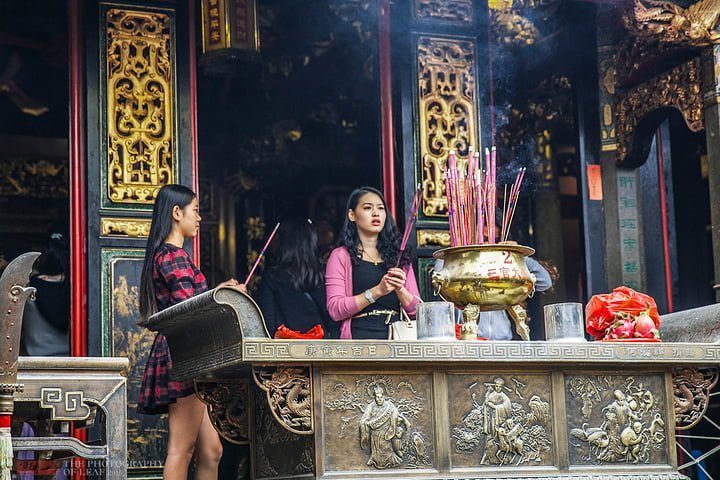
Inside the Main Hall: Guan Yu as Gesar Gyalpo
Stepping into the main hall, visitors are immediately drawn to the commanding statue of Guan Yu, the legendary general from the Three Kingdoms period. He stands tall, holding his iconic guandao, embodying loyalty, righteousness, and courage.
Beside him is Zhang Fei, his sworn brother, portrayed with a fierce and powerful expression. Among local Tibetans, Guan Yu is respectfully called “Gesar Gyalpo”, equating him with King Gesar and reinforcing the shared heroic values between Han and Tibetan cultures.
The Buddha Hall (Jamyang Lhakhang)
Behind the main hall lies the Buddha Hall, known in Tibetan as Jamyang Lhakhang, dedicated to Manjushri, the Bodhisattva of Wisdom.
Sacred Statues Inside
- Manjushri at the center, symbolizing wisdom and insight
- Vajrapani, representing spiritual power
- Thousand-Armed Avalokiteshvara, embodying compassion
Although the hall reflects Han architectural influence, the statues themselves are unmistakably Tibetan in style, demonstrating how Buddhist art transcended political boundaries and became deeply localized.
A Living Symbol of Cultural Integration
Guandi Temple’s transformation—from a monument of military victory to a deeply spiritual site—mirrors the broader integration of Han and Tibetan traditions. It stands as physical evidence of historical dialogue, religious exchange, and cultural adaptation that shaped central Tibet during the Qing dynasty.
Today, the temple is both a place of devotion and a historical archive, offering insight into how different belief systems and artistic traditions coexisted and enriched one another.
Exploring the Unique Features of Guandi Temple
Beyond its main halls, Guandi Temple holds several unusual and fascinating details that intrigue visitors and researchers alike.
Fascinating Totems on the Outer Walls
Near the roofline on the outer walls, visitors may notice rare fertility totems depicting reproductive symbols. These elements are unusual for a temple setting and reflect ancient folk beliefs connected to life, protection, and prosperity, adding another layer of cultural depth.
The Guandi Temple Stele
Just inside the main gate stands the “New Guandi Temple Stele of Mopan Mountain”, erected in 1793.
- Height: 2.92 meters
- Width: 1.17 meters
- Thickness: 0.29 meters
The stele is carved with two dragons playing with a pearl and inscribed with characters meaning “Eternal Prosperity.” It records the Qing military campaign against the Gurkhas and the construction of the temple, making it an important historical document as well as a fine example of Qing-era stone carving.
Visitor Tips and Local Customs
The Magical Stone Wall
At the corner of Deji Middle Road, below the temple, stands a blackened stone wall polished smooth by generations of visitors. Locals believe rubbing against it can relieve leg pain and improve circulation. Whether viewed as faith or folklore, it remains a popular ritual among pilgrims.
Releasing Chickens at the Temple
One of the most charming customs at Guandi Temple is the practice of releasing chickens. Local Tibetans bring chickens to the temple grounds and set them free as an act of compassion and merit-making. As a result, it’s common to see chickens wandering freely around the temple, adding a uniquely peaceful and humane atmosphere.
Why Guandi Temple Is Worth Visiting
Guandi Temple offers far more than sightseeing. It provides a window into Sino-Tibetan history, religious coexistence, and living traditions that continue to shape local life. From its blended architecture and sacred statues to its unusual totems and heartfelt customs, the temple remains one of Lhasa’s most quietly compelling cultural landmarks.