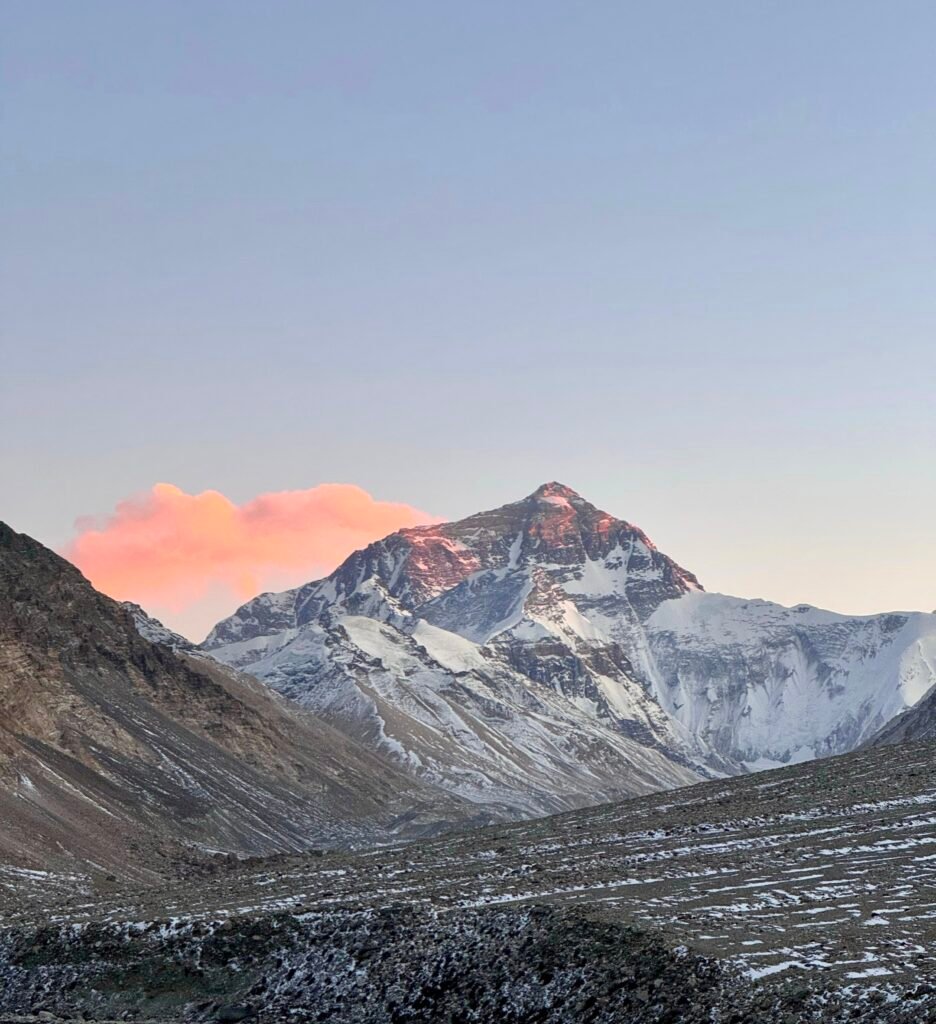
Mount Everest, known variously as Qomolangma and Sagarmatha, stands not just as a geographical boundary between China and Nepal, but as a cultural nexus and the ultimate symbol of human endeavor. At a staggering 8,848.86 meters, it is the Earth’s highest point, officially measured jointly by China and Nepal in 2020.
The mountain Qomolangma (རི་བོ་ཇོ་མོ་གླང་མ་) has an elevation of 8,848.86 meters. This mountain is located on the border between Dingri in Tibet and Nepal within the Himalayan range .
This snowy mountain is recorded as Miyo Langsang Ma (མི་གཡོ་གླང་བསང་མ་) in the Rongpu scriptural texts. It is widely known that the Sherpas call it Jomo Lhanga (ཇོ་མོ་ལྷ་ལྔ་), and it is believed that the name Jomolangma is a mispronounced or phonetic simplification of this Tibetan phrase.
Other names (synonyms) include Jomo Lozang (ཇོ་མོ་བློ་བཟང་) or Lo Salma (བློ་གསལ་མ), Jomo Gangkar (ཇོ་མོ་གངས་དཀར་), Jomo Gangchen (ཇོ་མོ་གངས་ཅན), and Gang Gyalmo Thonthing (གངས་རྒྱལ་མོ་མཐོན་མཐིང་) or Gang Thonthing Gyalmo (གངས་མཐོན་མཐིང་རྒྱལ་མོ་).
Geographic Majesty and Dual Ownership
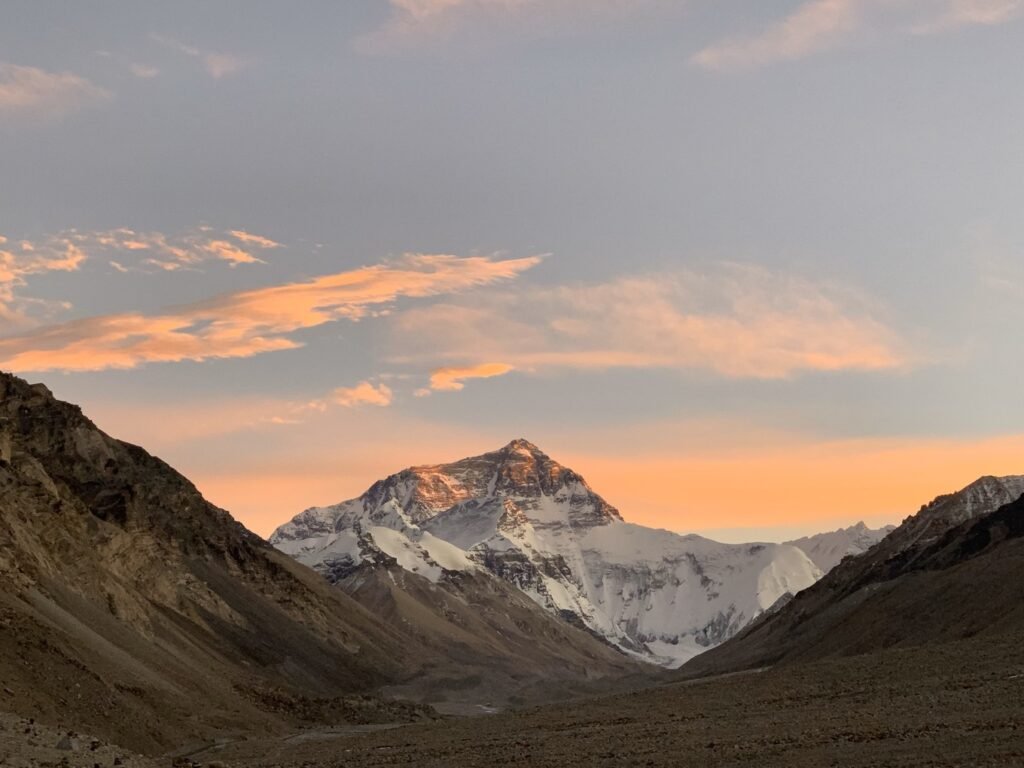
Everest is an integral part of the Himalayas, the world’s highest mountain range. Its towering bulk forms a border peak, dividing its immense slopes and cultural significance between two nations.
| Aspect | Chinese / Tibetan Side (North Slope) | Nepali Side (South Slope) |
| Administrative Belonging | Dingri County, Xigaze, Tibet, China | Nepal |
| Slope Feature | Steep (average gradient over 45circ), offering a more technically demanding climb. | Relatively Gentle, which was the route of the historic first summit. |
| Glacier Coverage | Extensive, covering approximately 1,500 square kilometers across the region. |
The peak’s geography dictates different challenges and experiences for climbers and travelers on each side, from the challenging North Slope to the slightly more accessible South Slope.
The Names of the Goddess: Cultural Etymology
The many names of Everest are a testament to its spiritual importance across different cultures, with all names relating to the divine feminine.
The Goddess Peak: Jomolangma
- Language: Tibetan
- Meaning: Goddess Peak.
- Cultural Context: In Tibetan Buddhism, the mountain is a sacred site and is revered by the local populace as a “Holy Mountain.”
The Goddess of the Sky: Sagarmatha
- Language: Nepali.
- Meaning: “Goddess of the Sky.”
- Cultural Context: This name is used in Nepal and is recognized globally as the mountain’s Nepali identity, highlighting its connection to the heavens.
English Name : Mount Everest
The English name Mount Everest was assigned in 1865 in honor of Sir George Everest, despite his objections. Before that, it was known simply as Peak XV in British surveys.
Geographic Setting of Mount Everest
Mount Everest is located in the Mahalangur Himal sub-range of the Himalayas, directly on the border between Nepal and China (Tibet Autonomous Region). The summit itself marks the international boundary, with Nepal’s Solukhumbu District to the south and China’s Tingri County (Xigazê) to the north.
Geologically, Everest was formed during the collision of the Indian and Eurasian tectonic plates in the Cenozoic era. This collision is still active today. The mountain continues to rise by approximately 2 millimeters per year, while shifting northeast due to tectonic movement along the Main Himalayan Thrust.
The mountain’s northern side slopes gently across the Tibetan Plateau, while the southern Nepalese side is steep and dramatic, featuring iconic landmarks such as the Khumbu Icefall, Western Cwm, and major glaciers like the Khumbu and Rongbuk Glaciers, all of which are retreating rapidly due to climate warming.
Geology and Mineral Composition
Mount Everest is composed of three major geological formations:
- Qomolangma Formation (summit to ~8,600 m)
Ordovician limestone containing marine fossils such as trilobites and crinoids. - North Col Formation (7,000–8,600 m)
Includes the famous Yellow Band, made of Cambrian marble, schist, and phyllite. - Rongbuk Formation (below 7,000 m)
Dominated by schist and gneiss with granite intrusions formed 20–24 million years ago.
The summit limestone cap was officially recognized as a geological heritage site in 2022, highlighting Everest’s origin as ancient seabed uplifted to the roof of the world.
Flora and Fauna Around Everest
Life at extreme altitude is limited but remarkable. Above 5,500 meters, vegetation consists mainly of mosses, lichens, and cushion plants, with moss recorded as high as 6,480 meters, possibly the highest plant life on Earth.
Animal life includes extraordinary species such as:
- Euophrys everestensis, a jumping spider found up to 6,700 m
- Bar-headed geese, which migrate over the summit
- Yellow-billed choughs, seen near 7,900 m
Lower elevations support snow leopards, Himalayan tahr, red pandas, yaks, and black bears. Conservation is managed through Sagarmatha National Park (Nepal) and Qomolangma National Nature Reserve (China).
Historical, Scientific, and Economic Importance
Mount Everest symbolizes human endurance and exploration. The first successful ascent was achieved on May 29, 1953, by Sir Edmund Hillary and Tenzing Norgay. Since then, over 5,000 successful summits have been recorded, including record-holders like Kami Rita Sherpa.
Scientifically, Everest is vital for research into:
- High-altitude physiology and the “death zone”
- Plate tectonics and mountain building
- Atmospheric pollution and jet stream behavior
- Glacier dynamics and climate change
Economically, Everest is central to Nepal’s tourism industry, contributing nearly 8% of GDP before the pandemic. Climbing permits, which can cost $35,000 to over $200,000, fund infrastructure, healthcare, and education in remote Himalayan regions.
Geopolitical Dimensions
Everest’s location on the Nepal–China border has long carried geopolitical sensitivity. During 1960s boundary negotiations, a compromise placed the summit directly on the border, allowing access from both sides.
The mountain has three faces—two facing Tibet and one facing Nepal—resulting in two main climbing routes: the South Col (Nepal) and North Ridge (Tibet). Broader concerns include border management, Chinese investment in Nepal, and Tibet’s political status, all of which add layers of complexity to Everest’s governance.
Climate Change and Global Impact
Often described as a climate sentinel, Everest clearly shows the effects of global warming. The South Col Glacier has lost ice that once took thousands of years to form, disappearing in just a few decades. Melting glaciers increase the risks of floods, water shortages, and ecosystem disruption across the Himalayas.
At 1.5°C of global warming, scientists warn that up to half of the world’s glaciers could vanish, making Everest a powerful symbol of climate change impacts worldwide.
Tourism Challenges and the Future of Everest
While Everest tourism brings income and opportunity, it also creates serious challenges. Overcrowding, summit traffic jams, pollution, and waste have damaged fragile ecosystems. Tragically, more than 340 climbers have died, with many bodies remaining preserved in ice.
Efforts by Nepal and China—including waste cleanup campaigns and infrastructure improvements—aim to balance economic benefits with sustainability. However, debates continue over permit limits, safety, and environmental protection.
Historical Milestones and Modern Tourism
The history of Everest is defined by its first successful ascent, an event that reshaped the world’s perception of human limits.
The 1953 First Summit
On May 29, 1953, the world was changed when New Zealand explorer Edmund Hillary and his Nepali guide Tenzing Norgay successfully reached the summit. They achieved this historic feat via the South Slope (Nepal side), solidifying the route’s place in mountaineering legend.
Applying the History in Travel
- High-End Tourism: Travel services leverage this history by designing “Dual Slope Expeditions,” allowing tourists to experience the Tibetan culture of the North Slope and trace the steps of the 1953 first summit on the Nepali side (for serious climbers).
- Cultural Promotion: Multi-lingual materials, such as cultural posters featuring the Tibetan “Goddess Peak” and the Nepali “Sagarmatha,” are used to promote the dual cultural identity of this majestic peak in international forums.
Beyond the Summit: Key Facts and Future Vision
The Everest region offers crucial information for both academic study and practical planning.
| Data Category | Key Information | Application / Relevance |
| Best Climbing Season | April–May and September–October. | Essential for travel planning and expedition scheduling. |
| Chinese Side Highlights | Rongbuk Monastery (highest altitude monastery, best viewing point) and the North Slope Base Camp. | Key attractions for non-climbing tourists. |
| Bilateral Cooperation | China and Nepal are jointly developing a Cross-Border Tourism Cooperation Zone. | Highlights the mountain’s role as a symbol of cooperation and future infrastructure projects (e.g., the Lhasa-Kathmandu railway). |
These facts underscore that Everest is more than just a challenging climb; it is a center for high-altitude research, cultural pilgrimage, and international collaboration.