
George Bogle’s Mission to Tibet: The First British Diplomatic Journey Across the Himalayas
George Bogle was born in 1746 and became one of the earliest British diplomats to venture into Tibet. His life unfolded during the 18th century—a period of dramatic political and economic transformation in British India. As the British East India Company expanded its influence across the Indian subcontinent, attention increasingly turned toward the Himalayan region.
Tibet’s strategic location between India and China made it geopolitically significant. At the time, both Britain and Qing China sought influence across Asia. For the British, Tibet was not only a cultural mystery but also a potential gateway to trade routes leading into China and Central Asia.
Bogle’s mission in 1774 marked the first formal attempt by Britain to establish diplomatic relations with Tibet. His journey was ambitious: he aimed to open trade links, build political relationships, and gather intelligence about the broader Asian power landscape. What began as a diplomatic expedition would become a defining moment in early British-Tibetan relations.
Why Was George Bogle Sent to Tibet?
In 1774, Warren Hastings, then Governor-General of Bengal, appointed Bogle as an envoy to Tibet. Hastings recognized the region’s importance for trade and diplomacy. The British East India Company wanted:
- Access to trade routes linking India and China
- Commercial opportunities in wool, gold, and other regional goods
- Political intelligence regarding Qing China
- Influence in the Himalayan corridor
Bogle was selected due to his diplomatic skills, cultural sensitivity, and experience in India. Unlike many of his contemporaries, he understood that successful diplomacy required more than political negotiation—it required cultural understanding.
His mission objectives included:
- Establishing commercial ties
- Meeting Tibetan religious and political leaders
- Understanding Tibetan governance and society
- Assessing Qing influence over Tibet
This multi-layered mission reflected Britain’s growing geopolitical ambition in Asia.
Crossing the Himalayas: A Diplomatic Adventure
The journey to Tibet was physically and politically challenging. Bogle had to cross the Himalayan foothills—rugged terrain marked by unpredictable weather, high mountain passes, and limited infrastructure.
The journey was not simply geographical—it was diplomatic. Along the way, Bogle interacted with local communities, navigated complex regional alliances, and encountered suspicion from Qing officials who monitored foreign activity in Tibet.
The Qing Empire viewed Tibet as falling under its sphere of influence. Any British envoy entering the region was therefore treated cautiously. Bogle had to balance diplomacy with discretion, ensuring that his mission did not provoke political tensions.
Despite the challenges, his perseverance allowed him to reach his destination: one of Tibet’s most important religious and political centers.
Arrival at Tashilhunpo Monastery
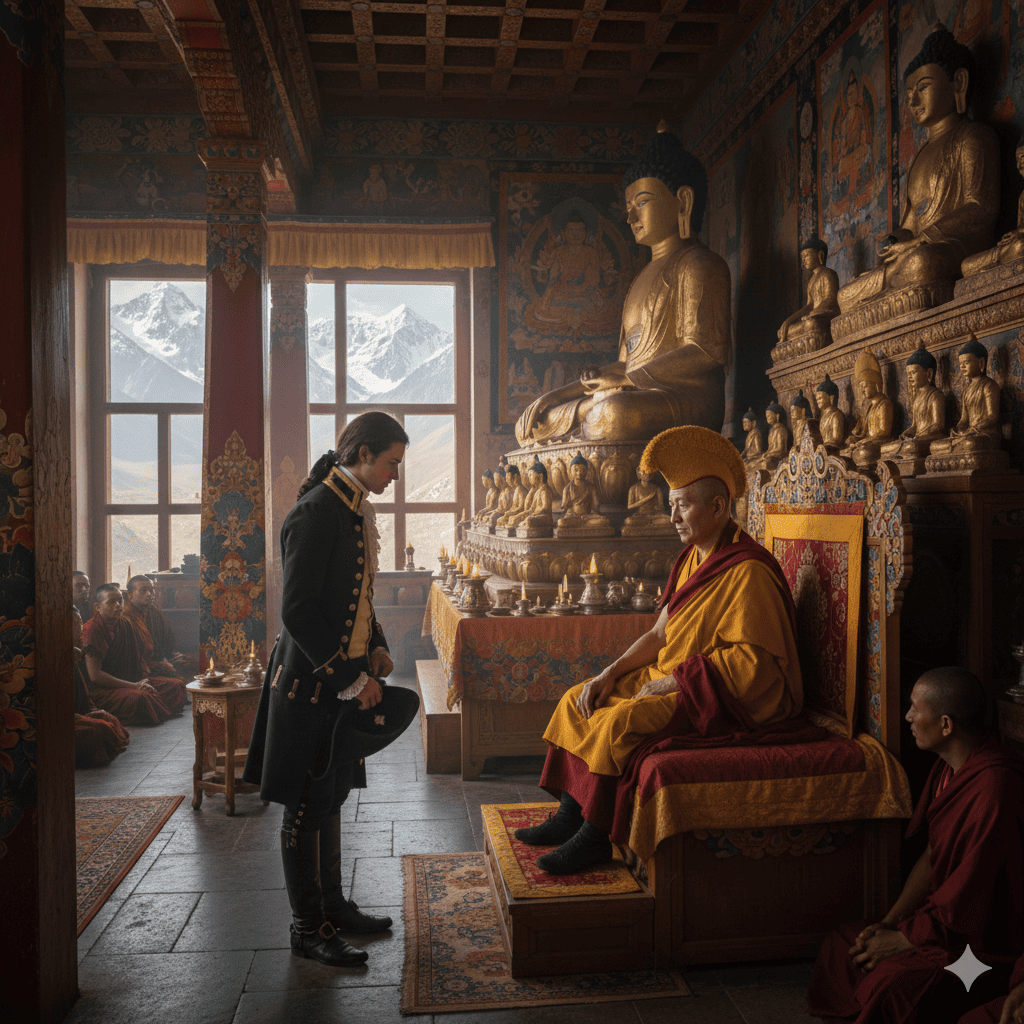
Bogle’s arrival at Tashilhunpo Monastery marked a turning point in his mission. Located in Shigatse, Tashilhunpo was the seat of the Panchen Lama and a major center of Tibetan Buddhism.
The monastery was more than a religious institution—it was a political hub where spiritual authority and governance intersected. Understanding this dual structure was crucial for Bogle’s diplomatic success.
At Tashilhunpo, Bogle observed:
- The integration of religion and state authority
- Monastic administration and governance
- Ritual practices central to Tibetan society
- The influence of Buddhist leaders in political decisions
His ability to show respect for Tibetan customs helped build trust—an essential element for diplomatic dialogue.
Friendship with the Sixth Panchen Lama
One of the most remarkable aspects of Bogle’s journey was his relationship with Lobsang Palden Yeshe, the Sixth Panchen Lama.
Their friendship became the heart of the mission.
The Panchen Lama was a highly respected spiritual leader in Tibetan Buddhism. Through conversations and personal exchanges, Bogle gained invaluable insights into:
- Tibetan religious philosophy
- Governance structures
- Social hierarchy
- Relations between Tibet and Qing China
Unlike purely transactional diplomacy, this relationship was built on mutual curiosity and respect. Bogle admired Tibetan culture, while the Panchen Lama showed genuine interest in British customs and political structures.
This bond helped soften suspicion toward British intentions and demonstrated a new diplomatic approach—one rooted in cultural understanding rather than dominance.
Documenting Tibetan Society for Europe
Bogle meticulously recorded his observations in journals and letters. These writings became some of the earliest detailed European accounts of Tibet.
His documentation covered:
- Religious rituals and monastic life
- Social customs and traditions
- Political structures
- Trade practices
- Geography and travel conditions
For European audiences, Tibet had long been a mysterious and mythologized land. Bogle’s writings helped replace speculation with observation.
His accounts shaped early Western perceptions of Tibetan Buddhism and governance. Scholars today view his journals as foundational documents in the history of Western engagement with Tibet.
Goals vs. Outcomes: Did the Mission Succeed?
Original Goals:
- Establish formal trade routes
- Open diplomatic relations
- Expand British influence
Actual Outcomes:
- No immediate formal trade treaty
- Limited commercial development
- Strong personal diplomatic connections
- Foundational knowledge for future engagement
The Tibetan government remained cautious about formal agreements. Infrastructure and political realities limited immediate trade expansion.
However, the mission succeeded in a different way—it created trust, dialogue, and knowledge.
Bogle’s expedition laid the groundwork for future British missions to Tibet and informed British strategy in the Himalayan region during the 19th century.
The Long-Term Legacy of George Bogle
George Bogle became the first official British envoy to Tibet, setting a precedent for later diplomatic efforts.
His legacy includes:
- Establishing early British-Tibetan dialogue
- Providing detailed documentation of Tibetan society
- Introducing a culturally sensitive model of diplomacy
- Influencing British Himalayan policy
Later British diplomats and explorers relied heavily on the framework Bogle created. His writings remained reference materials for decades.
More importantly, his mission demonstrated that diplomacy in Asia required cultural literacy and patience—not merely political ambition.
Early British-Tibetan Relations: A Turning Point
Bogle’s expedition marked the beginning of formal British engagement with Tibet. While the mission did not achieve immediate economic dominance, it transformed how Britain approached the region.
Key historical impacts include:
- A shift from speculation to informed understanding
- Greater European awareness of Tibetan Buddhism
- The beginning of structured British interest in Himalayan geopolitics
- A model for cross-cultural diplomacy
His journey highlights an important lesson in international relations: meaningful diplomacy depends on respect, curiosity, and the willingness to understand different worldviews.
George Bogle’s expedition was more than a political mission—it was the first bridge between two distant worlds, built across some of the highest mountains on earth.