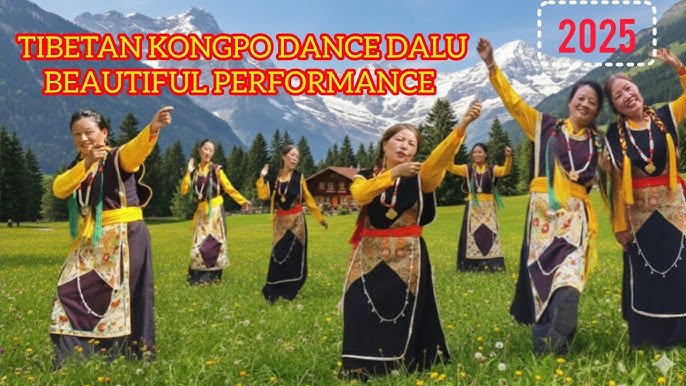
The Kongpo Nyingchi dance “Bo”, also known as Kongpo Nyingchi Cheba Bo and commonly called the Nyingchi Dance, is one of the most vibrant and expressive traditional dances of eastern Tibet. Deeply rooted in the daily life and spiritual world of the Kongpo people, this dance blends song, movement, and community participation into a powerful cultural performance. Often compared to the famous Gorshey dance, Kongpo Nyingchi Bo carries its own regional charm, rhythm, and symbolic meaning.
What Is Kongpo Nyingchi Qieba Bo?
Kongpo Nyingchi Qieba Bo is a large-scale circle dance that can involve anywhere from a dozen dancers to several hundred participants. Both men and women dance together freely, reflecting the open and communal nature of Kongpo culture.
The dancers usually form a wide circle:
- Men on one side and women on the other
- Or alternating male and female circles
At the front of each group stand the “bo ben”, the lead dancers and organizers who guide the rhythm, songs, and movement of the entire performance.
Singing and Rhythm: From Gentle Beginnings to Lively Climaxes
A defining feature of the Kongpo Nyingchi Bo dance is its alternating rhythm, shifting smoothly between slow and fast sections.
Slow Rhythm: Song Without Dance
In the slow phase, performers sing without dancing. These songs are often calm and expressive, praising:
- Snow-capped mountains
- The beauty of the homeland
- Religious devotion
- Love and human emotion
The melodies are gentle, creating a peaceful and almost meditative atmosphere.
Fast Rhythm: Dance, Dialogue, and Energy
As the performance builds, it transitions into a fast rhythm. Here, men and women engage in call-and-response singing while dancing, with movements becoming quicker and more energetic. During the climax, the pace accelerates, emotions rise, and improvised lyrics and movements may appear, adding excitement and creativity to each performance.
Traditional Costumes and Props of Kongpo Nyingchi Bo
The visual beauty of Kongpo Nyingchi Qieba Bo is enhanced by its distinctive traditional attire and symbolic props, which reflect the lifestyle of the Kongpo people.
Men’s Costume
- Gyazha felt hat
- Gushu Tibetan robe
- Zomba tall leather boots
- A Long earring worn on the left ear
- Badri long knife tucked into the belt
- Shujan (decorative cloth or streamer) held in the left hand
Women’s Costume
- Suolin Zhamo small hat
- Gushu sleeveless robe
- Jargo decorative waist belt
- A Long small earrings
- Sisha necklaces
- Zomba women’s boots
- Dada colorful arrows held in the left hand
These costumes are not only decorative but also express identity, social values, and regional aesthetics.
Dance Movements and Performance Style
The movements of Kongpo Nyingchi Bo are both simple and expressive, making the dance accessible while still visually captivating. Common steps and gestures include:
- Stepping forward in rhythm
- Swinging the arms naturally
- Small jumps with lifted legs
- Stomping steps and kicking motions
- Inclined palm support movements
- One-step-at-a-time walking patterns
- Waving flags or streamers with the wind
Style Characteristics
- Slow rhythm: gentle, graceful, and flowing
- Fast rhythm: lively, cheerful, and full of energy
This contrast between calm elegance and joyful excitement gives Kongpo Nyingchi Bo its unique emotional depth.
Cultural Meaning and Living Heritage
The Kongpo Nyingchi dance Bo is more than entertainment—it is a living expression of community life, celebrating nature, belief, love, and unity. It is often performed during festivals, gatherings, and important social occasions in the Nyingchi region.
Intangible Cultural Heritage Status
- Nyingchi Kongpo “Cheba Bo” was officially included in the fourth batch of autonomous region-level intangible cultural heritage of Tibet, highlighting its cultural importance and the need for preservation.
Kongpo Folk Songs: A Rich Musical Tradition
Closely connected to Kongpo Nyingchi Bo are the Kongpo folk songs, which were also included in the same heritage list. These songs appear in many forms, such as:
- Drinking songs
- Pastoral songs
- Love duets
- Working songs
- Arrow songs
- Nursery rhymes
- Performances accompanied by the six-stringed qin
Types of Kongpo Folk Songs
Based on melody and singing style, they are commonly classified as:
- Lu – mountain songs
- Shey – circle songs and dances
- Dashey – arrow songs
- Dro or Bo – Gorshey-style dances
- Nyaba Shey – fishermen’s songs
The lyrics are rich, diverse, and deeply connected to everyday life on the Tibetan Plateau.