
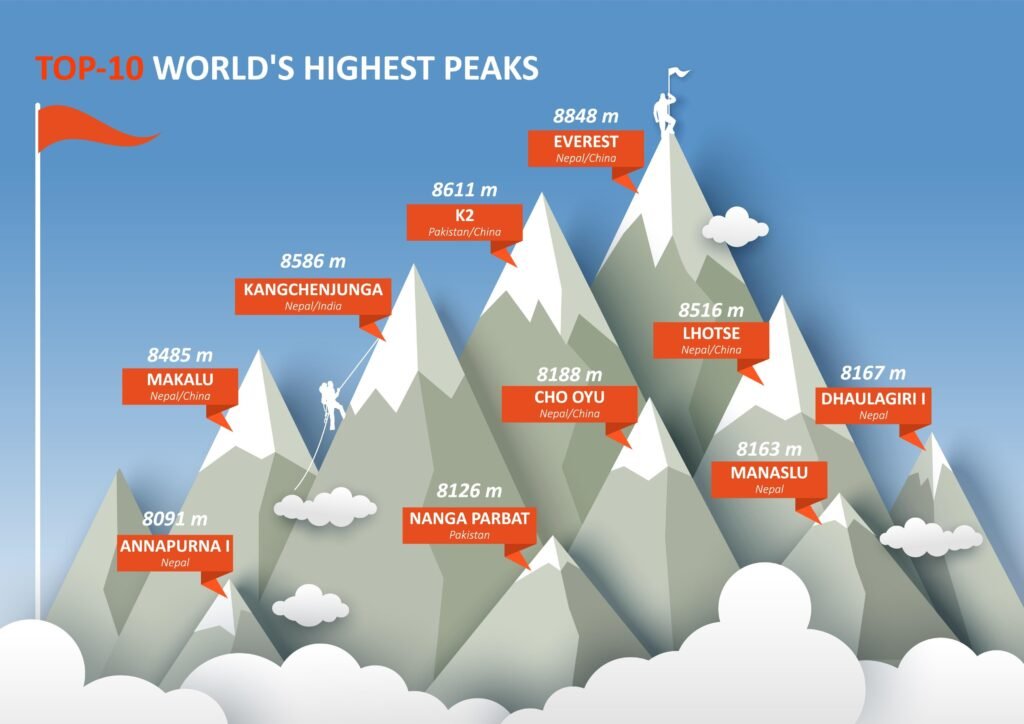
At 8,611 meters, Qogir Feng—better known globally by its mountaineering codename, K2—stands as the world’s second-highest peak and the crowning jewel of the Karakoram Range. Widely regarded as the most difficult and dangerous of all eight-thousanders. Rising dramatically in the heart of the Karakoram Range, K2 is famed for its extreme steepness, unpredictable weather, and formidable climbing challenges—earning it the legendary nickname “The Savage Mountain.”
This mountain is the highest peak in the Karakoram range and is located on the border between Xinjiang (China) and Pakistan. The name of this snowy mountain is said to mean “High and Majestic” in the Tajik language. Because there is a Tibetan ethnic group living on the southern side of the mountain, it is also understood in Tibetan to mean “White Goddess” (Lhamo Karpo) ཇོ་མོ་དཀར་པོརི or “White Lady” (Jomo Karpo).
Mythical and Cultural Significance
Among the Balti people of Gilgit-Baltistan, K2 is revered as a sacred guardian mountain, symbolizing isolation, strength, and spiritual power. Its inaccessibility has long fueled local myths portraying it as an untouchable spirit realm.
In broader mountaineering culture, K2 is often called:
- “The Savage Mountain” (coined by climber George Bell, 1953)
- “The King of Mountains”
- “The Mountaineers’ Mountain”
While not central to Tibetan religious lore like Everest, K2 gained pan-Himalayan symbolic importance after the historic all-Nepali winter ascent in 2021, which transformed it into a symbol of indigenous Himalayan excellence. In Pakistan, K2 appears on stamps, artwork, and national imagery as a symbol of resilience and pride.
Geographic Setting
Mount K2 lies in the northwestern Karakoram Range, directly on the border between Pakistan and China:
- South: Gilgit-Baltistan (Pakistan, administered Kashmir)
- North: Xinjiang Uyghur Autonomous Region (China)
The summit marks the international boundary. The famous Abruzzi Spur, the standard climbing route, lies on the Pakistani side, while the North Ridge faces China.
K2 is exceptionally steep, with over 3,200 meters of vertical rise in just 3,000 meters horizontally, giving it one of the greatest reliefs on Earth. Major geographic features include the Godwin-Austen Glacier, the Baltoro Glacier, and neighboring Broad Peak. Meltwater from K2 feeds into the Indus River system, critical for downstream agriculture.
The Border Peak: China and Pakistan
| Aspect | Chinese / Tibetan Side (North Slope) | Pakistani Side (South Slope) |
| Administrative Belonging | Taxkorgan County, Xinjiang, China | Gilgit-Baltistan, Pakistan |
| Cultural Link | Sacred to the Tajik communities who inhabit this region of Xinjiang. | Revered by the Balti nomadic communities. |
| Access Point | Requires travel via the Karakoram Highway (G314) from Kashgar. | Accessed via Islamabad to Gilgit, then road and trekking. |
The Codename and Its Meaning
K2 carries two powerful names:
- Codename K2: This is its original designation from the 19th-century British survey, meaning the 2nd (2) peak surveyed in the Karakoram.
- Jowo Karpori (乔戈里峰) Qogir: The name comes from the Tibetan language, translating to “White Goddess.” This traditional name contrasts sharply with its fierce modern reputation.
II. The Ultimate Test: K2’s Core Features
K2 is universally recognized as the most difficult of all 8,000-meter peaks. Its reputation as the “Savage Mountain” is earned through extreme conditions and treacherous terrain.
Mountaineering Peril
- Difficulty: K2 is one of mountaineering’s “Three Killers,” boasting a summit fatality rate exceeding 25%, making it deadlier than Mount Everest.
- Terrain: The mountain is a dramatic, steep-sided pyramid with an average gradient over 50 and is riddled with dangerous crevasses and ice features.
- Climate: The summit’s annual average temperature is a brutal -30, subjected to frequent, high-velocity blizzards and hurricane-force winds (up to 20 grades). The only feasible climbing window is a short period in July and August.
Historical Ascent
The first successful summit was achieved relatively late—on July 31, 1954, by an Italian team led by Ardito Desio, with climbers Lino Lacedelli and Achille Compagnoni reaching the top from the South Slope.
Geology and Mineral Composition
K2 is built primarily from the Karakoram Metamorphic Complex, dominated by high-grade gneiss formed from ancient granitic rocks buried deep during the India–Asia collision.
Key geological features include:
- Orthogneiss and paragneiss
- Marble layers with garnet and diopside
- Leucogranite intrusions
- Lamprophyre dikes on western flanks
Common minerals include quartz, feldspar, biotite, hornblende, garnet, clinopyroxene, and graphite. Rapid uplift has exposed deep crustal rocks, making K2 a critical site for studying mountain building and tectonic processes.
Flora and Fauna of the K2 Region
No vascular plants grow on K2 itself. Life above 5,000 meters is limited to lichens, mosses, and algae. Lower elevations along the Baltoro Glacier support sparse alpine vegetation such as cushion plants, dwarf junipers, and rhododendrons.
Wildlife in surrounding valleys includes:
- Snow leopards
- Himalayan ibex and markhor
- Pikas and marmots
- Himalayan griffon vultures and choughs
The region is protected under Central Karakoram National Park (Pakistan) and conservation zones in western China.
Historical, Scientific, and Economic Importance
Climbing History
- 1954: First ascent by Italian climbers via the Abruzzi Spur
- 2021: First winter ascent by a team of 10 Nepali Sherpas, without supplemental oxygen
- K2 historically had a fatality rate near 25%, making it the deadliest major peak
Scientific Value
K2 contributes to research on:
- High-altitude physiology and hypoxia
- Jet stream–driven storms
- Glacier dynamics and tectonic uplift
Economic Impact
K2 climbing generates $10–15 million annually for Pakistan through permits, logistics, and porter employment, significantly supporting the Skardu and Baltoro regions.
Geopolitical Significance
K2 sits within Gilgit-Baltistan, a region disputed between Pakistan and India, while bordering China. The 1963 Sino-Pakistani boundary agreement fixed the border at K2’s summit—an arrangement India does not recognize.
Strategically, K2 overlooks glacier-fed headwaters vital to the Indus Basin, making it geopolitically sensitive. Infrastructure such as the Karakoram Highway further links the mountain to broader regional politics.
Climate Change and Global Impact
K2’s glaciers are now retreating at 0.5–1 meter per year, accelerated by rising temperatures and black carbon pollution. The Godwin-Austen and Baltoro Glaciers have lost around 10% of their mass since 2000, increasing risks of avalanches and glacial lake outburst floods.
These changes threaten water security for over 300 million people dependent on the Indus River and signal wider instability across the Himalayan–Karakoram region.
Tourism, Risks, and Sustainability
K2 attracts elite mountaineers, not mass tourism. The Baltoro Trek is one of the world’s most iconic high-altitude journeys, but overcrowding on the Abruzzi Spur, waste accumulation, and porter safety remain serious issues.
Recent initiatives—higher permit fees, cleanup campaigns, and local-led conservation—aim to balance economic benefits with environmental protection, though climate change continues to amplify risks.
Application: From Adventure Tourism to Cross-Border Projects
K2’s unique blend of cultural lore and extreme adventure provides a rich foundation for targeted projects.
1. Adventure Travel Promotion
- Chinese Side (North Slope): Focus on “K2 North Slope Seclusion Expeditions.” Key selling points include trekking to the Base Camp (4,200m) for observation, experiencing Tajik culture, and visiting the ancient Stone City of Taxkorgan.
- Pakistani Side (South Slope): Marketed for Extreme Mountaineering, offering guided attempts via the classic Abruzzi Spur route, requiring strict qualification and safety protocols.
- Core Slogan: “Challenge the World’s Second Highest Peak, Meet the ‘White Goddess’ of the Karakoram—K2, the ultimate mountaineer’s crucible.”
2. Cross-Border Collaboration
K2 can serve as a powerful central IP for China-Pakistan joint initiatives, emphasizing “K2 Ecological Protection and Cultural Heritage.”
- Projects: Joint environmental monitoring (glacier health), cultural corridor development showcasing Tajik and Balti art, and organized cross-border clean-up operations.
- Cultural Exchange: Host international forums on K2’s climbing history, featuring Chinese and Pakistani mountaineers, alongside displays of vintage gear and historical photos of the 1954 first ascent.
IV. Planning and Compliance Essentials
Given K2’s perilous nature, strict adherence to safety and environmental regulations is non-negotiable for any project or expedition.
- Compliance: On the Chinese side, climbers must apply for a High-Altitude Climbing Permit at least three months in advance and adhere strictly to designated activity zones.
- Environmental Protection: Both sides prohibit the use of non-degradable garbage, and expedition teams are typically required to pay an environmental deposit due to the fragility of the Karakoram ecosystem.
- Safety Warning: Due to the severe risks, it is mandatory to clearly communicate the three non-negotiable requirements for participants: Professional Qualifications, Peak Physical Condition, and Comprehensive Insurance Coverage.