
Lhasa Railway Station stands as one of the most remarkable transportation hubs in the world. Located on the legendary Qinghai–Tibet Railway, it connects the remote Himalayan region with major Chinese cities while offering travelers a dramatic introduction to the Tibetan Plateau.
At an elevation of around 3,641 meters above sea level, Lhasa Station ranks among the highest railway stations on Earth. Since opening in July 2006, it has transformed travel to Tibet, making the once-isolated region more accessible without sacrificing its cultural identity.
Blending traditional Tibetan architectural elements with modern engineering, the station is more than a transit point—it is often the first glimpse visitors get of Tibet’s unique atmosphere.
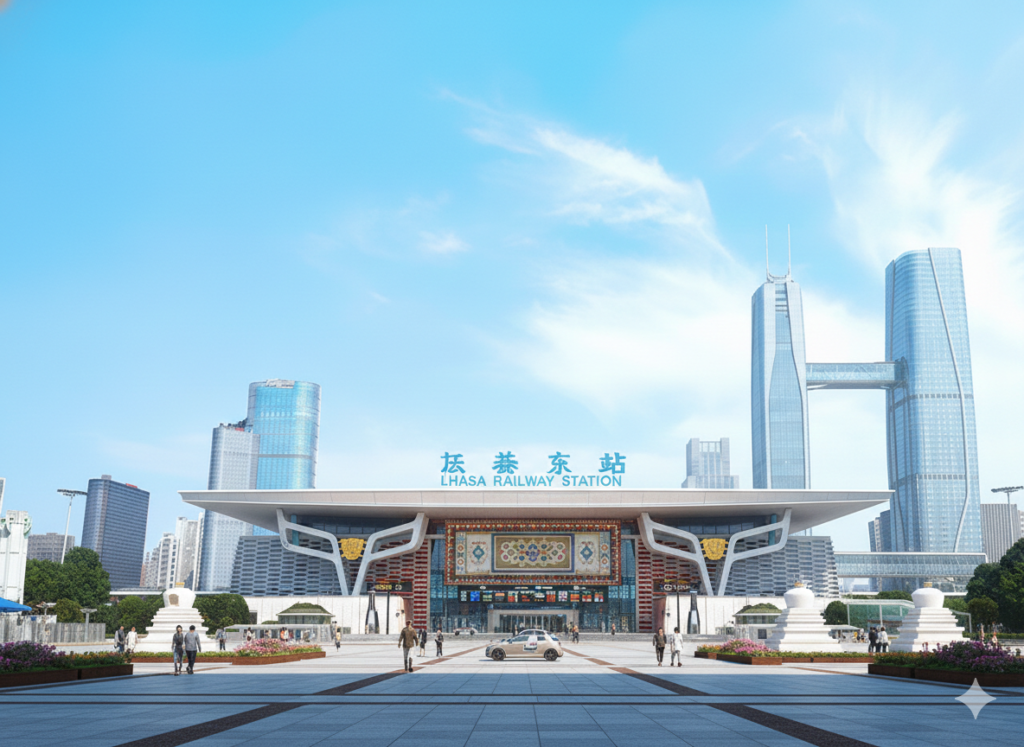
Overview of Lhasa Railway Station
Also known simply as Lhasa Station, this railway terminal serves as the primary gateway for rail travel into Tibet. It functions as the terminus of the iconic Qinghai–Tibet Railway and supports extensions deeper into the plateau, including routes toward Shigatse and Nyingchi.
Operated by China Railway under the Qinghai-Tibet Railway Group, the station manages both passenger and cargo services with a designed capacity of roughly 2,700 passengers per day.
Today, trains connect Lhasa with major cities such as: Beijing, Shanghai, Guangzhou, Chengdu. Special Z-series plateau trains are equipped with oxygen systems, ensuring safer and more comfortable travel in high-altitude conditions.
Location and Scenic Setting
Lhasa Railway Station is situated in the Liuwu (Niu New) Area of Doilungdêqên District, southwest of central Lhasa in the Tibet Autonomous Region.
Key Geographic Highlights:
- Approximately 1 km south of the Lhasa River
- Connected to downtown via the Liuwu Bridge
- Coordinates: 29°37′30″N 91°04′07″E
- Surrounded by scenic valleys and mountain landscapes
The location was carefully chosen to accommodate rail infrastructure while preserving the natural environment.
Distance to Potala Palace and City Center
Although the station is not directly inside downtown Lhasa, it is conveniently close to major landmarks.
Estimated distances vary slightly depending on the source:
| Destination | Distance | Travel Time |
|---|---|---|
| Potala Palace | 5–10 km | 15–30 minutes |
| Downtown Lhasa | Up to 10 km | 20–30 minutes |
Typical Transportation Costs:
- Public bus: About 1 yuan per person
- Taxi: Usually CNY 25–50
- Carpool minibus: Around CNY 10 per person
This short transfer allows travelers to quickly move from modern rail infrastructure into the historic heart of Tibetan culture.
Architectural Design and Construction
One of the most fascinating aspects of Lhasa Railway Station is its design philosophy—modern functionality wrapped in Tibetan aesthetics.
Architectural Features:
- Built along a hillside with a sloping structure that blends into the landscape
- Measures 340 meters long, 60 meters wide, and 22.9 meters high
- Covers approximately 23,600 square meters
Inside, visitors notice red-toned interiors, anti-slip stone flooring, and decorative tapestries portraying iconic Tibetan landmarks such as Potala Palace and Mount Everest. The station later received the prestigious China Building Construction Luban Award, recognizing its engineering excellence.
Eco-Friendly High-Altitude Engineering
Operating in a fragile plateau ecosystem required innovative solutions. One standout feature is that the entire building is heated using solar energy, helping reduce environmental impact and pollution. The structure also incorporates high-altitude adaptations and space for future expansion, including additional platforms and tracks.
Interior Layout: Three Levels of Efficiency
Lhasa Railway Station consists of three floors—two above ground and one underground—designed for smooth passenger flow. Entering the central hall often feels like stepping into an ancient Tibetan palace. Traditional motifs create a warm cultural atmosphere, while LED displays and escalators remind travelers they are in a modern facility.
| Level | Description | Key Facilities |
|---|---|---|
| First Floor | Entering the central hall feels like stepping into an ancient Tibetan palace, where traditional motifs blend with modern elements such as LED displays and escalators. | • Central hall• Ticket hall (west side)• Large soft-seat waiting room (southeast)• Ordinary Waiting Hall One• Ticket services for trains, flights, and long-distance buses |
| Second Floor | Designed for comfort and convenience, this level offers enhanced waiting areas and passenger amenities. A flyover connects travelers to the platforms and provides panoramic valley views. | • Shopping area with cafes and fast-food outlets• Waiting Halls Two and Three• Mother & Baby Waiting Room• Soldier Waiting Room• VIP rooms• Medical room with oxygen supply |
| Underground Level | Primarily dedicated to arriving passengers, this level ensures smooth exits through well-planned pathways. | • Arrival passages• Escalators• Efficient exit routes |
Track Layout and Capacity
The station features a sophisticated rail arrangement designed for growth.
Current infrastructure includes:
- Four tracks serving two island platforms
- Space reserved for an additional island platform
- Ten total tracks (eight passenger, two cargo)
- Seven waiting platforms with pillarless canopies
A large LED departure board displays information in Chinese, Tibetan, and Latin characters, ensuring clarity for international travelers.
Facilities and Passenger Services
Lhasa Railway Station prioritizes comfort, particularly for travelers adjusting to high altitude.
| Category | Description | Key Features |
|---|---|---|
| Waiting Areas | Designed to provide comfort for travelers, especially those adjusting to Tibet’s high altitude. | • Soft-seat waiting room (about 800 sq m)• Three VIP rooms totaling nearly 700 sq m• Ordinary waiting hall• Maternal and infant room• Soldier waiting room |
| Ticketing Services | Efficient ticketing system with multiple booking options for convenient travel planning. | • Over 10 ticket windows• LED schedule displays• Multi-transport booking options (train, flight, bus) |
| Shopping and Dining | A variety of food and retail choices enhance the station experience. | • Restaurants• Cafes• Retail shops• Convenience stores• Walls decorated with 3D renderings of Tibet’s famous attractions |
| Accessibility | Infrastructure ensures easy movement for all passengers. | • Escalators throughout the building• Luggage slides• Disabled-friendly facilities |
| Additional Services | Extra amenities improve convenience for both domestic and international travelers. | • Tourist information• Free Wi-Fi in some areas• Nearby bus terminal• Assistance from station staff• Complimentary shuttle services from some travel agencies |
The Station Square and Nearby Transport Hub
In front of the terminal lies a large plaza that acts as a transportation interchange.
East side: City bus parking lot
West side: Liuwu Long-distance Bus Station
From here, buses depart to destinations such as:
- Chamdo
- Shangri-La
- Zhangmu
- Ngari
- Kathmandu (Nepal)
Taxi stands are located just outside the exit, making transfers effortless.
Train Routes, Schedules, and Ticket Prices
Lhasa Railway Station handles a wide range of long-distance and regional routes.
Note: Schedules are for reference only and may change. Always check real-time availability before booking.
Major Train Routes from Lhasa
| Destination | Train No. | Duration | Soft Sleeper / Hard Sleeper (CNY) |
|---|---|---|---|
| Beijing West | Z22 | ~40h | 1,168 / 763 |
| Shanghai | Z166 | ~48h | 1,310.5 / 841.5 |
| Guangzhou | Z266 | ~55h | 1,526 / 919 |
| Chengdu | Z324 | ~36h | 1,101 / 709 |
| Chongqing North | Z224 | ~36h | 1,120 / 720 |
| Xi’an | Z166 / Z266 | ~33h | 1,005.5 / 647.5 |
| Xining | Multiple | ~21h | 815 / 530 |
| Lanzhou | Multiple | ~24h | 852 / 550 |
| Nanjing | Z166 | ~45h | 1,258.5 / 809.5 |
| Wuchang | Z266 | ~43h | 1,221 / 786 |
| Changsha | Z266 | ~47h | 1,293.5 / 832.5 |
| Shigatse | Z8801 / Z8803 | ~3h | 174.5 / 122.5 |
On average, the station manages about nine departures per day, though this varies seasonally.
City Transportation from Lhasa Railway Station
Getting around after arrival is straightforward thanks to buses, taxis, and shared vehicles.
| Category | Details | Key Information |
|---|---|---|
| Public Bus Routes | Affordable and reliable transportation connects the station to major parts of Lhasa. | Bus No. 1: Beijing Ave., Century Ave., Qinghai-Tibet Highway Monument, Fukang HospitalBus No. 6: Tibet Museum, Chakpori Hill Market, Tibet UniversityBus No. 13: Museum, Social Welfare Institute, North Suburban Coach StationBus No. 14: Liuwu Bridge, Norbulingka, Lhasa Restaurant |
| Taxi Options | Fast and convenient for reaching downtown or hotels. | • Metered taxi: About CNY 25• Typical negotiated fare: CNY 30–50• Tip: Confirm the fare beforehand, as many drivers prefer fixed pricing. |
| Didi & Shared Transport | Budget-friendly choices for solo travelers and small groups. | • Shared taxi: CNY 15–20 per person• Minibus carpool: Around CNY 10 per person |
Operational Insights
Rail travel to Tibet involves additional procedures compared to other regions.
Important Notes:
- Tibet travel permits are required for entry
- Security checks occur before boarding
- Oxygen-equipped trains help prevent altitude sickness
- Staff are trained to assist travelers unfamiliar with plateau conditions
Together, these measures ensure safe and organized operations.
Why Lhasa Railway Station Matters
Since its inauguration, Lhasa Railway Station has reshaped tourism and mobility across the Tibetan Plateau. What was once an arduous journey is now a scenic rail adventure accessible to travelers from across China and beyond.
The station successfully merges:
- Cultural authenticity
- Environmental awareness
- Advanced engineering
- Passenger comfort
For many visitors, stepping off the train here marks the beginning of a life-changing journey into one of the world’s most spiritually rich regions.