
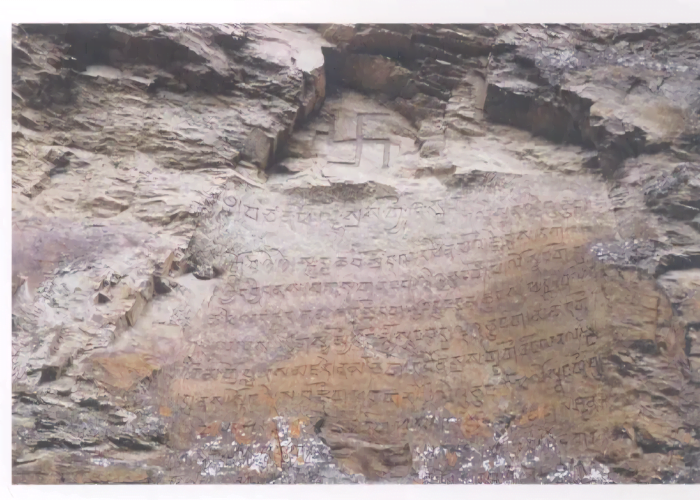
Hidden within Yunzeng Village in Nyingchi, eastern Tibet, the Kongpo Dimu Cliff Inscription stands as one of the most important ancient stone inscriptions in Tibetan history. Carved more than 1,200 years ago, this remarkable relic is recognized as the earliest known stone inscription in Nyingchi and offers rare insight into Tibet’s early political structure, royal lineages, and regional alliances.
Erected shortly after the accession of Tride Songtsen (King Trisong Detsen) to the throne of the Tubo Kingdom, the inscription dates to the late 8th or early 9th century, during a period of strong imperial expansion and administrative consolidation.
Historical Background: The Rise of the Kongpo Kings
According to The Tubo Inscription Collection compiled by Wang Yao, the Dimu Cliff Inscription records the genealogy of rulers from the Kongpo region, historically known as the Kongpo kings or Gapo kings.
These rulers were not ordinary local chieftains. They were direct descendants of the Tubo royal family, tracing their lineage back to Nyatri Tsenpo, one of the earliest ancestral figures in Tibetan royal history. Within the Tubo political hierarchy, the Kongpo kings ranked ninth among the twelve vassal kings, enjoying both prestige and a degree of regional autonomy.
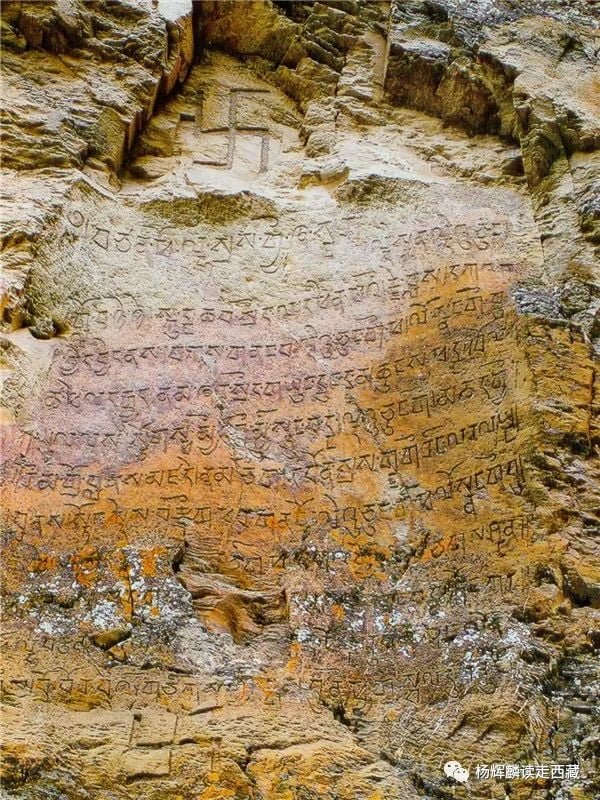
Nyatri Tsenpo and the Origins of the Kongpo Dynasty
The inscription recounts the legendary arrival of Nyatri Tsenpo from Bomê to the sacred mountains of Kongpo, where he began consolidating leadership among local tribes. This movement marked the foundation of a regional power base that later evolved into the Gyalrong dynasty in present-day Nyingchi.
Internal conflicts within the Xibu tribe eventually forced Nyatri Tsenpo’s sons, Nyatri and Shachi, to flee back to the Kongpo region. There, Nyatri formally established the Gyalrong dynasty, laying the foundation for one of the longest-lasting ruling houses in Tibetan history.
The Gyalrong Dynasty: Tibet’s Longest-Recorded Lineage
According to historical records preserved in the Dimu Cliff Inscription and later Tibetan chronicles, the Gyalrong dynasty ruled for 53 generations, lasting until the 1930s. This extraordinary continuity makes it the oldest clearly documented dynasty in Tibetan history.
Throughout successive periods, including the Tubo era and later Tibetan governments, the Kongpo kings maintained relative political independence, balancing loyalty to central authorities with strong local governance.
The Fall of the Kongpo Kings in the Republican Era
During the late Republican period, tensions escalated between the Gyalrong dynasty and the Tibetan Kashag government. Armed conflict broke out, resulting in the defeat of the Kongpo forces.
The final ruler, Wangchen Dutul, was forced into exile in India, marking the end of the Gyalrong dynasty. The once-grand Gyalrong Palace was destroyed during the conflict, leaving only stone foundations as silent testimony to a vanished royal house.
The Dimu Cliff Inscription as a Historical Source
The Kongpo Dimu Cliff Inscription is far more than a local monument. It provides critical textual evidence for understanding:
- The alliance system of the Yalong tribes
- The political hierarchy of Tubo vassal states
- Early Tibetan concepts of kingship and divine legitimacy
- The integration of regional rulers into imperial Tibet
Its value is frequently referenced alongside classical sources such as The Joyous Banquet of the Wise and the Dunhuang Version of Tubo Historical Documents, both of which expand on imperial genealogies and regional lineages.
Dimu Worship and Religious Authority in Kongpo
The term Dimu originally referred to a local protective deity worshipped in early indigenous religions of the Kongpo region. At the time the inscription was carved, Dimu worship played a central role in local spiritual life.
A Dimu Temple was established nearby, and during the Qing Dynasty, its abbot was elevated to the rank of Hutuktu, granting him substantial religious and political authority within the local Qing Tibetan administration. This highlights the close relationship between religion and governance in Kongpo history.
Tride Songtsen and the Imperial Context
The inscription was erected during the reign of Tride Songtsen, one of the most influential kings of the Tubo Dynasty. Known for his military strength and cultural vision, Tride Songtsen expanded Tibetan influence westward toward the Abbasid Caliphate, south into India, and famously led forces into Chang’an in 763 AD.
Beyond warfare, he played a decisive role in shaping Tibetan civilization by:
- Promoting Buddhism as a state religion
- Suppressing Bon institutions
- Founding Samye Monastery, Tibet’s first ordination center
- Sponsoring large-scale translation of Buddhist scriptures
Alongside Songtsen Gampo and Gar Trinring, Tride Songtsen is honored as one of the Three Wise Kings of Tubo.
Visiting the Kongpo Dimu Cliff Inscription in Nyingchi
Today, the Dimu Cliff Inscription rests quietly in a peaceful village landscape in Nyingchi, surrounded by forests and mountains. Though modest in size, it silently bears witness to over twelve centuries of Tibetan political, religious, and cultural transformation.
For travelers interested in ancient Tibetan history, imperial inscriptions, and the lesser-known royal lineages of eastern Tibet, the Kongpo Dimu Cliff Inscription offers a rare and deeply authentic historical encounter.