Litang (Lithang) – The Sky City of the Tibetan Plateau
Located in southwestern Garzê Tibetan Autonomous Prefecture, Litang County (ལི་ཐང་རྫོང་།) sits between the Jinsha River and Yalong River in the central Hengduan Mountains. Known as the “World’s High City” and “Sky City,” Litang stands at an elevation of over 4,000 meters, offering vast grasslands, sacred mountains, and a deeply rooted Tibetan culture.
This high-altitude region combines dramatic landscapes with spiritual heritage, making it one of the most distinctive destinations on the eastern Tibetan Plateau. Crossing the dramatic Zheduo Mountain Pass, the landscape suddenly opens into the vast Maoya Grassland.
History of Litang County
The name “Litang” comes from Tibetan, meaning “copper plain” (“Li” for copper and “Tang” for flatland). Its history reflects a long-standing connection between Tibetan and Han cultures. The area was inhabited by ancient Qiang-related or local Tibetan tribes. Pre-Tubo Empire time, it was associated with the Lido (or Lidou) tribe. It came under the influence or control of the Tubo (Tibetan Empire), as Tibetan forces expanded eastward.
In the Yuan Dynasty, Litang Prefecture was established along with military administration systems. The region fell under the influence of Gushri Khan (Gushi Khan) of the Khoshut Mongols, who supported the Gelug school and helped consolidate its power across Tibet and Kham.
Litang developed as a semi-independent chiefdom (Chiefdom of Lithang). Lamas from Litang Monastery often served as Desi (governors), blending religious and political authority. The 7th Dalai Lama’s stepfather was appointed chieftain, with a senior lama as vice-chieftain, highlighting the close ties between the monastery and local rule. In 1725, Litang was formally separated from direct Tibetan (Lhasa) administration and integrated more firmly into the Qing system. By 1729, it became a deputy pacification commission under Sichuan.
Terrain and Climate
Litang’s landscape is shaped by a vast high-altitude plateau, where mountains dominate the horizon and elevation gradually lowers from the northwest to the southeast. The region follows a natural pattern often described as “three mountains, one ridge, and one river,” creating a dramatic and varied terrain. Four distinct geographic zones define the area: the rugged Genyen alpine canyon region in the west, the open Maoya grasslands in the north, the fertile Wuliang River valley in the east, and the sacred mountain canyons of Zagga in the south. The Wuliang River, a key tributary of the Yalong River, flows through the county and is joined by more than ten smaller rivers, adding to the richness of the landscape.
Litang experiences a typical high-altitude plateau climate, known for its low temperatures and strong sunlight. The average annual temperature is around 3.0°C, with recorded extremes ranging from 25.6°C to -30.6°C. The region receives about 722.2 mm of annual precipitation and enjoys over 2,600 hours of sunshine each year. Winters are long and cold, while summers are short and mild. Large temperature differences between day and night are common, and the varied terrain creates diverse microclimates across the region.
Economy and Key Industries
Litang’s economy is driven primarily by the service sector, with strong support from traditional agriculture and steadily growing industrial development. In 2024, the county recorded a GDP of 3.027 billion RMB, with a growth rate of 4.8%. The economic structure reflects this balance, with 28.1% from primary industries, 15.1% from secondary industries, and a dominant 56.8% from the tertiary sector. This shift highlights the increasing importance of services, especially tourism, in shaping the local economy.
Tourism plays a central role in Litang’s growth. In 2024, the region welcomed over 2 million visitors, generating approximately 2.5 billion RMB in revenue. Popular destinations such as Genyen Mountain, Maoya Grassland, and Letong Ancient Town continue to attract travelers seeking natural beauty and cultural experiences. Alongside tourism, highland agriculture and animal husbandry remain essential. Yak-based industries form a complete production chain valued at 374 million RMB, while branded high-altitude agricultural products, including fruits and vegetables, are expanding their market presence.
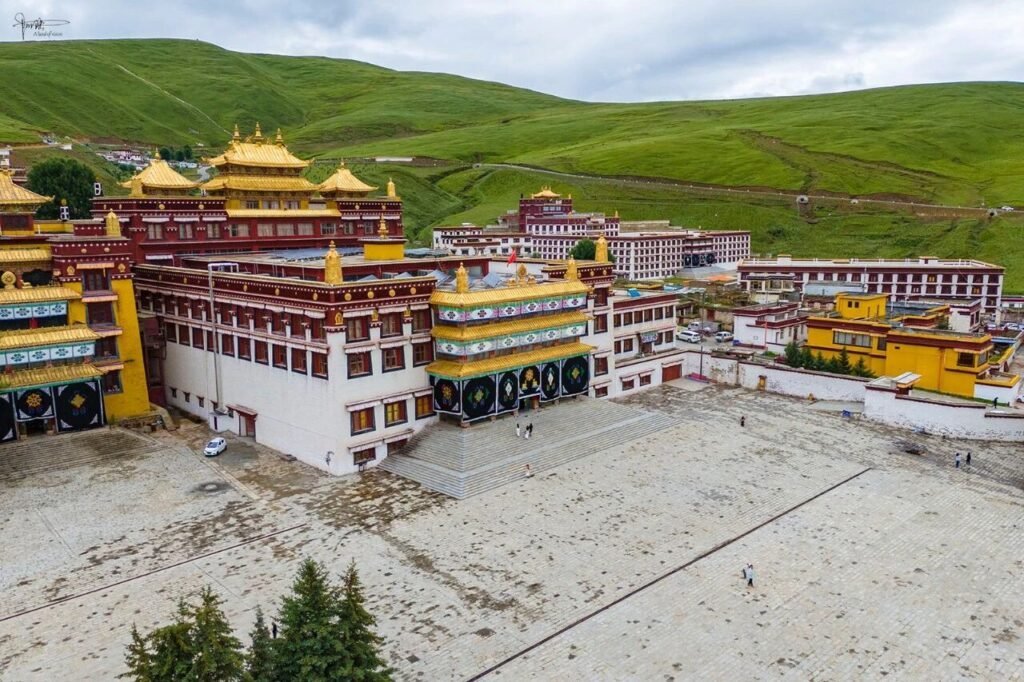
Litang Monastery – The Spiritual Heart of Kham
Perched on a hillside north of town, Litang Monastery is the spiritual center of the region and a remarkable viewpoint over the plateau. Founded in 1580 by Sonam Gyatso, the monastery is one of the most important institutions of the Gelug school in Kham, often ranked alongside Kumbum Monastery and Labrang Monastery.
Inside the monastery, visitors can discover:
- A towering 19-meter statue of Maitreya (Future Buddha)
- Thousands of Buddha images offered by devotees
- Murals dating back to the Ming and Qing dynasties
- Sacred relics linked to high lamas
Daily prayer rituals are open to visitors, offering an authentic glimpse into monastic life on the plateau.
Letong Ancient Town – A Living Tibetan Settlement
Located in northern Litang, Letong Ancient Town is one of the largest Tibetan residential communities, with more than 4,000 traditional houses. Walking through its narrow stone alleys feels like stepping into the past, where echoes of poetry and trade from the historic Tea Horse Road still linger. Small cafés and artisan shops add a subtle modern charm while preserving the original atmosphere.
During summer evenings, locals gather for traditional Guozhuang dances, filling the town with music, rhythm, and vibrant cultural energy.
Birthplace of the Seventh Dalai Lama
Litang holds deep religious importance as the birthplace of Kelsang Gyatso. His former residence, known as Renkang House, still stands as a quiet and meaningful site.
Despite restoration, the residence maintains its authentic character, where the slow rhythm of daily life, prayer smoke, and mountain silence reflect the spiritual depth of the region.
White Stupa Park – A Living Pilgrimage Site
A short walk along Xingfu West Road leads to White Stupa Park, where a 33-meter white stupa rises among hundreds of smaller ones.
From early morning until evening, pilgrims walk in devotion around the stupas, creating a peaceful and continuous flow of spiritual activity. This is one of the best places to observe daily Tibetan religious life.
Maoya Grassland – Endless Highland Landscapes
Stretching across 660 square kilometers, Maoya Grassland is among the largest grasslands in Sichuan. From June to September, the landscape transforms into a vibrant natural canvas:
- Wildflowers bloom across the plains
- Yaks and sheep graze freely
- Prayer flags move gently in the wind
Each section of the grassland reveals a slightly different scene, making every journey feel unique.
Genyen Sacred Mountain – Untouched and Revered
Rising to 6,204 meters, Genyen Mountain is one of the most sacred peaks in Tibetan Buddhism and remains unclimbed. Considered one of the 24 sacred mountains, it is believed to embody a powerful female deity. The surrounding region is rich in wildlife and natural diversity.
Nearby stands Lenggu Monastery, founded in 1164 by Dusum Khyenpa, adding further spiritual significance to the landscape.
The “Eye of Genyen” – A Hidden Alpine Wonder
Within the vast grasslands lies a small alpine lake known as the “Eye of Genyen.” With a diameter of around 50 meters, its shape resembles a human eye, perfectly reflecting the surrounding mountains.
This quiet and striking location offers:
- Mirror-like reflections of snow peaks
- Seasonal blooms of alpine flowers
- Ideal light conditions for sunrise and sunset photography
It is one of the most serene and visually captivating spots in the region.
Scenic Drive: Litang to Daocheng
The route along the G227 Highway is one of the most scenic drives in western China.
Highlights along the journey include:
- Rabbit Mountain, known for its unique rock formations
- Haizi Mountain, featuring a vast “stone ocean” and over 1,000 alpine lakes
- Traditional Tibetan villages near Sangdui Town
The route also reveals geological wonders and cultural landscapes shaped over centuries.
Hot Springs and Alpine Flower Seas
Near Chaka Village, natural hot springs provide a perfect place to relax after long journeys across the plateau. In July, the Zangbala Flower Sea blooms at elevations above 4,000 meters, creating a short-lived but stunning display of alpine colors.
Travel Tips for Visiting Litang
Due to its high altitude—over 4,000 meters—visitors may experience altitude sickness. It is recommended to:
- Stay in accommodations with oxygen support
- Rest properly upon arrival
- Descend to lower elevations if symptoms persist
Litang is also a key stop along the famous Sichuan–Tibet Highway (G318), making it an essential destination for overland journeys across the plateau.
Local Specialties and Transportation
Litang offers a rich variety of local specialties shaped by its high-altitude environment and traditional lifestyle. Yak-based foods are especially popular, including dried yak meat and hearty hot pot dishes. Other traditional foods include highland cod from local rivers, along with staples such as tsampa, butter tea, barley wine, yogurt, and blood sausage. The region is also known for valuable medicinal herbs like cordyceps, fritillaria, musk, rhodiola, and snow lotus. In addition, Litang produces a range of local products such as highland fish, apples, honey, black fungus, and wild mushrooms including matsutake and morels.
Transportation to Litang mainly relies on road travel, making it accessible yet still remote. The county has a road network of over 1,500 km, with the Sichuan–Tibet Highway (G318) serving as the main route across the plateau. Litang is located about 285 km from Kangding and 654 km from Chengdu. The nearest airports are Daocheng Yading Airport, approximately 120 km away, and Kangding Airport, around 250 km from Litang. Future development plans include railway construction and the expansion of regional air transport, which will further improve connectivity to this highland destination.