
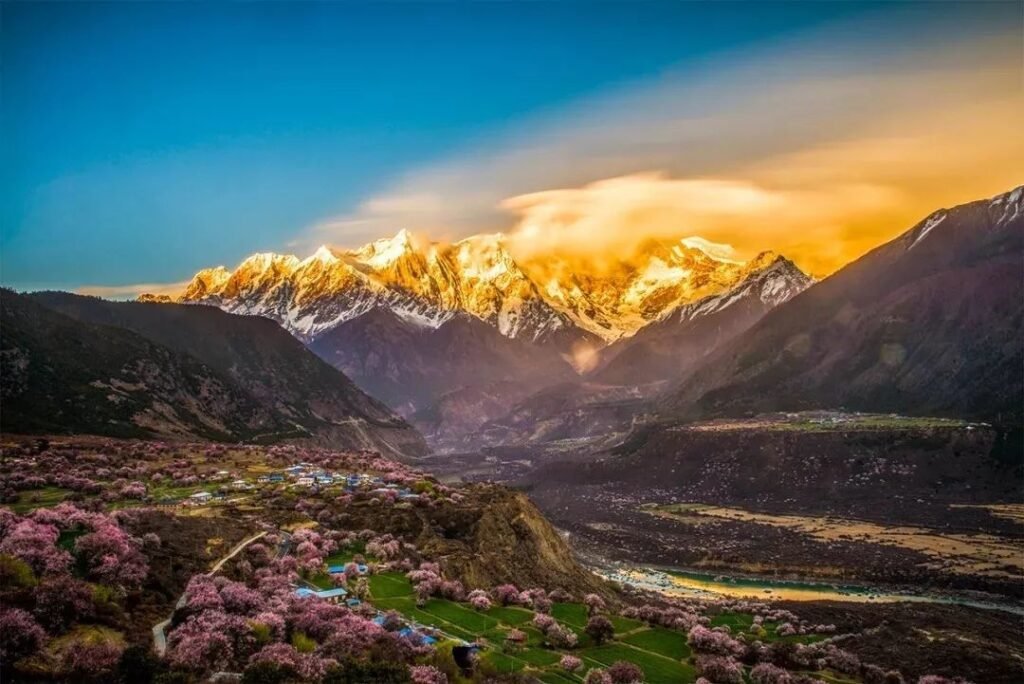
Mount Namcha Barwa, known in Tibetan as “the burning thunder and lightning” or “the spear that shoots straight into the heavens,” is one of Tibet’s most mysterious and breathtaking peaks. Rising to 7,782 meters, it dominates the eastern Himalaya and stands as the highest mountain in Nyingchi Prefecture, earning legendary status among climbers, pilgrims, and nature lovers alike.
Often hidden behind swirling clouds and mist, Namcha Barwa is revered not only for its dramatic beauty but also for its powerful cultural, ecological, and geological significance.
Meaning and Origin of the Name Namcha Barwa
The Tibetan name Namcha Barwa (南迦巴瓦峰) carries deep symbolic meaning. One interpretation describes it as “flaming thunderbolts,” while another calls it “the lance that stabs straight to the sky.” These vivid images reflect the mountain’s steep slopes, sharp ridges, and untamed nature.
In Tibetan legends, the name is linked to King Gesar, the epic hero whose divine spear is believed to have transformed into this towering peak during the legendary Menlin Battle. This association reinforces Namcha Barwa’s reputation as a sacred and unconquerable mountain.
Basic Facts About Mount Namcha Barwa
- Elevation: 7,782 meters
- Global Ranking: One of the world’s highest independent peaks (often cited among the top 30)
- Location: Eastern Himalaya, Nyingchi City, Tibet
- Nickname: “Shy Maiden Peak” (due to frequent cloud cover)
- Other Title: “Father of Tibetan Mountains”
Although lower than the 8,000-meter giants, Namcha Barwa is the highest peak below 8,000 meters, giving it a unique position among the world’s great mountains.
Geographic Location and Surroundings
Mount Namcha Barwa rises dramatically at the great horseshoe bend of the Yarlung Tsangpo River, where the river curves around the mountain before plunging into the world-famous Yarlung Tsangpo Grand Canyon.
Geographically, it lies at the junction of Nyingchi, Milin, Metok, and Bomi counties, in one of the most tectonically active regions of the eastern Himalaya. This complex terrain has shaped its steep cliffs, deep valleys, and unstable geological structure.
A Mountain Shaped by Ice and Stone
Namcha Barwa has a massive triangular pyramid shape, with sheer western cliffs dropping sharply into the valley below. A long ridge of peaks over 7,000 meters extends northwestward, resembling a giant iron saw coated in ice and snow.
To the south, three enormous glaciers descend between Namcha Barwa and Naipeng Peak, eventually melting into dense green forests. To the north stands Gyala Pheri Peak (7,234 meters), shaped like a horse saddle and permanently wrapped in snow and fog.
Extreme Climate and Challenging Conditions
The climate around Mount Namcha Barwa is famously unpredictable. Influenced by warm, moist air from the Indian Ocean, weather conditions can shift dramatically within hours.
- Frequent clouds, lightning, avalanches, and snowstorms
- Heavy snowfall year-round at high elevations
- Earthquakes and landslides due to active tectonic plates
These extreme conditions explain why Namcha Barwa remained a “virgin peak” for centuries.
Historic First Ascent and Mountaineering Legacy
For a long time, Namcha Barwa was considered unclimbable. Its steep terrain, violent weather, and remote access repelled even the most experienced climbers.
It was not until October 30, 1992, that a Sino-Japanese joint expedition successfully reached the summit after nearly a month of grueling effort. Since then, Namcha Barwa has become one of the most challenging objectives for elite mountaineers, although climbing activities remain strictly controlled today.
From Tropical Forests to Eternal Snow
One of Namcha Barwa’s most astonishing features is its vertical ecological diversity. Within a horizontal distance of less than 200 kilometers, landscapes change dramatically from tropical jungle to permanent ice fields.
Along this elevation range, you can encounter:
- Bananas and tropical plants in low valleys
- Camphor trees in subtropical zones
- Cedar, azalea, and conifers in temperate forests
- Alpine shrubs and meadows at high altitudes
- Permanent snow and glaciers near the summit
This complete vertical vegetation spectrum is rarely seen anywhere else in Tibet.
Cultural and Religious Significance
Mount Namcha Barwa is regarded as a sacred mountain in both Bon (Yungdrung Bon) and Tibetan Buddhism. In Bon tradition, it is honored as the “Father of All Mountains in Tibet.”
Local beliefs hold that the mountain is home to powerful deities and spiritual forces. Because of this, Namcha Barwa is treated with deep reverence, and many Tibetans believe it “stands in the human world but never fully reveals itself to humans.”
Legends and Mysticism of Namcha Barwa
According to folklore, Namcha Barwa is not merely a mountain but a living spiritual presence. One legend says it is the transformed weapon of King Gesar, while others link it to Guru Padmasambhava, who is believed to have subdued demons in this region.
These stories emphasize the mountain’s reputation as steep, dangerous, and unconquerable, reinforcing its aura of mystery.
How to Reach Mount Namcha Barwa
Travel to Namcha Barwa usually begins in Lhasa, following the scenic Kham-Tibet Highway:
- Lhasa to Bayi (Nyingchi): ~404 km
- Bayi to Milin County: ~75 km
- Milin to Pai District: ~91 km
- Pai to Namcha Barwa base area: ~18 km
The mountain climbing campsite sits at around 3,512 meters, serving as a base for expeditions and scientific research teams.
Why Mount Namcha Barwa Is Unlike Any Other Peak in Tibet
From its cloud-shrouded summit to its lush subtropical foothills, Mount Namcha Barwa combines raw natural power with profound spiritual meaning. It is a place where glaciers meet forests, legends meet geology, and heaven feels just within reach—yet always slightly out of sight.
Hidden, revered, and eternally dramatic, Namcha Barwa remains one of the most captivating mountains in the Himalaya.