

Overview of Biru’s Natural Landscape
Biru County is located in northern Tibet under the administration of Nagqu City. Nestled between the Tanggula Mountains and the Nyenchen Tanglha Range, the county lies within the upper reaches of the Nujiang River basin. Biru County is set within a dramatic high-altitude landscape dominated by low mountains, rolling hills, deep valleys, glaciers, and snow-capped peaks. The county sits at an average elevation of approximately 4,000 meters (13,120 feet) above sea level, placing it firmly within Tibet’s northern plateau environment.
Often referred to as the “Jiangnan of Northern Tibet,” Biru stands out for its relatively mild and humid plateau climate, which supports abundant vegetation and diverse natural landscapes rarely seen at such elevations. The terrain slopes gently from northwest to southeast, resembling a leaf-shaped landform. Higher elevations dominate the northwest, while the southeast gradually descends, creating diverse landforms and multiple microclimates across the county.
Major Mountain Ranges and Key Landforms
Two major mountain ranges play a defining role in Biru’s geography and serve as natural boundaries within the Nagqu region:
Damuyela Mountain (达木业拉山)
With a pass elevation of 5,014 meters, Damuyela Mountain—also known locally as Miantang Mountain—acts as a symbolic and geographical divider between western and eastern Biru.
Lang’ela Mountain (朗俄拉山)
Located along the border with Sog County, Lang’ela Mountain rises to 4,744 meters and is considered an important geographical marker separating the eastern and western areas of Nagqu Prefecture.
The Damuyela Pass naturally divides Biru County into two distinct regions, each with its own landscape character and ecological features.
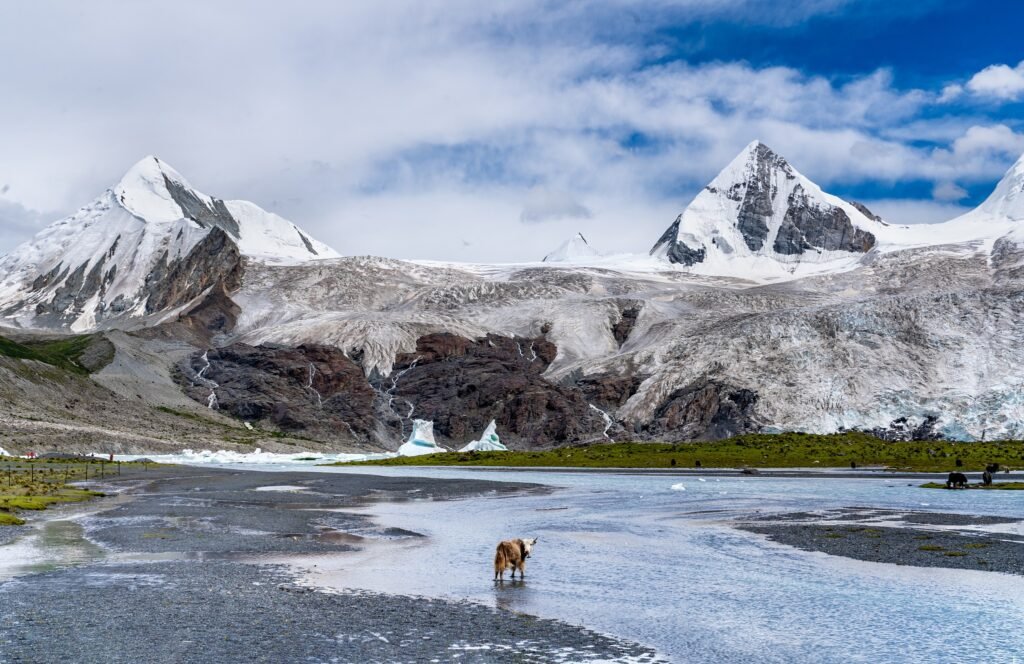
Sacred Mountains of Biru County
Sacred mountains are central to the natural and spiritual landscape of Biru County. Among the many revered peaks, Sepu Kangri Sacred Mountain, Nala Zangba Sacred Mountain, and Gupu Zaxi Taji Sacred Mountain are the most influential.
Sapuk Sacred Mountain, also known as Sepu Gangri, is located in Puzong Valley of Yangxiu Township, about 107 kilometers from the county town. Rising to 6,956 meters, it is the highest peak in the eastern Nyenchen Tanglha range and is widely honored as the “King of Sacred Mountains.” Its striking triangular summit is surrounded by seven snow peaks, with massive glaciers and year-round snow cover. Sapuk Mountain is an important sacred site in Tibetan Buddhism and Bon and is considered one of the most significant holy mountains in the Tibetan cultural world.
Nala Zangba Sacred Mountain lies in the central part of Biru County and holds deep spiritual meaning for local communities. Traditional mountain worship rituals associated with Nala Zangba continue to this day, reflecting the strong connection between local religious beliefs and the natural environment.
Gupu Zaxi Taji Sacred Mountain is known for its thirteen distinct peaks, each associated with unique legends and religious symbolism. Together with Sapuk Mountain and Nala Zangba Mountain, it forms the trio of the most revered sacred mountains in Biru County.
Western Biru: Open Valleys and Agricultural Heartland
Western Biru lies at an average altitude of about 4,400 meters and is characterized by gentle hills, low mountains, and broad river valleys.
Townships such as Chairen, Biru, and Baiga are located in this region. The valleys here are wide—often 1 to 1.5 kilometers across—with deep, fertile soil and abundant water resources. These favorable conditions make western Biru ideal for barley cultivation, a staple crop in Tibetan agriculture.
Thanks to its relatively mild climate and accessible terrain, western Biru has historically been a center of settlement, farming, and human activity.
Eastern Biru: High Mountains and Dramatic Gorges
In contrast, eastern Biru sits at a lower average altitude of around 3,800 meters but features far more rugged terrain. Steep mountains rise sharply above narrow river valleys, creating dramatic vertical landscapes.
This region is carved by numerous tributaries of the Nujiang (Salween) River, which flow eastward and deepen as they descend. In some areas, the elevation difference between mountain peaks and valley floors reaches nearly 1,000 meters, forming spectacular gorges and canyon scenery.
Eastern Biru is remote and less accessible, making it an ideal region for exploring untouched alpine ecosystems, rare vegetation, and pristine wilderness.
Lakes and Glacial Waters of Biru County
Lakes are scattered across Biru County, many of them formed by ancient glaciers. The most famous among them is Sapuk Sacred Lake, also known as Samutso, located at the foot of Sepu Kangri Sacred Mountain.
Sapuk Sacred Lake is created by centuries of glacial meltwater and consists of two parts: an outer lake and an inner lake. The outer lake is easily accessible and offers wide-open views ideal for photography, while the inner lake requires a short hike or horseback ride and provides closer views of glaciers and ice formations. In summer, the lake reflects the surrounding snow peaks in brilliant shades of blue. In winter, the lake freezes completely, allowing visitors to walk across the ice to the glacier’s edge. According to local belief, the lake freezes overnight on September 15 and thaws overnight on May 15 each year.
Another remarkable body of water is the Two-Color Lake, located near the ancient site of the legendary Women’s Kingdom. The lake displays two distinct colors—white and green—and is closely linked to local myths involving White Tara and Green Tara, giving it a mysterious and sacred character.
Rivers and Water Systems in Biru County
Biru County lies within the upper Nujiang River basin and is crossed by numerous rivers and tributaries that nourish its valleys and grasslands. The Nujiang River itself flows through Chaqü Township, where it forms the famous “First Bend of the Nujiang River,” one of the county’s most iconic natural landmarks. Here, fast-flowing waters carve deep gorges between steep cliffs, creating dramatic scenery that contrasts beautifully with nearby rapeseed flower fields and Danxia landforms.
Several important tributaries feed into the Nujiang River, including the Suoqu River, the largest tributary in the upper basin, as well as the Baiqu, Yuqu, Caqu, and Biru rivers. Together, these waterways form a dense river network that supports agriculture, grasslands, and wildlife across the county.
Climate Characteristics of Biru County
Biru County experiences a plateau sub-frigid to temperate semi-humid monsoon climate, typical of northern Tibet.
- Annual precipitation: 580–650 mm
- Average annual temperature: around –2°C (28°F)
- Frost period: from October to April
The region is prone to snowstorms and strong winds, especially during the long winter months, which can affect transportation and grazing. Despite the harsh conditions, summers bring a dramatic transformation. Meadows turn lush and green, wildflowers bloom across the valleys, and the landscape contrasts beautifully with surrounding snow-covered peaks.
Wildlife and Biodiversity of Biru County
Biru County is rich in wildlife resources, with more than 500 species of wild animals and plants recorded in the region. Among them are over 40 species of mammals, more than 70 species of birds, and 58 types of valuable medicinal plants.
Nationally protected species such as snow leopards, Tibetan antelope, wild yaks, Tibetan wild donkeys, white-lipped deer, and black-necked cranes inhabit the high-altitude zones above 4,500 meters. Forests and river valleys provide shelter for brown bears, musk deer, red deer, and a wide variety of bird species. The Sapuk Mountain area is particularly important as a habitat for white-lipped deer, Tibetan foxes, snow chickens, and rare alpine plants, including cordyceps and fritillaria.
Forest Resources of Biru County
Forests cover more than 160,000 hectares of Biru County and are mainly distributed in the southern and southeastern river valleys. These forests belong to the cold-temperate mountain coniferous zone and are dominated by spruce, fir, and juniper, with pockets of broadleaf forest and dense shrubs.
The primeval forest of Pengpan Township is one of the few remaining untouched forest areas in Nagqu Prefecture. With towering ancient trees and high vegetation coverage, it serves as a critical habitat for many wildlife species. Another notable area is the Biru Xiong ancient poplar forest, where centuries-old poplar trees form a unique and ecologically important landscape in central Biru County.
Grasslands and Alpine Pastures of Biru County
Grasslands form the ecological backbone of Biru County and play a vital role in local animal husbandry. The county has approximately 15.66 million mu of grassland, most of which is designated as protected basic grassland. These grasslands consist mainly of alpine meadows and high-cold grasslands and are an integral part of the greater Qiangtang grassland system.
The grasslands are widely distributed across the county, particularly in the northern and western regions, where they support large grazing areas and limited hayfields. Among them, the Yagong Grassland is especially well known as a major production area for cordyceps and an important habitat for Yagong yaks. For generations, local herders have safeguarded these grasslands, where glaciers, lakes, snow mountains, and wildlife coexist in a fragile yet magnificent high-altitude environment.