

Parnashavari in Tibetan Buddhism: The Leaf-Clothed Mother of Healing
In Tibetan Buddhism, Parnashavari is revered as the “Leaf-Clothed Mother”, a powerful healing goddess known for her ability to protect beings from diseases, epidemics, and unseen harmful forces. She holds a vital position as one of the most important messenger goddesses, serving as a swift intermediary between enlightened beings and sentient beings in times of crisis.
Parnashavari is especially associated with curing infectious diseases, plagues, and environmental illnesses. Practitioners believe that visualizing her form and chanting her mantra can strengthen the immune system, purify negative karmic conditions, and create a protective shield against illness and misfortune.
Parnashavari’s Role as a Messenger Goddess
As a messenger deity, Parnashavari is known for her swift and compassionate response to suffering caused by disease. In Vajrayana practice, messenger goddesses are invoked during times of urgent danger, especially when illnesses spread rapidly or when natural balance is disturbed.
Her leaf-clad appearance symbolizes her close connection to nature, forests, herbs, and natural healing, emphasizing harmony between the human body and the natural world. This association makes her particularly relevant in times of widespread epidemics and environmental imbalance.
Widespread Practice Across Tibetan Buddhist Schools
The practice of Parnashavari is embraced by all major schools of Tibetan Buddhism, including Nyingma, Kagyu, Sakya, and Gelug traditions. Among them, the Kagyu school, particularly the Drikung Kagyu lineage, maintains a deep and continuous devotion to her practice.
A key event associated with Parnashavari practice is the ten-day teachings held during the Year of the Snake, traditionally observed every twelve years. During this sacred period, practitioners from various Tibetan Buddhist traditions gather at Drikung Thil Monastery, where extensive rituals, empowerments, and mantra recitations are conducted under the guidance of the Drikung Kagyu throne holder.
These teachings focus on healing practices, epidemic prevention rituals, and long-life blessings, making Parnashavari an essential deity in collective spiritual health practices.
Parnashavari in Thangka Art: Symbolism and Sacred Iconography
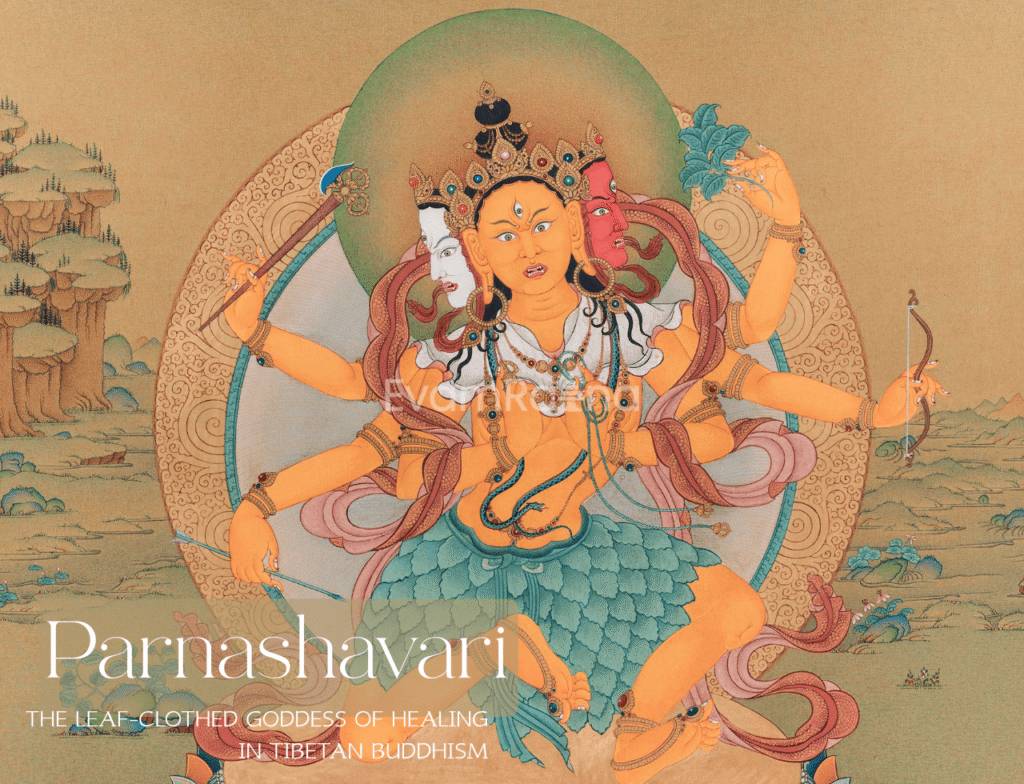
In Tibetan Thangka paintings, Parnashavari is depicted with a milky-white complexion, symbolizing the two enlightened activities of pacifying and enriching. This color reflects her power to calm harmful influences while nurturing positive conditions for healing, longevity, and spiritual growth.
She is shown with three faces, each bearing three eyes, signifying her all-seeing wisdom and awareness across time and space.
- Central face: Milky-white, half-smiling and half-wrathful, symbolizing balance and harmony with nature
- Left face: Red, representing transformed desire and compassionate engagement
- Right face: White, signifying tranquility, purity, and peaceful healing
Her expression communicates that healing requires both gentle compassion and decisive action.
Ornaments and Natural Symbols of Healing
Parnashavari is adorned with a crown of flowers, emphasizing renewal, life force, and natural vitality. Her hair is tied in a topknot and secured with a white snake, a powerful symbol of regeneration, medicine, and life energy.
She wears earrings, armlets, bracelets, anklets, and jeweled necklaces, all entwined with a garland of fresh leaves, reinforcing her identity as the Leaf-Clothed Goddess. These leaves represent herbal medicine, forest wisdom, and the regenerative power of nature itself.
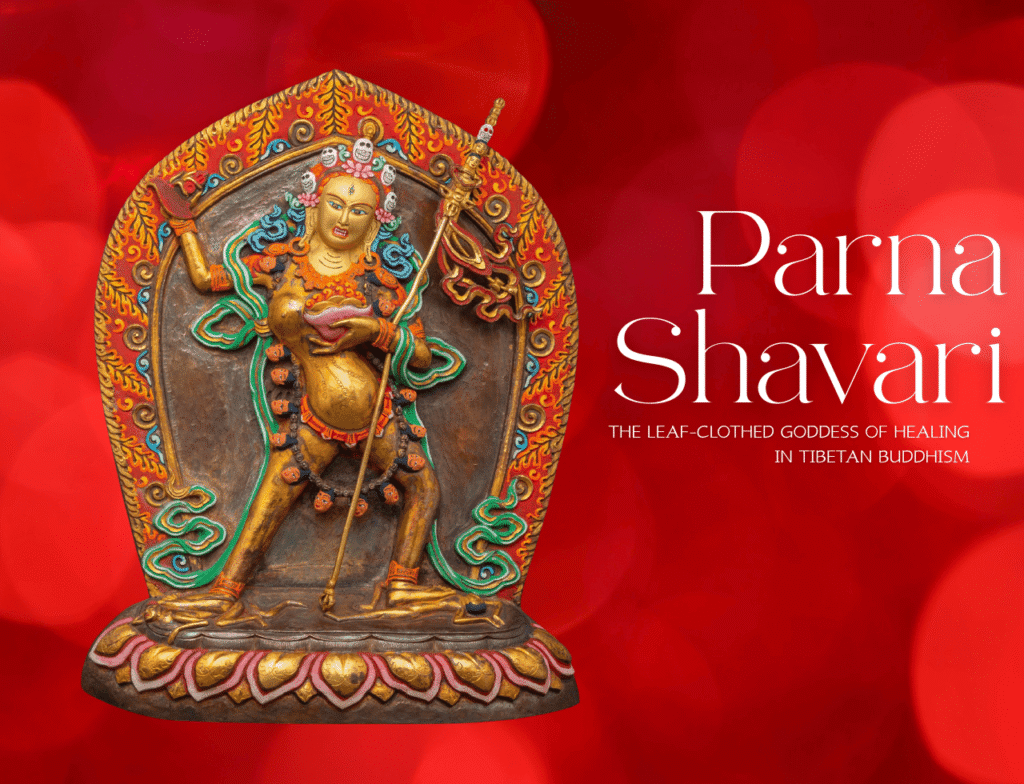
The Six Arms of Parnashavari and Their Sacred Meanings
Parnashavari’s six arms express her multifaceted healing abilities and enlightened activities.
The Principal Arms: Wisdom and Control
Her main pair of arms holds:
- A golden vajra, symbolizing indestructible wisdom and the unshakable nature of enlightenment
- A noose, representing mastery over internal afflictions and external harmful forces
Together, these symbolize her ability to bind and neutralize disease-causing energies.
The Second Pair: Removing Disease at Its Root
The second set of arms holds:
- A vajra axe, signifying the cutting away of illness and negative karma
- A blue lotus, symbolizing purity, healing, and rebirth
These attributes represent her power to eradicate disease at its source.
The Third Pair: Penetrating Ultimate Truth
The third set of arms wields:
- A bow and arrow, representing focused intention and penetrating wisdom
This symbolizes the ability to aim the arrow of wisdom directly at ignorance and suffering, eliminating their root causes.
Lotus Pedestal: Purity and Enlightened Healing
Parnashavari is depicted dancing upon a lotus pedestal, a universal Buddhist symbol of purity arising from suffering. The lotus signifies that healing and enlightenment can emerge even from conditions of pain, disease, and impermanence.
Her dancing posture expresses dynamic healing energy, showing that enlightened compassion is active, responsive, and ever-moving.
The Spiritual Assembly in Parnashavari Thangka Paintings
In elaborate Thangka compositions, Parnashavari is often surrounded by a powerful spiritual assembly.
At the top center, Tsongkhapa, the founder of the Gelugpa school, is depicted, representing pure lineage and doctrinal clarity. He is flanked by:
- Dragon King Buddha on the right, symbolizing elemental harmony
- Vajradhara on the left, representing the source of tantric teachings
In the lower section, protective deities appear:
- Six-Armed Protector at the center
- Career-Protecting King and Four-Armed Protector on the right
- Guan Yu and Shanglon Protectors on the left
This assembly emphasizes that healing is supported by wisdom, protection, and karmic balance across multiple realms.
Parnashavari as a Living Symbol of Healing and Protection
Through her rich iconography, ritual practices, and widespread veneration, Parnashavari stands as a powerful embodiment of healing, protection, and harmony with nature. Her presence in Tibetan Buddhism reflects the deep understanding that true healing arises from the union of wisdom, compassion, and natural balance.