
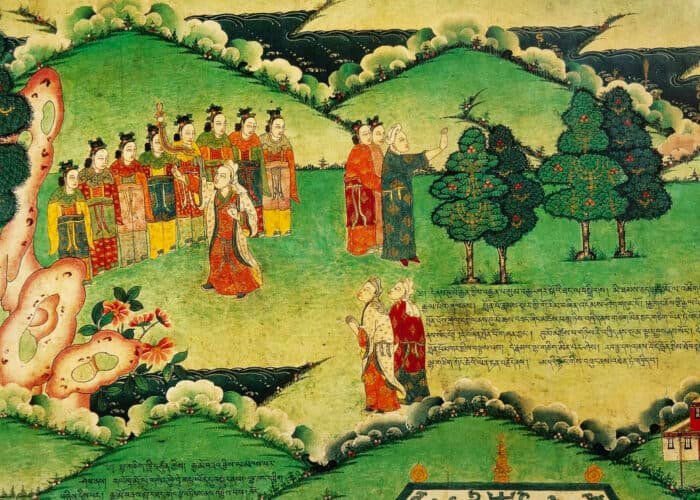
A Royal Life Shaped by Responsibility
Princess Wencheng, also known as Wencheng Gongzhu and Gyasa Kongjo in Tibetan tradition, was a noblewoman of the Tang Dynasty. Her marriage to Songtsen Gampo in 641 CE created a lasting alliance between the Tang Empire and the rising Tibetan Empire.
Her story combines diplomacy, cultural exchange, and legend. While official records describe her as a key figure who introduced Buddhism and advanced knowledge to Tibet, traditional stories reveal a more emotional side—marked by sacrifice, homesickness, and deep loneliness.
Early Life and the Call of Duty
Born into a branch of the Tang imperial family, possibly connected to Emperor Taizong of Tang, Princess Wencheng grew up in the grand capital of Chang’an. She received a refined education in Confucian classics, poetry, music, art, and Buddhism.
In the 630s, Songtsen Gampo sought a Tang princess to secure peace after conflicts along the border. In 640, Emperor Taizong agreed and granted her the title “Princess Wencheng.” At around 16 years old, she was chosen for a diplomatic marriage.
Escorted by officials including Li Daozong, she began a difficult journey of nearly 3,000 kilometers across mountains and remote landscapes. She was eventually welcomed by Songtsen Gampo near Bohai Lake.
This was not a romantic union but a political alliance—her role was to represent Tang culture, strengthen ties, and bring stability to the region.
Arrival in Tibet and Cultural Influence
Upon reaching Lhasa, Princess Wencheng entered a land very different from Chang’an. The environment was harsh, and local customs were unfamiliar. Tibetan accounts suggest that she influenced certain practices, including discouraging the use of red ochre face painting.
She brought with her a large entourage and valuable knowledge, including Buddhist scriptures, agricultural techniques, medical practices, and craftsmanship. Among the most significant items was a sacred statue of Shakyamuni Buddha, later enshrined in the famous Jokhang Temple.
In addition to religion, she contributed to agriculture and daily life by introducing seeds, irrigation knowledge, weaving skills, and other practical techniques

A Life of Loneliness and Inner Struggle
Despite her public role, Princess Wencheng’s personal life is often portrayed as lonely and difficult. Legends describe her longing for her homeland and the emotional burden of living far from Chang’an.
One well-known story tells of a “Sun-Moon Mirror” she used to look toward home. Instead of seeing Chang’an, she saw only her own reflection and broke the mirror in sorrow. It is said that her tears formed the Daotang River, and Riyue Mountain marks the place of her grief.
After the death of Songtsen Gampo around 649 CE, she remained in Tibet for more than three decades. Historical accounts suggest she had no children and continued her life in a distant land shaped by duty and adaptation.
Legacy in History and Tradition
Princess Wencheng passed away around 680–682 in Lhasa. Today, she is remembered in both historical records and cultural traditions. Her legacy lives on in murals, folk stories, and performances, especially in large-scale productions inspired by her life.
In Tibetan belief, she is sometimes regarded as an embodiment of Green Tara, symbolizing compassion and devotion. Her story continues to represent the connection between cultures and the role of individuals in shaping history.
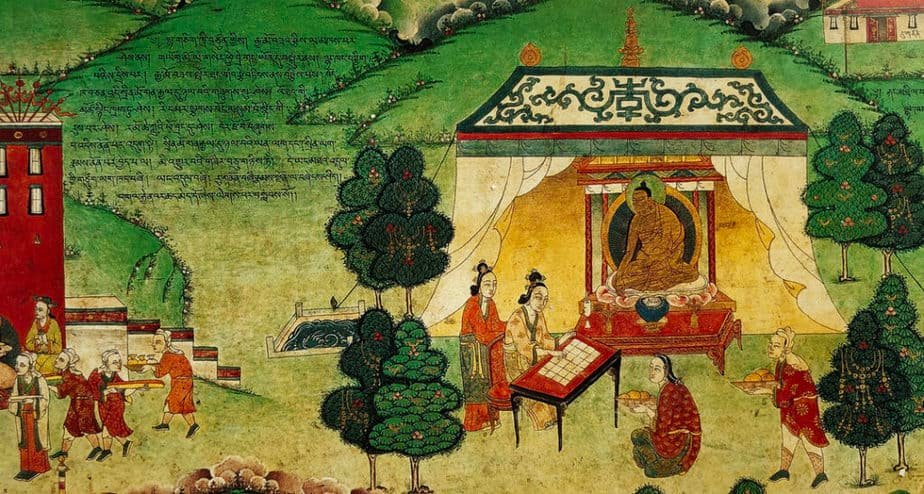
Beyond Diplomacy: A Story of Endurance
While some modern interpretations highlight romance, the deeper meaning of her story lies in quiet endurance. Princess Wencheng was a young woman sent far from home to serve political and cultural purposes. Through education, faith, and resilience, she fulfilled her role despite personal hardship.
Her life reflects how diplomacy is not only shaped by power and strategy but also by human sacrifice, emotional strength, and lasting cultural impact.
Chinese Historical Sources: A Political Narrative
Chinese dynastic histories present Princess Wencheng’s marriage as a diplomatic milestone, with limited attention to her personal life.
The Old Tang Book and New Tang Book record that in 640/641 CE, Emperor Taizong granted her the title “Princess Wencheng” and sent her to Tibet under the escort of Li Daozong.
These texts emphasize political outcomes. They describe how Songtsen Gampo welcomed her, adopted elements of Tang culture such as silk clothing and literacy, and sent Tibetan nobles’ sons to study in Chang’an. The narrative highlights Tang influence and stability along the borders, but offers very little detail about Wencheng herself.
Dunhuang Sources: Early Tibetan Records
More direct historical evidence comes from manuscripts discovered at Dunhuang, especially the Old Tibetan Annals.
These records, such as P.T. 1288, state that the Tibetan minister Gar Tongtsen Yulsung escorted Princess Wencheng to Tibet. They refer to her as “Tsanmo,” meaning queen or royal consort, confirming her high status at the Tibetan court.
The annals also record her death around 680–682 CE and note that she received funeral rites appropriate for a queen, including posthumous honors and sacrifices.
Compared to Chinese texts, these sources are brief but valuable. They focus on factual details such as chronology, court roles, and official events, without later legendary additions.
Tibetan Historical Sources: From History to Sacred Narrative
Later Tibetan writings, especially from the 11th to 14th centuries, expand her story into a rich religious and cultural narrative. Texts such as the Blue Annals, along with works like Buton’s History of Buddhism and Mirror Illuminating the Royal Genealogies, portray Princess Wencheng as a central figure in the spread of Buddhism in Tibet.
In these accounts, she is often regarded as an incarnation of Green Tara or sometimes White Tara. She is said to have brought a sacred statue of Shakyamuni Buddha, now enshrined in Jokhang Temple.
Other Tibetan texts, including Vase-shaped Pillar Testament and Pronouncement of Ba, describe her journey, dowry, and role in introducing agriculture, medicine, and crafts. These works present her not only as a royal figure but as a spiritual and civilizing force.
Contrasting Narratives Across Traditions
Different traditions portray Princess Wencheng in distinct ways:
- Chinese sources present a concise and political account, focusing on diplomacy and Tang influence.
- Dunhuang and early Tibetan records provide factual details about her role, status, and death.
- Later Tibetan sources transform her into a sacred and legendary figure, emphasizing Buddhism and cultural transformation.
Folk traditions further add emotional depth, including stories of homesickness, such as the legend of the Sun-Moon Mirror. These elements are not found in early historical texts but became an important part of her cultural image.
The “Secret Story” of Princess Wencheng and Gar Tongtsen
The story of Princess Wencheng and Gar Tongtsen Yulsung is a lesser-known narrative preserved mainly in Eastern Tibetan traditions. Unlike official histories that present her marriage to Songtsen Gampo as a diplomatic success, this version introduces a personal dimension, suggesting a possible emotional or romantic bond between the princess and the minister who escorted her to Tibet. It survives in folklore rather than formal records.
Historically, Gar Tongtsen was a powerful minister and key diplomat who arranged the marriage alliance with the Tang Empire. Sources like the Old Tang Book and early records from Dunhuang describe him as a strategist and envoy, with no mention of any personal relationship. These accounts focus strictly on politics, negotiation, and state affairs.
The romantic legend appears later in regions such as Kham, Amdo, Powo, and Minyak, along Princess Wencheng’s travel route. Stories describe a deep bond formed during the long journey, sometimes including a child who did not survive and a sense of emotional conflict. These elements highlight her inner struggle between personal feelings and royal duty, reinforcing themes of loneliness and sacrifice.
This narrative remains “secret” because it challenges official versions that emphasize harmony and religious legacy, often linking her to Green Tara. Modern scholars such as Cameron David Warner view it as a later folkloric development without contemporary evidence. Even so, it adds a human layer to her story, portraying her as a figure shaped not only by diplomacy, but also by emotion and personal loss.