Tibetan people
Tibetan Customs
Major Festivals in Tibet
Tibetan Language
Western Tibet’s Ali region — known as Ngari — is one of the least visited and most extraordinary destinations on the Tibetan plateau. This 12-day expedition traces the Great Northern Loop through a landscape shaped by ancient kingdoms, sacred mountains, wildlife-rich grasslands, and some of the highest and most remote lakes in the world. From Lhasa’s familiar streets to the untamed wilderness of Ngari and back again, this journey covers terrain that few travellers ever reach.
Ali sits at the crossroads of history and wilderness. It is home to the ruins of the ancient Zhangzhong Kingdom and the Guge Dynasty. Beyond its historical depth, Ali is a sanctuary for wildlife — Tibetan antelope, wild yak, Tibetan wild ass, and the elusive brown bear all roam its vast open terrain.
The region’s landscapes are equally extraordinary. The sacred Mount Kailash, the holy waters of Manasarovar Lake, the surreal earth formations of Zada Forest, and the celestial expanse of Namtso Lake are all part of this single expedition. Ali is not a destination for those seeking comfort and convenience — it is a destination for those seeking something genuinely rare.
The best time to visit Ngari is from May to October, when weather conditions are more stable, roads are accessible, and visibility is clear across western Tibet. The ideal months are May, June, and September, offering mild daytime temperatures, cold but manageable nights, and excellent views of Mount Kailash with fewer crowds and less wind. During summer (July–August), the landscape around Lake Manasarovar becomes greener and more vibrant, though occasional
and road disruptions may occur. Early season (April) and late season (October) are also rewarding for travellers seeking fewer tourists and dramatic lighting for photography, though temperatures can drop significantly, especially at night and on high passes. Winter (November–March) is generally not recommended due to extreme cold, strong winds, and limited access to remote sites like the Guge Kingdom Ruins. Regardless of the season, weather in Ngari changes rapidly, so it is essential to prepare for intense sun, wind, and cold conditions at any time.
The expedition departs Lhasa and heads south through landscapes immediately rich with visual reward. The golden hues of rapeseed flowers frame the approach to Yamdrok Lake — one of Tibet’s three largest lakes, surrounded by perpetual snow-capped mountains. The lake’s clarity and colour shift constantly with the light, and Tibetan Mastiffs can often be spotted near the shoreline as local fishermen go about their work.
Continuing south, the route reaches the 4,330-meter Smila Pass, where the Karola Glacier comes into full view. One of Tibet’s three continental glaciers and the closest to any road in the region, its ice face rises dramatically from the valley floor. Local children sometimes offer fossils found beneath the glacier — a small but striking reminder of the geological age of this landscape.
The day ends in Shigatse, where Tashilhunpo Monastery provides a fitting close. Dating back over 570 years to the Ming Dynasty, this monastery stands as one of the great Gelug Sect monasteries of Tibet, blending traditional Tibetan architecture with profound Buddhist significance.
Leaving Shigatse via Lazi and through Dingri County, the road climbs steadily toward the Himalayas. The approach to Everest Base Camp via the Old Valley Road is unlike any other route to the mountain.
At Jawula Pass, the famous “108 Turns” reveal themselves — a winding mountain road that descends in tight switchbacks, prayer flags marking the bends, snow peaks extending across the entire horizon. Standing at the Everest Observation Deck here is a moment that consistently stops travellers in their tracks.
Passing Rongbuk Temple — the world’s highest monastery — the route arrives at Everest Base Camp, now a marked check-in point at 5,020 meters. As night falls, snowfall can blanket the entire camp. The morning after brings its own reward — clearing skies, fresh snow, and the true face of Mount Everest emerging above the clouds in full, unobstructed view.
The descent from Base Camp delivers an extraordinary natural experience — the altitude drops rapidly enough that all four seasons appear to unfold within a single day, from snow-covered slopes with black wild yaks to lush green valleys and wildflowers beside shallow wetlands.
Departing the snow-draped Everest Base Camp, the route moves through valleys and ravines into warmer, more varied terrain. The day’s destination is Peku tso — the largest inland lake in the Everest Reserve, nestled in the heart of Shigatse and spanning over 300 square kilometres.
Under the midday sun, the lake’s waters shift through layers of emerald green and emerald blue, creating gradients of colour that are genuinely difficult to describe. Along the shoreline, a grazing in the sunlight — their crimson coats contrasting with the vivid blues and greens of the lake — adds a quietly memorable moment to an already stunning landscape.
The approach to Manasarovar Lake from the undulating slopes near Darchen is one of the journey’s most anticipated moments. As the vehicle crests the hills, a deep, vivid blue stretches across the horizon of Manasarovar, a color that appears almost artificially intense under the high-altitude light.
Manasarovar holds a place of extraordinary spiritual significance. It is recognized as the highest freshwater lake in the world and one of Tibet’s three sacred lakes. It is also the cradle of four of Asia’s major rivers. Indian pilgrims come here to perform sacred rituals, washing in the lake’s remarkably clear waters.
Adjacent to Manasarovar lies Langtso — a crescent-shaped companion lake known as the “Ghost Lake.” Despite sitting side by side with Manasarovar, the two lakes hold notably different water qualities. Local legend ties them both into a larger tale connecting Namunani Peak, Kailash, Manasarovar, and Langtso in a story of love and mythology that locals say ensures the lake is never truly still.
Approaching Mount Kailash from Tarchen, the mountain’s conical, pyramid-shaped peak becomes visible long before arrival. Kailash is considered the pinnacle of the Gangdise Mountain range and has been listed among the top ten most beautiful mountains in China by China National Geographic magazine.
Its spiritual significance extends across multiple religions and cultures. Kailash is recognized as the source of the Indus, Ganges, and Brahmaputra rivers, all originating from its slopes. Ancient scriptures describe it as the “Mountain of Ten Thousand Waters” — a fitting title for a peak that feeds the lifeblood of the Qinghai-Tibet Plateau.
A pilgrimage to Kailash is as much a spiritual experience as a physical one. As the steep walls of the mountain come into full view, the sense of standing in the presence of something genuinely sacred is difficult to dismiss — regardless of one’s beliefs.
Zada Earth Forest — Nature’s Sculpted Labyrinth
The Zada Earth Forest, set within the Xiangquan River Valley, is one of the most unusual landscapes in Tibet. Carved over millennia by ancient geological forces and weathering, the distinctive Danxia landform here produces towering formations of earth and stone that stretch for dozens of kilometres. The shapes shift constantly — pillars, ridges, and platforms rising to heights of tens of meters — creating a landscape that feels genuinely otherworldly.
The Guge Dynasty — A Civilization Lost Overnight
Perched on the banks of the Xiangquan River, the Guge Dynasty originated from the Xiangzhong Kingdom in the 9th century and flourished for more than 700 years through the Song, Yuan, and Ming dynasties. Three centuries ago, the entire civilization vanished overnight — leaving behind palace ruins, temples, murals, and sculptures in an almost perfectly untouched state. Climbing to the top of the earth mountain that hosts the Guge ruins at sunset, the golden light falls across collapsed rooftops and standing watchtowers alike. Hidden within the ruins are murals of remarkable artistry — some dimly lit, some entirely off-limits — their existence hinting at the cultural sophistication of a people whose disappearance remains unexplained.
Entering Ngari proper, the road — where it exists at all — begins to feel like a suggestion rather than a certainty. The Shiquan River marks the gateway into terrain where rivers and mountains replace conventional obstacles. The route winds through Geji, Damxung, Gaize, and Nyima, passing Salt Lake, Dalaocuo, Dongcuo, Bawucuo, Dazecuo, Wuru, and Se Lincuo along the way — each name carrying the weight of the stories embedded in this remote landscape.
At an average altitude of 4,500 meters, Ngari presents challenges that go beyond the physical. Weather here shifts without warning — bright sunshine can give way to storm clouds within minutes, and the road surface demands constant attention. The terrain unfolds as a genuinely unpredictable environment where the conditions encountered are never quite the same twice.
Nima translates to “sun” in Tibetan, and the name carries a warmth that extends to what the area offers. The open plains around Nima are a sanctuary for Tibetan wild ass and antelope, which can be seen galloping freely beneath the snow-capped mountains — a spectacle that stays with travellers long after the journey ends.
Further along, Dongcuo — meaning “Desolate Lake” — reveals itself as a provincial wetland nature reserve sitting at 4,396 meters. Despite its name, the lake’s beauty is anything but desolate, demonstrating how the Tibetan plateau has a way of finding elegance in its most remote and overlooked corners.
The route from Nima to Bangor passes through Serincuo — Tibet’s largest lake and the second-largest saltwater lake in China. Formerly known as “Qilin Lake” and “Selindongcuo,” its clear waters reflect the surrounding sky with remarkable clarity, creating a shifting ballet of light and shadow across the lake’s surface. The scale of Serincuo, set against the vast plateau landscape, reinforces just how far the expedition has travelled from the familiar contours of Lhasa.
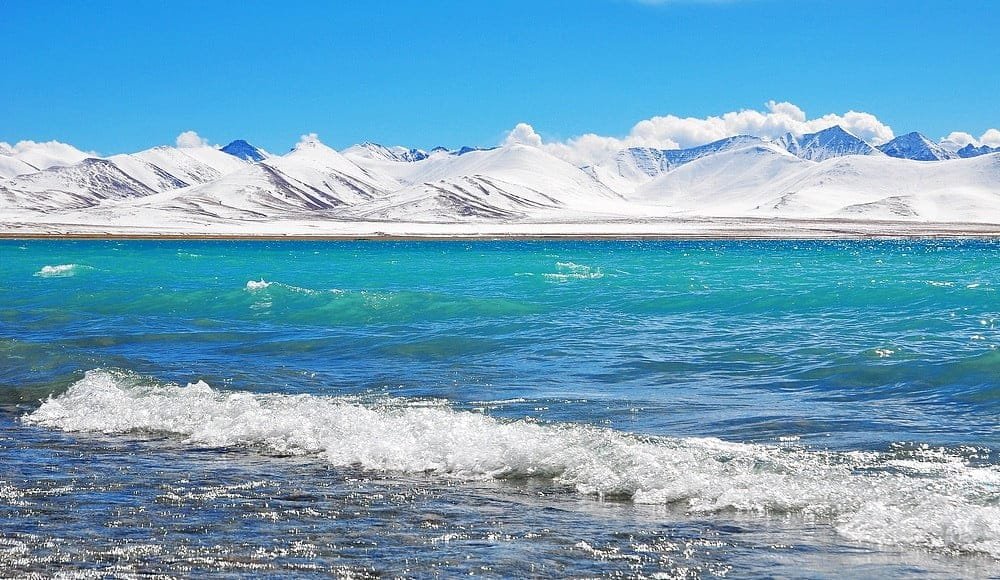
Namtso sits at 4,718 meters above sea level and marks the culmination of the Great Northern Loop. Despite the altitude’s physical demands, the lakeside delivers a sunrise that makes every challenge of the preceding days feel entirely worthwhile. The lake’s vastness is immediately striking — its deep blue waters stretching to the horizon under an open sky. Human encounters here add their own texture: a cyclist overwhelmed by the sheer scale of the view, an elderly Tibetan in vibrant traditional dress feeding fish along the shore.
At sunset, climbing the hillside above the lake reveals a light and shadow display across the water that captures something the Tibetans have long described as “Lake Light and Sky Color” a phrase that proves itself accurate the moment the sun begins to descend.
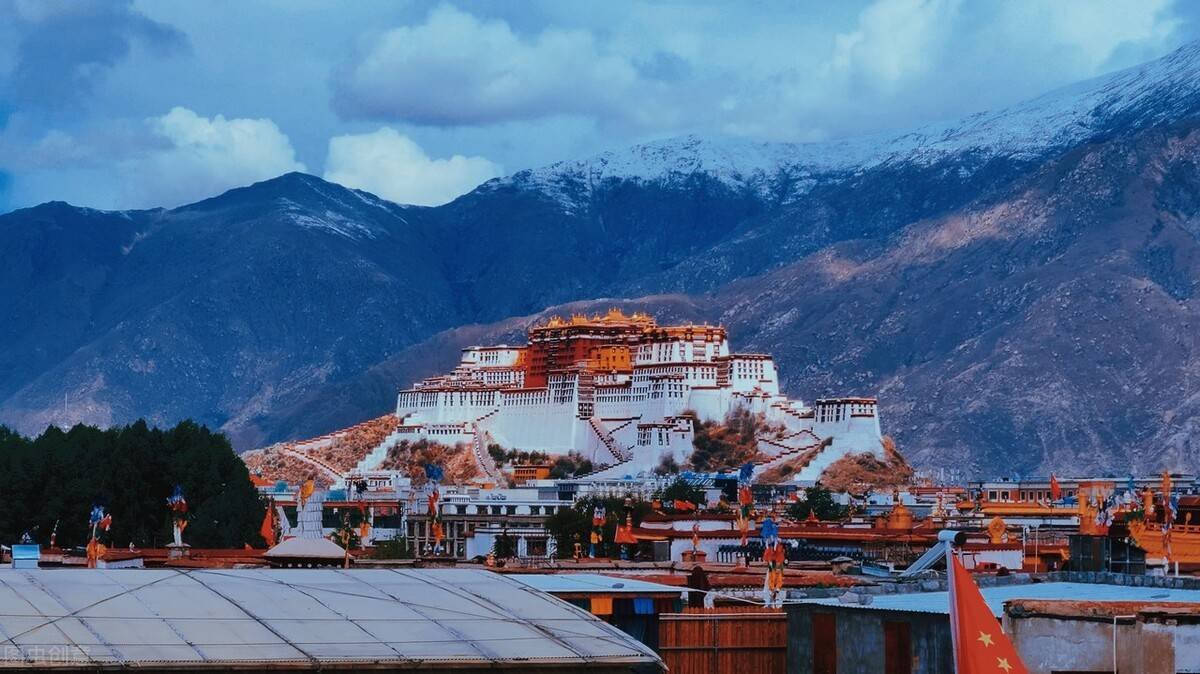
The final day carries the expedition back to Lhasa, where Barkhor Street welcomes the return with its familiar energy — market stalls, pilgrims, prayer flags, and the circular route around Jokhang Temple that has drawn people here for centuries. At Jokhang Temple Square, time slows. The pace of Lhasa after the raw solitude of Ngari feels like a different world entirely — and in many ways, it is.
The sunlit streets of Lhasa on the final day carry the weight of everything the expedition has passed through — glaciers, sacred lakes, ancient ruins, wild grasslands, and the highest mountain on earth — all folded into a city that wears its history openly and invites every returning traveller to sit with it for a while longer.
Travel through Ngari takes you into one of the most remote and challenging environments in Tibet. Along the North Ring Road near the Shiquan River, road conditions are unpredictable, with rough terrain, river crossings, and minimal infrastructure across regions like Geji, Gaize, Nyima, and Bangor. Delays and detours are common, requiring patience and flexibility. The entire journey remains at high altitude, averaging around 4,500 meters, with even higher points at Namtso Lake and Everest Base Camp. Proper acclimatization in Lhasa is essential, along with a steady pace to manage the physical demands.
Weather across the plateau changes rapidly, shifting from bright sunshine to snow, wind, or rain within hours, especially near Everest Base Camp. Wildlife encounters are a highlight, with Tibetan Antelope and Tibetan Wild Ass roaming freely around areas like Dongcuo Wetland Reserve. The journey also passes sacred sites such as Mount Kailash, Lake Manasarovar, Tashilhunpo Monastery, and Jokhang Temple, where respect for local traditions is essential. Historical treasures like the Guge Kingdom Ruins require careful preservation. Above all, this expedition demands flexibility—embracing unpredictable conditions is what makes the journey truly unforgettable.
The 12-day Ali Ngari Great Northern Loop is unlike any standard Tibet itinerary. While most journeys remain within the familiar route of Lhasa, Shigatse, and Everest Base Camp, this expedition pushes far into the remote west, reaching regions that very few travellers ever experience. What truly sets this route apart is the combination of multiple layers of experience—historical, spiritual, natural, and visual—woven into a single journey.
The historical depth is extraordinary, taking you back over a thousand years to the mysterious Guge Kingdom Ruins and even further to the ancient Zhangzhung Kingdom. Alongside this, the route explores some of the most sacred geography on Earth, including Mount Kailash—revered across multiple religions—and Lake Manasarovar, a site of deep spiritual importance shaped by centuries of pilgrimage and myth.
Equally remarkable is the untouched wilderness and ever-changing scenery of Ngari. At an average altitude of 4,500 meters, the journey crosses vast, wild landscapes where wildlife roams freely and nature remains largely untouched. Highlights include the dramatic formations of Zanda Earth Forest, the serene waters of Pekucuo Lake, the crescent-shaped Lake Rakshastal, and the vast beauty of Namtso Lake. Every day reveals a completely different landscape, making this loop one of the most diverse and visually striking journeys in all of Tibet.
Here are our contact options for your convenience:
Feel free to reach out anytime!
Yes, you have the option to cancel your tailor-made tour. However, be aware that cancellation charges will be applied as per the Tour Tibet cancellation policy. For detailed information, please review our Terms and Conditions.
Arranging a tour in Tibet independently is not possible due to the mandatory Tibet Travel Permit. This essential document is a requirement for all foreign visitors traveling to the region and can only be obtained through a local travel agency authorized by the Tibet Tourism Bureau.
Absolutely! We encourage you to visit our office and discuss your travel plans directly with our experienced travel consultants. Together, we can create a tailor-made Tibet tour that suits your preferences and requirements.
After confirming your tour arrangements, a deposit of 20% of the total trip cost is required to secure your booking. This deposit can be made via PayPal, Credit Card, Western Union, or Wire Transfer. The remaining balance is due at the start of your tour.