

Trandruk Temple: One of the Earliest Buddhist Temples in Tibet
Trandruk Temple (ཁྲ་འབྲུག་གཙུག་ལག་ཁང།), is one of the oldest and most historically significant Buddhist temples in Tibet. Located on Nedong County, the temple lies just 5 kilometers from Tsedang Town.
Recognized as a national key cultural relic protection unit, Trandruk Temple has a history of around 1,300 years, making it one of the earliest temples associated with the spread of Buddhism in Tibet. Its long history, legendary stories, and architectural development make it an important spiritual and cultural landmark.
Historical Significance of Trandruk Temple
Establishment During the Reign of Songtsen Gampo
Trandruk Temple was built during the reign of Songtsen Gampo, the powerful Tibetan king who played a crucial role in the early development of Buddhism in Tibet.
The temple dates back more than a thousand years, placing it among the earliest Buddhist temples in the region. Its construction marks an important moment in Tibetan history, when Buddhism began to take root and shape the spiritual culture of the Tibetan people.
Astrological Selection by Princess Wencheng
According to traditional accounts, the temple’s location was determined by Princess Wencheng, the Chinese princess who married Songtsen Gampo.
Legend says she used astrological calculations to identify the exact location where the temple should be built. The site was believed to suppress a powerful demon beneath the land. Building the temple there was thought to bring stability, harmony, and prosperity to the country.
Legends and Myths of Trandruk Temple
Songtsen Gampo’s Battle with the Dragons
Trandruk Temple is closely linked with an ancient legend about King Songtsen Gampo and a group of dangerous dragons living in a nearby lake.
According to the story, five dragons lived in the waters and threatened the safety of the surrounding land. To protect the country, Songtsen Gampo fought these dragons.
In the legend, the king transformed himself into a roc, a powerful mythical bird. From the sky, he battled the dragons in a series of fierce encounters until they disappeared.
This story represents the victory of positive forces over harmful ones and reflects the belief that spiritual power protects the land and its people.
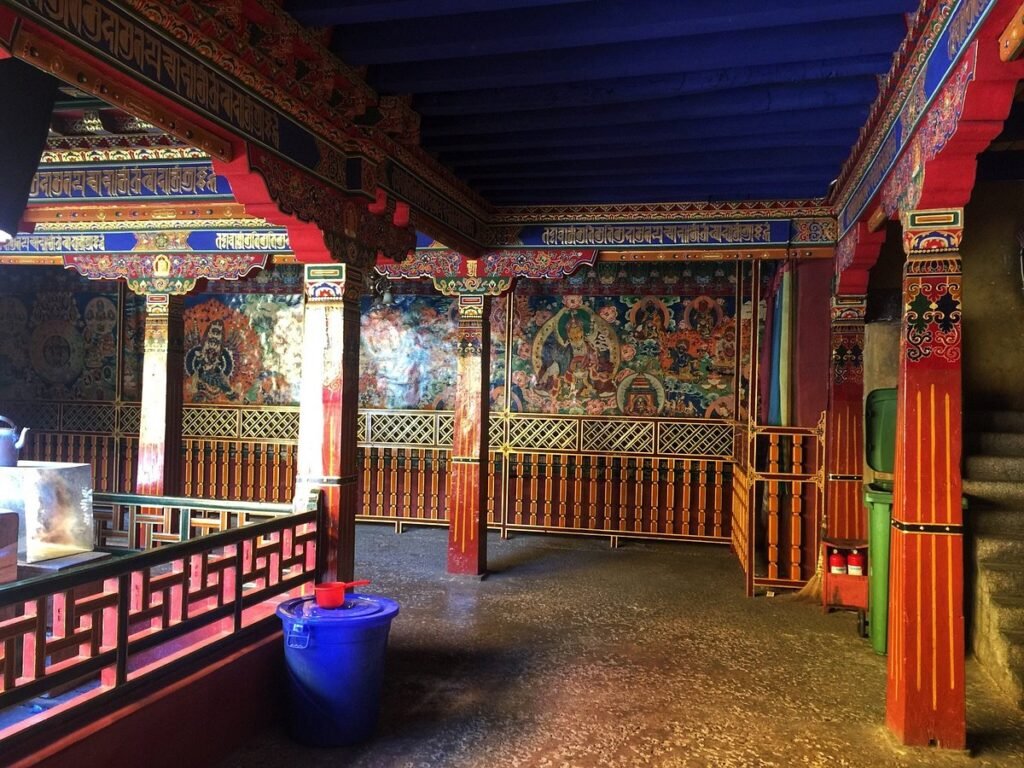

Structure and architecture of Trandruk Temple
The earliest structure of Trandruk Temple is a small hall known as “Naiding Lhakang,” positioned opposite the temple’s main building. This hall spans approximately 75 square meters and is supported by six pillars. Within Lhakang, the principal deity revered is a statue of Tibetan King Songtsen Gampo. The dimensions of the hall are 10.2 meters in length and 7.3 meters in width, and it originally housed a statue of Master Padmasambhava.
Expansion and Renovation of the Temple
Early Expansion: Naidong Gongma Situ Bodhi
In its earliest stage, Trandruk Temple was a small and simple structure, consisting of only a few rooms and a basic layout. One of the first major expansions was the construction of the Nedong Gongma Situ Bodhi. Historical records indicate that this expansion could not have occurred earlier than 1351.
During this period, additional Buddhist halls were built, gradually shaping the temple’s layout into a more organized complex.
Renovations During the Fifth Dalai Lama’s Era
Major renovations were carried out during the time of Fifth Dalai Lama.
These improvements included:
- Installation of a golden dome on top of the main hall
- Construction of a gate tower in front of the Tsochen main hall
- Addition of the Sanga Phodrang
These developments greatly expanded the temple and enhanced its architectural appearance.
Transformation into a Major Temple Complex
Through centuries of construction, renovation, and expansion, Trandruk Temple gradually evolved from a small religious site into a large temple complex.
Each stage of development reflects the growth of Tibetan Buddhist architecture and religious practice. The buildings, halls, and sacred spaces within the temple preserve layers of history spanning more than a millennium.
Trandruk Temple remains an important place for understanding the early spread of Buddhism and the enduring spiritual traditions of Tibet.
Later expansions
Trandruk Temple underwent significant renovations and expansions under the guidance of the seventh Dalai Lama. These changes not only enhanced the temple’s size but also its architectural grandeur:
Expansion under the Seventh Dalai Lama:
- Size: The temple’s area expanded to approximately 4665.6 square meters, with a length of 81 meters and a width of 57.6 meters.
- Features: It now houses 21 lacans (chapels) and prayer corridors. The temple’s roof is adorned with a shining golden dome, adding to its magnificence.
- Reverence by Dalai Lamas: Following the fifth Dalai Lama, successive Dalai Lamas have made it a practice to visit Trandruk Temple annually to offer incense and worship.
Architectural Layout:
- Courtyard: The temple is divided into two main sections. The front part features a small courtyard, while the rear houses the Lakang compound with the Tsokchen Hall at its centre.
- Bronze Bell: A notable feature is a bronze bell at the entrance, dating back to the 8th century, showcasing the historical ties and cultural exchanges between Tibet and other regions.
Sang A Phodrang:
- Construction Era: Built in the late 17th century by the Nyingma sect.
- Purpose: Designed to accommodate Nyingma monks during visits by the Dalai Lama.
- Facilities: Includes teahouses, firewood sheds, warehouses, living quarters, and kitchens.
Inner Structure:
- Lakang Courtyard: The main building of the temple, features a tall porch and is connected to the prayer cloister.
- Deity Statues: The entrance is guarded by two protector god statues and flanked by four statues of heavenly kings.
- Cuoqin Hall: Following the patio courtyard, this hall is surrounded by an inner prayer corridor.
Trandruk Temple, with its rich history and elaborate expansions, remains a site of deep spiritual importance in Tibet. Its unique architectural features and the reverence it receives from successive Dalai Lamas underscore its status as one of the “Three Holy Temples,” revered in the hearts of Tibetan Buddhist practitioners.
Trandruk Temple, a revered Buddhist site, features a unique architectural layout with a series of chapels or lakhangs arranged around a transit corridor. This corridor serves as a pathway for worshippers to follow a sequential route for paying homage to different Buddhas.
Architectural Layout and Features:
- Transit Corridor: The temple has 12 Lhakhangs (chapels) distributed around the corridor, creating an organized route for worshipping.
- Support Pillars: The corridor is supported by single or ‘ten’ pillars. The design of these pillars has evolved. Initially, the base of the pillars featured raspberry-shaped stones with carved lotus petals. Later designs adopted a simpler, uncarved approach.
- Murals: The walls of the cloister are adorned with murals. The south and north walls depict Buddhist stories, while the west wall features portraits of the fifth Dalai Lama, Gushi Khan, and Diba Sangye Gyatso, likely dating back to the late Qing Dynasty.
- Tsoqen Hall: This hall is distinct in its architecture, contrasting early styles with its bright, large-bayed design.
The LaKhangs:
- Zu Lakang: The most prominent chapel, located at the rear center of the corridor. It is flanked by Qujie Lakang and Tuoqie Lakang, with all doors facing west. These three buildings are interconnected, forming a cohesive unit.
- Buddha Statues: Inside Zu Lakang, there is a beautifully cast bronze statue of the Third Buddha, surrounded by ten standing Bodhisattva statues. Also notable is a statue of Talking Tara, believed to have been brought by Songtsen Gampo from Liyu.
Additional Features:
- Connecting Corridors: There are passageways linking Zu Lakang and Cuoqin halls. These corridors feature a low column in the centre, with guardian deity statues at the doorposts, characterized by their short, stout, and unusual forms.
- Pagodas: Several small pagodas are built along the corridor, adding to the temple’s spiritual ambience.
Trandruk Temple, with its intricate design and sacred spaces, is a testament to the rich history and evolving architectural styles of Tibetan Buddhism. The layout facilitates a meaningful spiritual journey for visitors, allowing them to engage sequentially with various aspects of Buddhist teachings and iconography. This temple not only serves as a place of worship but also as a cultural and historical treasure, reflecting the deep-rooted spiritual traditions of Tibet.
Trandruk Temple, steeped in history and spirituality, houses several significant chapels (Lakhangs) and statues, each with its own unique importance and artistic value.
Key Chapels and Statues:
Choejie Lakang:
- Main Statue: Enshrines Songtsen Gampo, with Princess Wencheng on the right and Princess Chizun on the left.
- Other Statues: Features a standing statue of Ludongzan and Tunmi Sambuzha. Additionally, statues of deities like the Infinite Light Buddha are present, noted for their simplicity and vivid portrayal. The statue of Princess Wencheng is particularly notable for its Tang Dynasty style.
Thokche Lakang:
- Main Statue: The central figure is the Thousand-Armed Avalokitesvara Bodhisattva, flanked by statues of side servants. The craftsmanship of these sculptures is exquisite, representing early artistic styles.
- Murals and Artifacts: The walls are adorned with murals, including depictions of Buddha Zedanrathbu. A unique feature is a stake-shaped earthen stove with basin-shaped pottery, believed to have been used by Princess Wencheng.
Additional Lakhangs:
Dajin Lhakhang: Houses an image of Sakyamuni Buddha, with Horsehead Hayagriva and Dharma Protector statues alongside.
Ruodan Lakang: Dedicated to the eleven-faced Guanyin Bodhisattva, surrounded by various pagoda paintings.
Tsepak Lhakang: Features the main statue of the Longevity Buddha, accompanied by Bodhisattva and Dharma God statues.
Desha Lhakhang: Primarily enshrines the Medicine Buddha, with walls displaying 99 Buddha statues of intricate design.
Trandruk Temple’s intricate chapels and their sacred contents provide a deep insight into Tibetan Buddhist art and iconography. The presence of historical figures like Songtsen Gampo and Princess Wencheng, along with various Buddhist deities, adds layers of religious significance to the temple. Visitors to Trandruk Temple are thus offered a rich tapestry of Tibetan culture, history, and spirituality, encapsulated within its ancient walls.
Trandruk Temple features a range of chapels (Lakangs) and statues, each with its unique significance and artistry, contributing to the temple’s rich spiritual and cultural heritage.
Happy Pearl Festival Lakang:
- Structure: The Lakang is spacious, with a central area featuring eleven statues of the Great Compassion Avalokitesvara, complemented by a Bodhisattva statue and a lotus flower statue, known for their exquisite and simple design.
- Murals: The walls of the hall are adorned with paintings of Tsongkhapa, Jia Caojie, Kezhu Jie, and other founders of the Gelug sect, adding to the spiritual ambiance of the space.
Oujin Lakhang:
- Built by: The 1st Rezhen Living Buddha.
- Layout: Divided into a front room, where a statue of Amitayus is prominently displayed, and a back room that houses a tall statue of Padmasambhava, along with various depictions of this revered figure and guardian deities.
Adjacent Lakangs:
Abalakang: Featuring a one-story-high statue of the fifth Dalai Lama, flanked by statues of Tsongkhapa and other Gelug sect founders, as well as Dharma King Atisha and previous Dalai Lamas.
Tongchui Lhakhang: Primarily enshrines Tsongkhapa, surrounded by statues of patriarchs and past Dalai Lamas.
Gongkhang (Dharma Protector Temple):
- Central Statue: A tall, powerfully crafted protector deity, characterized by its black color and claw-like hands and feet, symbolizing its potent protective power.
- Artistry: The statue is an early work, notable for its delicate yet unconventional design.
These chapels and statues play a pivotal role in the religious life of Trandruk Temple, each contributing to the temple’s status as a bastion of Tibetan Buddhism. The temple’s architectural and artistic elements are deeply intertwined with the spiritual practices and teachings of the Gelug sect, making it a vital destination for practitioners and visitors seeking to immerse themselves in Tibetan religious culture.
Trandruk Temple is adorned with various symbolic and religious artifacts, intricately woven into the architectural fabric of the temple, illustrating its rich spiritual and cultural heritage.