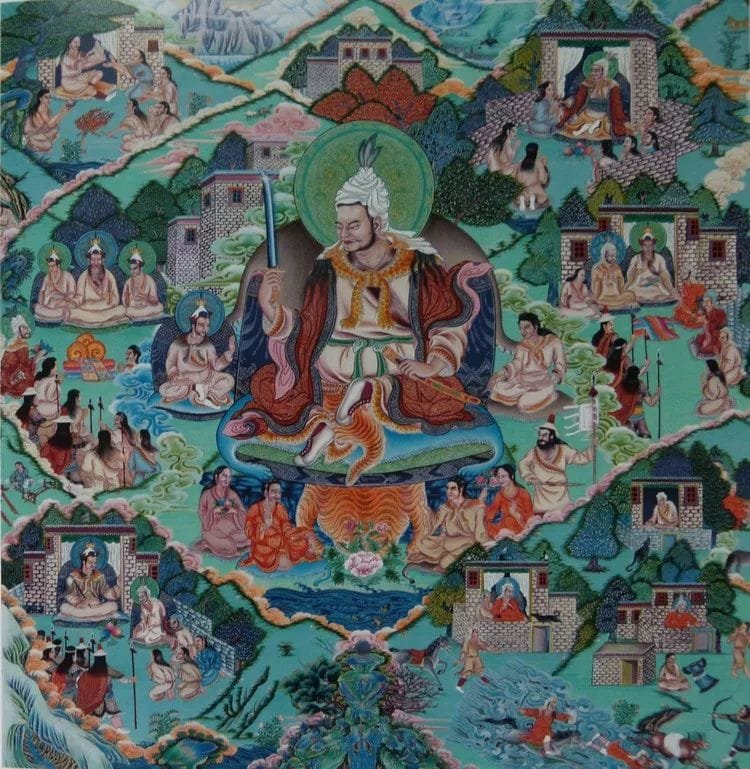
Across many ethnic histories, legends and myths act as vessels of memory. They may not always align neatly with historical fact, yet they often preserve deeper truths about origins, beliefs, and social structures. In Tibetan culture, one of the most influential and enduring legends is that of the “Tsenpo of the Sky”, a narrative that places the roots of Tibetan kingship within a sacred, celestial framework.
This legend is not merely folklore. It appears in ancient Tibetan manuscripts discovered in the Dunhuang caves, dating from the 7th to 9th centuries, a period that preserves invaluable records of Tibet’s early religious, political, and cultural life before the ninth century. These texts are considered essential for understanding Tibet’s prehistoric era, as they present the “Tsenpo of the Sky” as the founders of the Tibetan system of governance.
Divine Descent and the Birth of Kingship
According to manuscript P.T.1286, several divine beings descended from the heavens, including the six sons of the Heavenly Father and Tritön Dri, making seven celestial figures in total. Among them, Nyatri Tsenpo, the son of Tritön Dri, emerged as the ruler of the human world, establishing his authority in the Yarlung Valley, the cradle of early Tibetan civilization.
These early Tsenpo were believed to rule on earth temporarily before ascending back to the heavens, leaving no physical tombs behind. This idea of divine kingship deeply shaped Tibetan historical consciousness, embedding the belief that political authority was sanctioned by the sky itself.
Drigum Tsenpo and the End of Celestial Burials
Later Tibetan historical works, including the Red Annals and the Records of Tibetan Kings, continue to reference the heavenly burials of these early rulers. However, the legend reaches a turning point with the eighth king, Drigum Tsenpo.
Trigum Tsenpo’s death marked a fundamental rupture. His connection to the heavens was severed, and for the first time, a Tibetan king was given an earthly burial. This moment symbolized a profound shift in funerary practice and belief, marking the transition from celestial disappearance to physical interment.
Reinterpreting the Legend of the Sky Kings
The legend of the “Tsenpo of the Sky” raises important questions about early Tibetan burial customs. Rather than interpreting “heaven” purely as a supernatural realm, scholars suggest it may reflect high-altitude burial traditions, influenced by Bon religion, which venerates elevated and sacred landscapes.
Linguistic evidence from the Shuowen Jiezi dictionary defines “heaven” as both “high” and “origin”, suggesting that early burial practices evolved alongside social and economic changes. This perspective encourages scholars to move beyond literal interpretations and explore the symbolic and ideological meanings embedded in ancient funerary customs.
Looking Forward: Archaeology, Myth, and Cultural Memory
Modern archaeological discoveries and ethnographic research provide new ways to reassess the legend of the “Tsenpo of the Sky.” These findings allow researchers to examine how history, religion, and identity intertwine in Tibetan culture, offering deeper insight into ancient beliefs about kingship, death, and the afterlife.
Linking Heaven and Earth: The Meaning of “Cha” and “Mu”
Legends function as encoded history. To understand the funerary customs reflected in the “Tsenpo of the Sky,” it is essential to examine the symbolic geography behind the myth. Research into Southwest ethnic religions reveals a shared belief in soul migration, where the final resting place of the soul is the ancestral homeland, blending the concepts of the physical world and the afterlife.
This belief sheds light on the descent and return of the Tsenpo from “heaven.” Rather than a purely abstract realm, “heaven” may correspond to a real geographical region.
The “Kongpo Demu Carved Stone”, a Tubo-period inscription, states that Nyatri Tsenpo descended from Mount Gongto to rule humanity. In Bon religion, mountain worship and sky worship are inseparable, reinforcing the idea that political authority derived from sacred geography. This suggests that Nyatri Tsenpo’s origin was linked to a place known as “Cha.”
The Alliance Between Cha and Mu
Texts such as the Origin of Bon Religion describe a celestial king from Cha, Yalazhu, who married Sekama from Mu, producing six sons. During the Yarlung period, Tibetans began adopting territorial names as surnames, indicating lineage and noble origin. This supports the view that Nyatri Tsenpo belonged to the Cha clan, while his maternal lineage connected him to Mu.
The Five Lost Teachings recount a family conflict that led Nyatri Tsenpo’s father to be exiled to Mu, where the future king was born. Remarkably, Dunhuang manuscripts confirm diplomatic exchanges between Cha and Mu, with envoys traveling between the two regions.
Professor Shi Shuo argues that the famous myth of the monkey and demoness reflects a real historical alliance between the Cha clan of central Tibet and the Mu clan of the Trans-Himalayan region. This interpretation places Nyatri Tsenpo’s birthplace in the eastern Tibetan canyons, reinforcing Mu’s significance in Tibetan origins.
French Tibetologist Rolf Stein similarly observed that many Tibetan legends emphasize border regions rather than central Tibet, highlighting the formative influence of neighboring cultures in shaping Tibetan identity.
Dissecting the Body: Funeral Customs from the Mu Region
While P.T.1286 offers little detail on burial practices, manuscript P.T.1287 provides a vivid account of events following the death of Trigum Tsenpo. According to this text, the king’s body was sealed in a copper basket and cast into the Tsangpo River, eventually reaching the river’s end near Serkhang.
Years later, his posthumous son sought to reclaim the body. A woman from the Bird Family agreed to reveal its location on one condition: that the king’s body be dismembered and crushed, ensuring it would not remain in the human realm. This ritual promise was sworn, and only then was the body retrieved and buried at Jangdrolab.
Key Insights from Manuscript P.T.1287
This account reveals several critical aspects of early Tibetan funerary customs:
Movement of the Body
The transportation of the corpse along the river suggests a symbolic journey toward the Trans-Himalayan Mu region, aligning with ancient migration routes.
Secondary Burial Practices
The concealment and later retrieval of the body indicate a secondary burial tradition, supported by other Tibetan rituals conducted years after death.
Ritual Dismemberment
The promise to dismember and crush the body points to a ceremonial practice linked to beliefs about the soul’s release.
Matrilineal Cultural Influence
The central role of the Bird Family woman suggests matrilineal traditions, echoing customs found in neighboring societies such as the Dongnu Kingdom, where similar funeral rites were practiced.
Scattered Bone Burials and Elite Funeral Customs
Archaeological evidence supports these textual accounts. The oldest Tibetan burial practice is stone coffin burial, dating from the Neolithic period to the late Han Dynasty. These rectangular stone chambers, often containing burial goods, are widespread across Chamdo, Nyingchi, Shannan, and Shigatse.
Scholar Luo Kaiyu identified a strong cultural network across Eastern Tibet and the Trans-Himalayas, while archaeologist Huo Wei documented stone coffin burials containing scattered or disturbed bones, suggesting secondary burial practices.
Excavations in Chamdo, Angren, and Qugong reveal skulls with circumferential cutting marks and incomplete skeletons, evidence of deliberate post-mortem modification. These practices appear to have been reserved for the elite, supported by burial goods such as horse remains, ritual platforms, and ash pits.
Historical texts like the New Tang Book further confirm that body dismemberment was a prestigious funerary custom among nobles in regions associated with Bon religion.
Souls Returning to the Trans-Himalayas
What belief system underpinned these complex burial rites? In Bon religion, the soul’s ascent to the sky required proper ritual preparation. Manuscripts suggest that “heaven” was synonymous with Mu, a sacred land associated with sky deities.
Linguistically, Mu (dmu, rmu, smu) appears across Tibeto-Burman languages to mean heaven, people, and clan, reinforcing its spiritual significance. The ritual dismemberment described in P.T.1287 was believed to trigger the appearance of a golden heavenly rope, allowing the soul to ascend.
This explains why early Tibetan burial practices focused on separating flesh from bone. The belief that the soul resides in the bones shaped funerary customs, including stone coffin burials placed on high slopes, often facing east toward Mu.
Eastward Burial and Cultural Continuity
The orientation of ancient tombs toward the east reflects enduring beliefs linking the sunrise with rebirth and ancestral return. Even today, Tibetan burial customs often maintain this eastward orientation, blending Buddhist ideas with ancient Bon traditions.
The transition during Trigum Tsenpo’s era—from scattered bone burial to tomb construction—marks a broader cultural shift. It reflects changes in social structure, economic development, and the gradual movement from matrilineal to patrilineal systems of ancestry and worship.
The names of the “Tsenpo of the Sky,” lacking paternal lineage but emphasizing maternal ties, preserve the memory of this earlier social order, revealing how myth, burial practice, and identity evolved together in early Tibetan history.