

The dramatic collision between the Indian Plate and the Eurasian Plate is one of the most powerful geological processes shaping our planet today. This ongoing tectonic interaction has given rise to towering mountain ranges, vast plateaus, and complex structural formations—most notably the Tibetan Plateau, often called the “Roof of the World.”
Despite decades of research, scientists are still working to fully understand how the lithosphere beneath the Tibetan Plateau deforms and evolves. Recent large-scale geodetic observation networks have provided new insights into the three-dimensional kinematics of this diffuse plate boundary, revealing the hidden mechanisms operating deep within the upper mantle.
Why the India–Eurasia Collision Matters
The convergence of the Indian and Eurasian plates is not simply a boundary interaction—it is a continental-scale tectonic engine driving multiple geological processes. As the Indian Plate continues to move northward, it compresses and reshapes the crust, resulting in uplift, crustal shortening, and lithospheric restructuring across Asia.
This collision has played a critical role in forming the Himalayas and elevating the Tibetan Plateau to an average height exceeding 4,500 meters. However, the internal deformation patterns within the plateau remain complex, and researchers have long lacked a unified model to explain them.
Today, advanced GNSS (Global Navigation Satellite System) measurements are helping scientists map velocity fields with remarkable precision, allowing for a clearer interpretation of tectonic movements across the region.
Mapping the Tectonic Framework Around the Tibetan Plateau
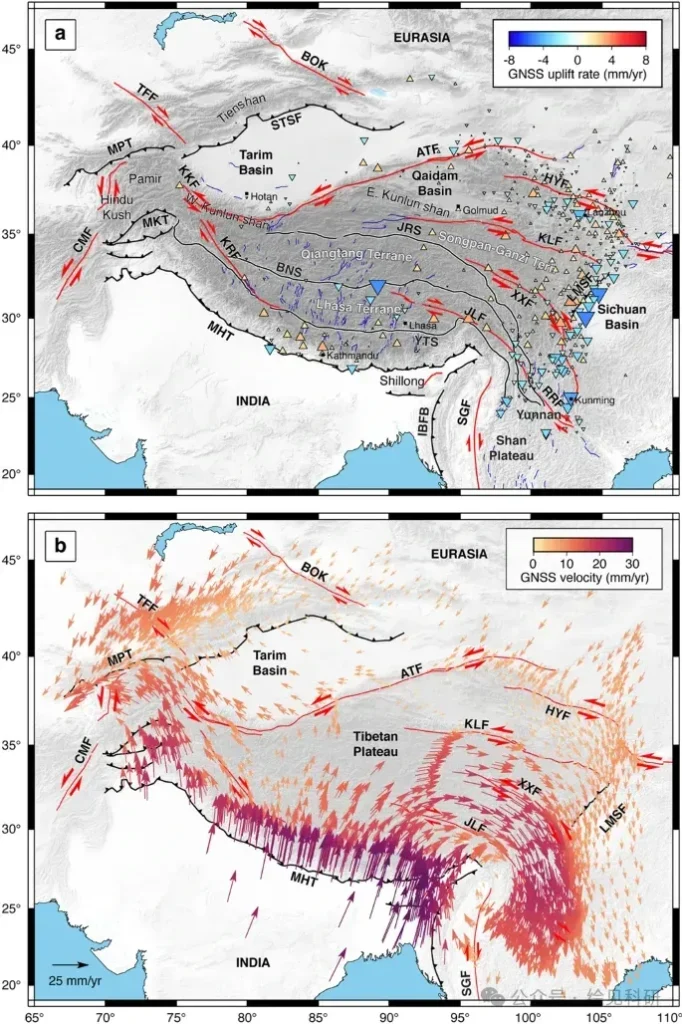
Figure 1: Tectonic background surrounding the Tibetan Plateau and distribution of GNSS velocity fields.
The Tibetan Plateau sits within a broad and diffuse plate boundary zone rather than along a single fault line. This means deformation is distributed across a wide region instead of being concentrated at one sharp boundary.
Three-dimensional velocity field data derived from geodetic networks reveal distinct tectonic behaviors across different parts of the plateau:
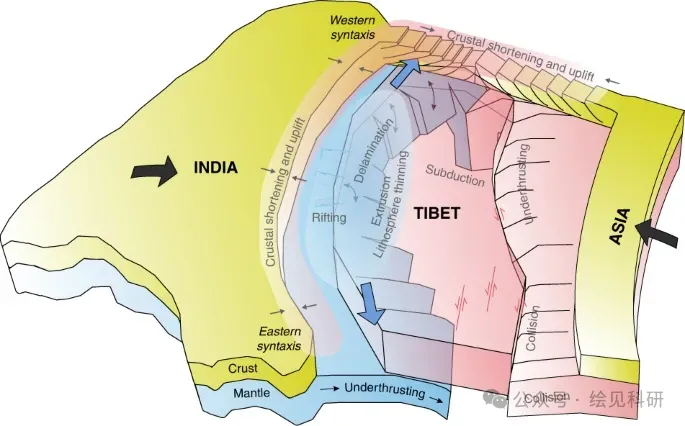
- Continental subduction is occurring beneath the central Himalayas.
- Slab detachment and rollback are evident beneath the western tectonic belt.
- Crustal shortening along the southern and northwestern margins contributes directly to plateau uplift.
- Central Tibet is experiencing subsidence accompanied by lateral extrusion and lithospheric thinning.
Together, these processes paint a dynamic picture of a plateau that is still actively evolving.
Continental Subduction Beneath the Central Himalayas
One of the most significant discoveries is the presence of continental subduction beneath the central Himalayan region. Unlike oceanic subduction—where dense ocean crust sinks into the mantle—continental subduction involves buoyant continental crust being forced downward.
This process creates enormous compressional stress, which contributes to the uplift of the Himalayas while simultaneously thickening the crust beneath southern Tibet.
The result is a powerful vertical and horizontal restructuring of the lithosphere that continues to reshape the region.
Slab Detachment and Rollback in Western Tibet
In contrast to the central Himalayas, the western tectonic zone shows evidence of slab detachment followed by rollback.
Slab detachment occurs when the descending portion of a tectonic plate breaks away from the rest of the plate. Once separated, the slab can sink deeper into the mantle, triggering mantle flow and altering stress patterns above.
Rollback then pulls the remaining slab backward, often leading to extension at the surface.
This mechanism helps explain the contrasting geological features between western Tibet and the central Himalayan belt.
What Drives the Uplift of the Tibetan Plateau?
The uplift of the Tibetan Plateau is not caused by a single process. Instead, it results primarily from crustal shortening along its southern and northwestern margins, where both the Indian and Asian plates compress the region.
As the crust shortens, it thickens—much like a rug bunching up when pushed from one side—forcing the land upward over millions of years.
This continuous uplift has profound implications for:
- Regional climate systems
- Asian monsoon patterns
- River formation
- Biodiversity
- Long-term geological stability
Understanding these forces helps scientists better predict future tectonic behavior.
Central Tibet: Subsidence, Lateral Extrusion, and Lithospheric Thinning
While much of the plateau is rising, central Tibet presents a surprising contrast: localized subsidence.
This sinking is closely associated with lateral extrusion, a process in which crustal material is squeezed outward due to intense compressional forces.
As material escapes sideways, the lithosphere becomes thinner. Researchers suggest that this thinning is further assisted by downwelling mantle flow generated beneath the opposing collision zones of the Indian and Asian plates.
These interacting mechanisms demonstrate that uplift and subsidence can occur simultaneously within the same tectonic system.
Evidence from Three-Dimensional Velocity Fields
Figure 2: Tectonic evolution of the India–Eurasia collision, illustrating uplift and subsidence patterns.
The use of three-dimensional velocity field data marks a major advancement in tectonic research. By analyzing how different sections of the plateau move relative to one another, scientists can reconstruct deformation patterns with unprecedented clarity.
Key observations include preventional motion gradients, distributed strain zones, and mantle-driven structural adjustments—all of which highlight the Tibetan Plateau as one of Earth’s most active continental laboratories.
A Record of Late Cenozoic Differential Evolution
The current kinematic characteristics of the India–Eurasia collision may reflect a broader pattern of differential evolution between the interior and outer regions of the Tibetan Plateau during the Late Cenozoic era.
Rather than evolving uniformly, the plateau appears to have undergone region-specific tectonic pathways shaped by variations in mantle dynamics, crustal strength, and plate interactions.
This perspective shifts scientific understanding away from simplified models toward a more nuanced interpretation of plateau development—one that recognizes the coexistence of compression, extension, uplift, and subsidence within a single geological system.
#TibetanPlateau #PlateTectonics #IndiaEurasiaCollision #HimalayanGeology #TectonicEvolution