

Mangsong Mangtsen: Steering the Tibetan Empire Through Transition and Expansion
Mangsong Mangtsen, the 34th Tsenpo of the Tibetan Empire, ruled from 650 to 676 AD, a period marked by political transition, territorial expansion, and complex relations with the Tang Dynasty. As the grandson of the legendary Songtsen Gampo, Mangsong Mangtsen inherited a rapidly growing empire and played a crucial role in shaping its administrative, military, and diplomatic foundations.
Born to Gongri Gongzan and a Tuyuhun princess named Mongjie Diga, Mangsong Mangtsen stood at the crossroads of Tibetan and neighboring royal lineages, a background that deeply influenced his reign and foreign policy.
A Young Emperor and the Rise of the Regency
Mangsong Mangtsen ascended the throne at a very young age. Due to his youth, real political power initially rested with Gar Tongtsen, the highly capable Grand Minister of Tibet. Acting as regent, Gar Tongtsen ensured continuity and stability during this sensitive transitional period.
Under his guidance, the Tibetan Empire avoided internal fragmentation and instead focused on strengthening governance, reinforcing borders, and preparing for future expansion.
Internal Stabilization and Administrative Reforms
Introduction of a Taxation System (652 AD)
One of the earliest reforms during Mangsong Mangtsen’s reign was the establishment of a formal taxation system in 652 AD. This reform helped regulate state revenue and strengthened the empire’s economic foundation, marking a move away from purely traditional tribute-based systems.
Codification of Laws (655 AD)
By 655 AD, a comprehensive legal framework was introduced. Gar Tongtsen personally toured vast regions of the empire—from Tuyuhun in the east to Zhangzhung in the west—to enforce these laws and ensure loyalty. These reforms laid the groundwork for centralized governance across Tibet’s expanding territories.
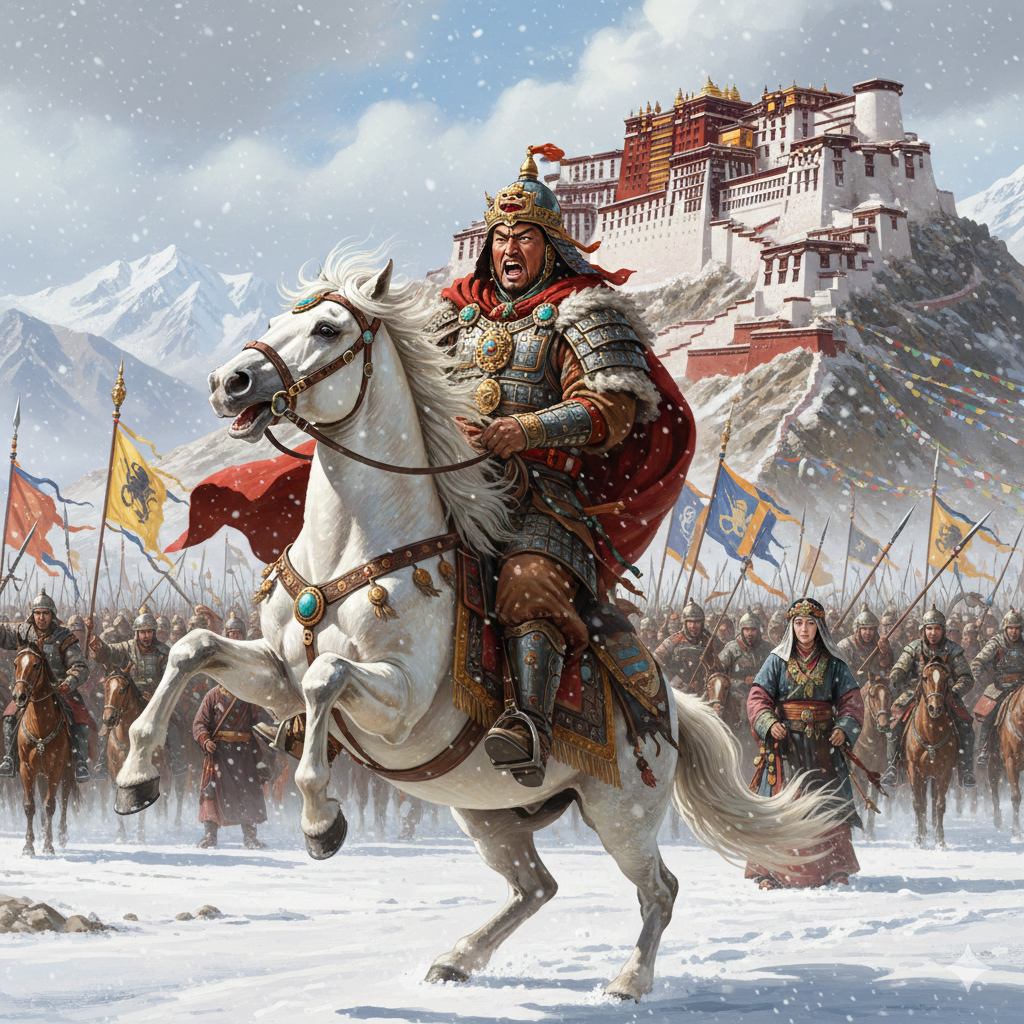
Military Expansion and Early Campaigns
Conquest of the Qinghai Lake Region (656 AD)
After securing internal stability, the Tibetan Empire turned outward. In 656 AD, Gar Tongtsen led a massive force of 120,000 troops against the Bailan, a key ally of Tuyuhun. The campaign succeeded, and the region around Qinghai Lake was incorporated as a vassal state, extending Tibetan influence further into strategic borderlands.
Diplomatic Engagements with the Tang Dynasty
Throughout this period, Tibet attempted to avoid direct confrontation with the powerful Tang Dynasty. The Tibetan court sought peaceful coexistence to prevent Tang military intervention on behalf of Tuyuhun.
In 658 AD, Tibet proposed a marital alliance with the Tang court. The proposal was rejected, signaling a diplomatic setback and foreshadowing future conflict between the two great empires.
The Fall of Tuyuhun and Tibetan Domination
Strategic Invasion and Final Conquest (659–663 AD)
In 659 AD, a Tuyuhun minister defected to Tibet, providing critical military intelligence. Seizing the opportunity, Gar Tongtsen launched a large-scale invasion. By 663 AD, Tuyuhun was fully conquered, and its king and queen fled to Tang territory seeking asylum.
Tuyuhun was absorbed into the Tibetan Empire as a vassal state, dramatically shifting the balance of power in the region.
Political Control Through Royal Alliances
To consolidate authority, Gar Tongtsen remained in Tuyuhun and installed a puppet king married to a Tibetan princess, ensuring political loyalty and long-term stability under Tibetan rule.
Expansion into the Western Regions and the Silk Road
Control of Strategic Corridors
With Tuyuhun secured, the Tibetan Empire extended its influence across the Western Regions, gaining control of the Wakhan Corridor. This strategic route strengthened Tibet’s position along the Silk Road, enhancing trade leverage and military mobility.
Incursions into Tang-Influenced Territories
In 662 AD, Tibetan forces advanced into the Balur region (modern Kashmir) and encouraged revolts among Tang allies. These actions intensified tensions and expanded Tibet’s geopolitical reach beyond the plateau.
The Battle for the Tarim Basin (670 AD)
One of the most significant achievements of Mangsong Mangtsen’s reign came in 670 AD, when Tibetan forces captured the Tarim Basin from the Tang Dynasty. This victory gave Tibet control over key Silk Road oases and trade routes, marking a major shift in Central Asian power dynamics.
Tang Counteroffensive and Shifting Power
In response to Tibetan expansion, Emperor Gaozong of Tang launched a massive counteroffensive led by the general Xue Rengui. Although initial Tang campaigns suffered setbacks, the Tang Dynasty eventually regained momentum.
By 676 AD, the Tang successfully recaptured the Anxi Four Garrisons, demonstrating the fluid and contested nature of power along the Silk Road frontier.
The Mysterious Death of Mangsong Mangtsen
Mangsong Mangtsen’s death remains one of the most intriguing episodes in Tibetan history. Tibetan sources record that he passed away quietly, leaving behind an infant heir, Dusong Mangpoje, who ascended the throne shortly after birth.
Due to ongoing wars with the Tang Dynasty, internal rebellions, and the absence of key ministers on distant battlefields, the Tibetan royal family took extraordinary measures to conceal the king’s death. His body was secretly preserved, and the news was withheld for nearly three years to maintain political stability.
Mourning, Tomb, and Royal Burial
In 679 AD, once stability was restored, Tibet officially announced Mangsong Mangtsen’s death. Rituals were performed, and the Tang court was formally notified.
His tomb, known as Oshay Saipo Ling, was built beside that of Songtsen Gampo and reportedly filled with treasures, reflecting the grandeur of the Tibetan imperial tradition.
Tomb Robbery, Rebellion, and Survival
Following the collapse of the Tibetan Empire, widespread rebellion erupted. By 877 AD, serf armies plundered the tombs of past Tibetan Tsenpos. Mangsong Mangtsen’s tomb, assigned to a figure named Niwa, was notably spared from desecration, allowing it to survive intact through centuries of turmoil.
Confusion in Historical Records
Chinese sources such as the New Book of Tang and Tongdian provide fragmented and sometimes conflicting accounts of Mangsong Mangtsen. Scholar Wang Yao later identified errors, suggesting that references to “Qilie Babu” were likely misidentifications of another historical figure, Lababu.
These discrepancies caused some of Mangsong Mangtsen’s achievements to be wrongly attributed, contributing to his relative obscurity in non-Tibetan historical narratives.
A King Shrouded in Mystery and Power
Mangsong Mangtsen’s reign represents a defining chapter in Tibetan imperial history, marked by institutional reform, military ambition, Silk Road expansion, and strategic diplomacy with the Tang Dynasty. The secrecy surrounding his death, the survival of his tomb, and the confusion in historical records all add to the enduring mystery of a ruler who guided Tibet through one of its most transformative eras.