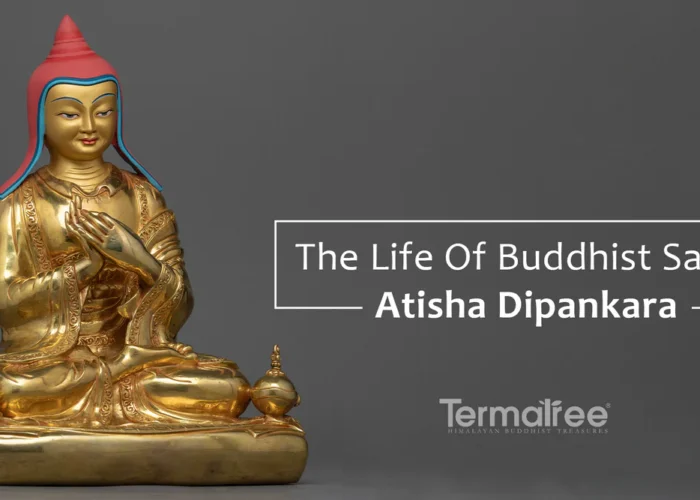
Atiśa Dīpaṃkara Śrījñāna, respectfully known in Tibet as Jowo Jé, meaning “Precious Lord,” is one of the most influential figures in the history of Tibetan Buddhism. Born in 982 CE in Vikrampura, Bengal (present-day Bangladesh), Atiśa emerged from a royal family yet chose a life devoted entirely to the Dharma.
Living during a critical period for Buddhism, Atiśa became the bridge between Indian Mahayana and Vajrayana traditions and the revival of Buddhism in Tibet after centuries of decline. His teachings emphasized ethical discipline, compassion, bodhicitta, and the harmonious integration of sutra and tantra, shaping Tibetan Buddhism in ways that continue to guide practitioners today.

Early Life and Spiritual Calling
Atiśa was born as Chandragarbha, the second son of King Kalyānaśrī and Queen Prabhavati, into a wealthy and powerful royal household in eastern India. From a young age, he showed little interest in royal privilege and a strong inclination toward spiritual life.
According to traditional accounts, at the age of eleven, Atiśa experienced a vision of Tara, the female bodhisattva of compassion and swift action. This vision profoundly shaped his destiny, guiding him away from worldly ambition. Despite his parents arranging a royal marriage, Atiśa renounced secular life on the eve of his wedding, choosing instead the path of spiritual liberation.
Monastic Training and Scholarly Mastery
By his late teens, Atiśa was already traveling across India, studying with the greatest Buddhist masters of his time. He received tantric teachings from renowned adepts such as Jetari, Kanha, and Naropa, and trained in advanced Vajrayana systems including Hevajra Tantra.
At the age of 29, following a prophetic dream in which the Buddha urged him to take full ordination, Atiśa became a monk at Bodh Gaya under the preceptor Śīlarakṣita. He received the name Dīpaṃkara Śrījñāna, meaning “Lamp of Deep Awareness.”
He later studied and taught at prestigious Indian monastic universities such as Odantipuri and Vikramashila, eventually becoming one of Vikramashila’s most respected abbots. His education covered the full spectrum of Buddhist thought—Hinayana ethics, Mahayana philosophy, and Vajrayana ritual systems.
Atiśa studied under more than 150 teachers, mastering teachings on emptiness (śūnyatā) and bodhicitta, earning a reputation as a guardian of pure Buddhist doctrine and strict monastic discipline.
Journey to Sumatra and the Quest for Bodhicitta
Although already highly accomplished, Atiśa sought deeper realization of ultimate bodhicitta, the altruistic aspiration to attain enlightenment for all beings. Guided by visions of Tara, at the age of 31 he undertook a dangerous sea voyage to Sumatra (Suvarnadvipa).
There, he studied for 12 years under the great master Dharmakīrti (Serlingpa), one of the most important transmitters of lojong (mind training) teachings. This period transformed Atiśa’s spiritual understanding, especially practices designed to overcome ego and cultivate compassion, such as teachings later known through texts like the Wheel of Sharp Weapons.
Return to India and Role as a Reformer
Around the age of 45, Atiśa returned to India and entered a long period of retreat and teaching at Vikramashila Monastery. During this time, he authored many texts, upheld strict vinaya (monastic discipline), and worked to correct distorted tantric practices that had emerged in some regions.
His reputation spread across Asia as a scholar who combined deep realization with ethical purity, making him one of the most respected Buddhist authorities of his era.
Invitation to Tibet and the Revival of Buddhism
By the early 11th century, Buddhism in Tibet had declined severely following persecution under King Langdarma in the 9th century. Alarmed by doctrinal confusion and corrupted practices, King Lha Lama Yeshe Ö of western Tibet sought to restore authentic Buddhism.
After many failed attempts and great personal sacrifice, including imprisonment and ransom demands, the mission to invite Atiśa succeeded. Encouraged by further visions of Tara and urged by Tibetan translator Nagtso Lotsawa, Atiśa finally agreed to travel to Tibet.
In 1042 CE, at the age of 60, Atiśa arrived in Ngari, later traveling to Nyetang near Lhasa. Over the next 12 to 17 years, he taught extensively across Tibet, corrected misunderstandings in Hinayana, Mahayana, and Vajrayana, and worked closely with translators such as Rinchen Zangpo to ensure accurate translations of Indian Buddhist texts.
Lamp for the Path: Atiśa’s Core Teachings
Atiśa’s most famous work, the Bodhipathapradīpa (Lamp for the Path to Enlightenment), became one of the most important texts in Tibetan Buddhism. It presented the entire Buddhist path in a clear, graduated system, later known as Lamrim.
This system categorized practitioners into three levels of capacity—small, medium, and great—and integrated morality, meditation, and wisdom into a unified path. This framework later deeply influenced Lama Tsongkhapa and the Gelug school, and remains foundational in Tibetan Buddhist practice today.
Atiśa also emphasized lojong mind training, teaching methods such as tonglen (giving and taking) to transform suffering into compassion. He introduced devotional practices related to Tara, his lifelong spiritual guide, and ritual traditions aimed at harmonizing spiritual and everyday life.
The Kadam School and Lineage
Atiśa’s foremost disciple, Dromtönpa, regarded as an emanation of Avalokiteshvara, founded the Kadam School of Tibetan Buddhism. This school emphasized humility, ethical discipline, compassion, and textual accuracy.
Although the Kadam School later merged into other traditions, its teachings profoundly shaped all major Tibetan lineages, including Nyingma, Kagyu, Sakya, and Gelug. Atiśa himself authored over 100 texts and played a central role in the New Translation (Sarma) period of Tibetan Buddhism.
Passing and Enduring Legacy
Atiśa passed away in 1054 CE at the age of 72 in Nyetang, Tibet, fulfilling a prophecy foretold by Tara. His relics were enshrined, and places associated with him—such as Tholing Monastery—remain important pilgrimage sites.
Revered as an incarnation of Manjushri, the bodhisattva of wisdom, Atiśa’s influence continues to shape Tibetan Buddhist philosophy, ethics, and practice. His Lamrim teachings are studied worldwide, and modern spiritual leaders, including the Dalai Lama, continue to draw inspiration from his message of compassion, clarity, and selfless service.
As Atiśa himself advised:
“Abandon all worldly concerns and devote yourself to the Dharma for the benefit of all beings.”