
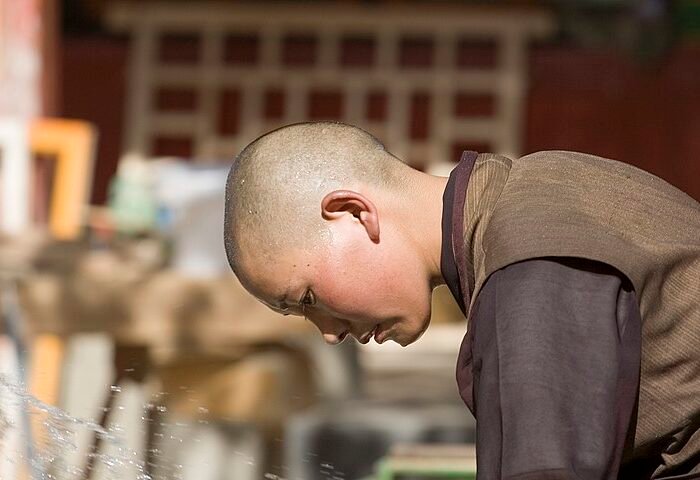
Shugseb Nunnery (ཤུག་གསེབ་དགོན།), also known as Shugseb Ani Gompa or Xiongse Temple, is the largest and most influential nunnery in Qushui County, Tibet. Nestled on the slopes of Shugseb Mountain, southeast of Qushui County in Caina Township, the nunnery overlooks the southern bank of the Lhasa River. Surrounded by dense shrubs and quiet mountain paths, Shugseb offers a serene environment ideal for meditation, retreat, and spiritual practice.
Founded in 1181, Shugseb Nunnery has played a vital role in the religious history of Tibetan Buddhism, particularly in supporting female monastic practitioners across different lineages.
Origins of Shugseb Nunnery and the Shugseb Kagyu Lineage
Shugseb Nunnery was founded in 1181 by Jetsün Chöjé Gyergom Tsultrim Sangey (1140–1204), a prominent Tibetan Buddhist master and disciple of Phagmo Drupa (1110–1170). Originally, the monastery served as the ancestral seat of the Shugseb Kagyu lineage, a branch emphasizing advanced tantric practices, especially Hevajra Tantra.
Under its founder’s guidance, Shugseb quickly developed into a thriving religious center, nurturing a disciplined community of practitioners and establishing a strong reputation for serious meditation and retreat.
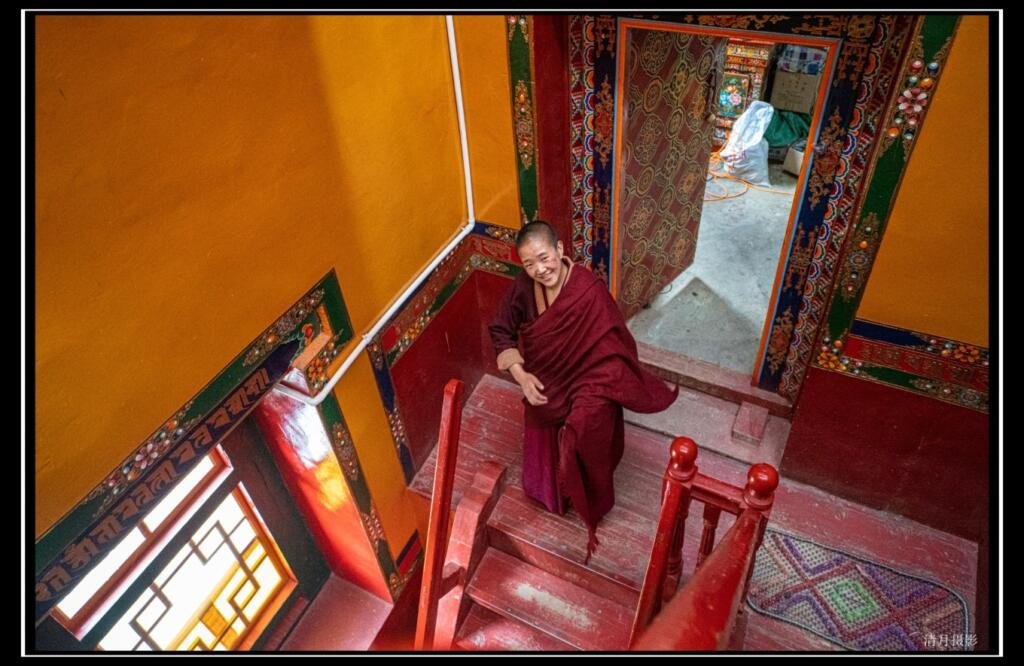
Shugseb Nunnery and Longchen Rabjam’s Spiritual Legacy
By the 14th century, Shugseb Nunnery gained profound importance within the Nyingma school of Tibetan Buddhism. During this period, the great Nyingma master Longchen Rabjam (1308–1364), also known as Kunkhyen Longchenpa, chose Shugseb as a place for extended retreat.
While residing here, Longchen Rabjam composed his most influential works, collectively known as “The Seven Treasuries” (Longchen Dzö Dun). These texts remain foundational scriptures in Nyingma philosophy, Dzogchen practice, and Tibetan Buddhist scholarship. Following his retreat, Shugseb gradually transitioned from a Kagyu monastery into a Nyingma-affiliated nunnery, a shift that deeply shaped its later identity.
A short walk downhill from the nunnery—approximately half an hour on foot—leads to Gangri Thökar (White Skull Snow Mountain). This sacred site contains Longchen Rabjam’s meditation cave, a statue, newly built retreat huts, and a sacred spring known as Oma Chumik, all revered pilgrimage points for practitioners.
Decline, Destruction, and Revival in the 20th Century
Like many Tibetan monasteries, Shugseb Nunnery suffered severe damage during periods of conflict and social upheaval. Despite these challenges, its spiritual lineage and reputation survived through oral transmission and continued devotion.
In the early 20th century, Shugseb experienced a major revival under the patronage of the Ngapo noble family and the leadership of the extraordinary female tulku Shugseb Jetsun Rinpoche (ཤུག་གསེབ་རྗེ་བཙུན་རིན་པོ་ཆེ།). She spearheaded the reconstruction of the main assembly hall and stupa, transforming Shugseb once again into a vibrant religious center.
During this period, the nunnery housed 400 to 500 nuns, making it one of the most important nunneries in central Tibet and a rare example of a large, well-organized female monastic community.
Jetsun Lochen: A “Self-Made Buddha” of Shugseb
One of Shugseb Nunnery’s most revered figures is Jetsun Lochen, also known as Jetsun Rinpoche. Unlike most tulkus recognized through reincarnation lineages, Jetsun Lochen was acknowledged based on her spiritual realization and rigorous practice. In Tibetan tradition, she is honored as a “Rangjung Lama”, meaning a “self-arisen” or “self-made Buddha.”
Jetsun Lochen passed away in 1953, at the remarkable age of 120. Her sacred body was enshrined in a stupa within the main assembly hall, where devotees continue to offer prayers and circumambulate in reverence. Today, the lineage is carried forward by Shugseb Dorje Rinpoche, a member of the Sikkimese royal family, who continues to emphasize Vajrayana Buddhist practice and disciplined retreat.
Cultural Heritage: Shugseb Nunnery’s Sacred Chant Tradition
Shugseb Nunnery is also renowned for its unique musical tradition known as “Choelu”, which has been officially recognized as part of China’s National Intangible Cultural Heritage (fourth batch). This tradition belongs to a rare form of Tibetan Buddhist ritual music that combines Chö chanting with ritual instruments.
The Shugseb Chant, performed exclusively by nuns during Chöd rituals, stands out for its depth, rhythm, and spiritual intensity. Among Tibetan nunneries, Shugseb’s chant tradition is considered one of the most representative and culturally significant expressions of female monastic ritual art.
The Founder: Chöjé Gyergom Tsultrim Sangey (1140–1204)
Chöjé Gyergom Tsultrim Sangey was born in the Yarlung region of southern Tibet and belonged to the Gyer (dgyer) clan. His father, Konchok Kyab, was a military official, while his mother was Gyeltsama Dode Gyen. He entered monastic life at the age of 11, receiving the name Tsultrim Sengge, meaning “Lion of Discipline.”
He studied initiation rites and esoteric teachings under Geshe Hol, later becoming a disciple of Phagmo Drupa, from whom he received advanced instructions, including the Six Yogas. Afterward, he trained under Zhije master Mel Kawachenpa and practiced advanced tantric systems such as Mahamudra and Chakrasamvara in the Eka region.
By his 30s, Tsultrim Sengge had renounced worldly concerns and traveled widely, teaching, writing, and subduing local spirits. With patronage from Nibeng, he composed influential works on causation and tantric practice. In 1181, he founded Shugseb Nunnery, leading it for 24 years and firmly establishing the Shugseb Kagyu lineage.
Visiting Shugseb Nunnery: Practical Travel Information
- Admission: Free (donations welcome)
- Opening Hours: 9:00 AM – 6:00 PM
- Location: 69 kilometers from downtown Lhasa
- Access: Self-drive or chartered vehicle recommended
- Accommodation: Basic guesthouse available within the nunnery
For travelers interested in women’s monastic life, Shugseb offers rare insight into Tibetan Buddhist practice in a peaceful mountain setting.
Other Notable Nunnery in Qushui County
Another important site nearby is Sama Drak Temple, located in Xierong Village. Founded in the 9th century by Jire Rinpoche, this ancient nunnery further illustrates the deep historical roots of female Buddhist practice in the region.