Planning a trip to Lhasa from America combines logistical precision with a sense of pilgrimage: high plateau landscapes, centuries-old monasteries, and a culture that moves at its own steady rhythm. This guide walks you through paperwork, routes, health preparations, and on-the-ground tips so the journey feels like a well-managed adventure rather than an ordeal. Read on for concrete steps, real-world advice, and a sample itinerary that will make traveling to Tibet from the USA manageable and rewarding.
Why Lhasa matters and what to expect when you arrive
Lhasa is the spiritual heart of Tibetan Buddhism and a city where prayer flags and yak-butter lamps are as commonplace as traffic lights. You’ll find ancient palaces, endless prayer wheels, and neighborhoods where daily routines have changed little over decades, all set against a backdrop of bright-blue alpine skies.
Expect altitude to shape your first impressions: everything feels more deliberate and quieter. Streets that look short on a map can take longer to walk, and you’ll quickly learn that patience is part of the local rhythm as well as a smart travel strategy.
Entry requirements: Chinese visa, Tibet Travel Permit, and related paperwork
Every U.S. citizen traveling to Lhasa must hold a valid Chinese visa and a Tibet Travel Permit issued by Chinese authorities. The Tibet Travel Permit (TTP) is separate from the Chinese visa; you cannot obtain it on arrival. The TTP is required for entry into Tibet and must be secured before departure via a licensed tour operator or travel agency.
Begin by applying for a standard Chinese tourist visa (L visa) through the Chinese consulate, embassy, or an authorized visa service. The visa process typically requires a passport valid for at least six months, a completed application form, a passport photo, and sometimes proof of outbound travel or hotel reservations—requirements can change, so verify current details before applying.
Once you have your Chinese visa, your Tibet tour operator will use your passport details to apply for the Tibet Travel Permit. Expect to hand over your passport to the tour company for a short period; the permit is printed on official letterhead and returned to you to carry during travel. Note that other permits (such as the Alien’s Travel Permit) may be required if you plan to leave Lhasa to visit restricted areas.
Choosing a licensed operator: arranging a Tibet tour from US-based companies
Foreign travelers are required to travel in Tibet with an authorized guide and a group organized by a licensed operator—individual independent travel is not permitted. If you’re planning a Tibet tour from US travel companies, pick an operator with solid experience handling permits, domestic transport, and local logistics. The most reliable outfits maintain relationships with local Tibetan guides and can tailor itineraries to your needs.
Look for transparency about what’s included: permit handling, domestic flights or train tickets, hotel bookings, local guides, and transport. Read recent reviews from travelers who visited Lhasa from America and ask specific questions about how the operator handles delays, altitude illness, and changes in local regulations.
Smaller boutique operators often provide more personalized service but sometimes at higher prices. Larger agencies can offer lower rates and predictable itineraries. Either way, ensure your contract specifies refund policies for permit denials, cancellations, and force majeure events.
Routes from the United States: typical flight paths and connection cities
There are no direct commercial flights from the United States to Lhasa; almost all journeys involve at least one stop in China. Common routes connect through Beijing, Chengdu, Xining, or Shanghai. Flight time to Beijing or Chengdu from the U.S. is long—expect 12 to 15 hours to China—and then you’ll take a domestic flight onward to Lhasa.
Most travelers fly into major Chinese hubs that offer scheduled flights to Lhasa Gonggar Airport (LXA). Chengdu and Xining are frequent transit points because of their geographic proximity and flight availability. When booking, allow ample time for domestic connections, and make sure your tour operator knows your international arrival time so local transit can be arranged smoothly.
An alternative is to fly into a Chinese hub and then take the train to Lhasa, which many consider an iconic overland experience despite the extra travel time. Whichever route you choose, synchronize your Chinese visa dates, Tibet permits, and local bookings to avoid mismatches that could delay the trip.
Train or plane to Lhasa: choosing the right approach
The Qinghai–Tibet Railway is legendary for its scenery and the novelty of traveling across the high plateau by rail. The train departs from major Chinese cities such as Beijing, Shanghai, Chengdu, Xining, and Guangzhou, and it arrives at Lhasa Railway Station after a journey that can last from 21 to more than 40 hours depending on the origin. Many travelers recommend sleeper berths for comfort and sleep during the trip.
Flying to Lhasa is faster—usually one to three hours from domestic Chinese hubs—and it reduces time spent at high altitude before arrival. That can help with initial acclimatization, though some medical advisors suggest that a gradual ascent by train offers a gentler adaptation to altitude because the train gains elevation slowly.
Weigh your priorities: time and convenience favor flying, while the train offers an unforgettable landscape experience and a slower ascent, which may help with altitude adjustment. A simple table below contrasts the two for quick comparison.
| Option | Typical duration (from Chengdu) | Pros | Cons |
|---|---|---|---|
| Flight | ~2 hours | Fast, convenient, more time in Lhasa | Less scenic, potential altitude shock |
| Train | ~36–48 hours (from Beijing) | Spectacular scenery, gradual ascent, unique experience | Long, can be cramped, motion discomfort for some |
Managing altitude: preparation, symptoms, and prevention
Lhasa sits at roughly 11,500 feet (3,490 meters), and altitude is the principal health consideration for visitors. Even healthy people can experience mild to moderate symptoms—shortness of breath, headache, dizziness, fatigue—especially during the first 24 to 48 hours. Serious altitude sickness is less common but possible, so preparation matters.
Prioritize slow pacing on arrival: plan low-activity days, avoid heavy exertion, and stay hydrated. Over-the-counter remedies such as acetazolamide (Diamox) are commonly used to prevent acute mountain sickness, but you should consult your physician before taking any medication. Some travelers find supplemental oxygen in hotel rooms or portable oxygen cans helpful for a night or two while their bodies adjust.
Don’t ignore symptoms that get worse—severe headache, persistent vomiting, confusion, or difficulty breathing require immediate attention and possible descent to lower altitude. Make sure your travel companions and local guide understand recommended responses to serious symptoms, and carry emergency contact numbers for evacuation services if you have known health concerns.
Flights, baggage, and domestic logistics once in China
Domestic Chinese flights to Lhasa have luggage limits that vary by carrier and fare class; confirm allowances when you book. Because you may hand your passport to an operator for permit processing, keep photocopies of important documents and digital backups in secure cloud storage. Packing light will simplify transfers and make it easier to reorganize if flights are delayed.
Allow buffer time between your international arrival and the domestic flight to Lhasa. Customs, visa processing lines, and domestic check-in can take longer than expected, especially during peak travel seasons. If your international airline and domestic flight are not on the same ticket, you may need to collect baggage and re-check it—factor that into your schedule.
If your itinerary includes multiple stops in China before Lhasa, keep medication and essential items in carry-on luggage, because checked bags can be delayed. Also, carry cash in small denominations: while larger cities accept cards, smaller vendors and remote areas often prefer cash.
Local transport in Tibet: getting around Lhasa and beyond
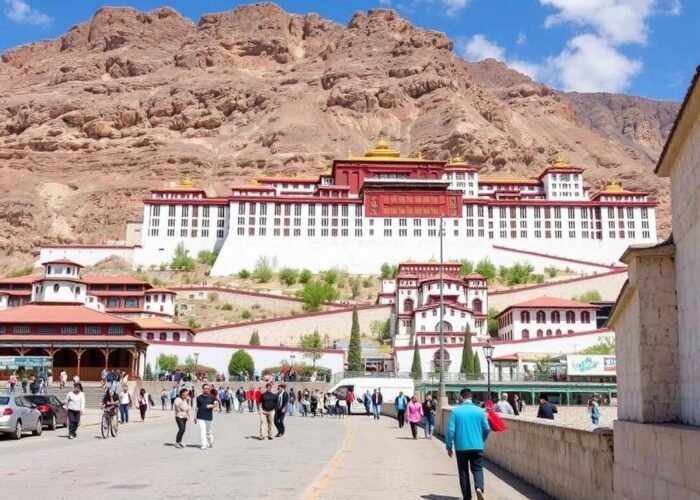
Within Lhasa, taxis and private vans are common, and many hotels can arrange airport transfers. For excursions to Jokhang Temple, Barkhor Street, or the Potala Palace, walking is practical in the city center, but plan for reduced pace because of the altitude and sun intensity. Your tour will usually include coach transport to outlying sights such as Drepung Monastery or Norbulingka.
If you plan to travel to places like Namtso Lake, Shigatse, or Everest Base Camp, expect long drives on mountain roads; distances that look short on the map can require many hours because of the terrain. Many travelers combine a Lhasa-focused trip with one or two longer overland days to reach iconic sites, while others keep Lhasa as the primary destination for a shorter, less strenuous trip.
Packing smart: clothing, gear, and medical supplies
Layering is essential. High-altitude weather changes quickly: mornings can be frigid and midday surprisingly warm under strong sun. Good base layers, a warm mid-layer, a windproof outer shell, and a hat and gloves for mornings are recommended. Sun protection is non-negotiable—broad-spectrum sunscreen, a wide-brimmed hat, and high-SPF lip balm will pay off.
Functional footwear is crucial: comfortable, broken-in walking shoes or light trekking boots are ideal for city streets and mild hikes. Include a small daypack, reusable water bottle, basic first-aid kit, and any prescription medications with a pharmacy note if possible. Pack a compact oxygen inhaler or portable oxygen canisters if you want an extra peace-of-mind measure for early altitude symptoms.
- Passport, printed Chinese visa, and Tibet Travel Permit copies
- Prescription meds, Diamox if prescribed, and a basic first-aid kit
- Sunscreen SPF 50+, sunglasses with UV protection, and a hat
- Layered clothing, warm jacket, and sturdy walking shoes
- Portable phone charger, local SIM card or roaming plan, power adapter
Money, connectivity, and practical day-to-day tips
ATMs are available in Lhasa but may not always accept foreign cards; bring some Chinese yuan in cash as backup. Credit cards are accepted at larger hotels and some restaurants, but many local vendors operate on a cash basis or use mobile payments that may not accept foreign accounts. Plan accordingly to avoid inconvenience in smaller towns.
Internet access in Tibet is variable and subject to local regulations; services like VPNs that travelers habitually use may perform inconsistently. Purchase a local SIM from Chinese providers if you need reliable mobile data, and download any offline maps, translation apps, and key travel documents before you lose reliable connection. Keep roaming disabled to avoid unexpected charges and use offline tools for navigation and basic communication.
Cultural etiquette and respectful travel in Tibetan communities
Observe local customs: remove shoes where requested, walk clockwise around stupas and prayer wheels if following local practice, and avoid touching sacred objects unless invited. Photography can be sensitive in religious sites—watch for signs and follow your guide’s instructions. A little humility and curiosity will take you far in conversation and access to spaces.
Be mindful of respectful conversation topics. Political discussions about Tibet are complex and emotionally charged; following local guidelines and focusing on cultural exchange and personal experience is safer for travelers. Small acts—like learning a few Tibetan greetings, accepting tea offered by a host, or dressing modestly at monasteries—signal respect and often open doors to memorable encounters.
Best times to visit Lhasa and weather considerations
The plateau enjoys clear skies and bright sunlight for much of the year, but winters are cold and some high passes close or become difficult to cross. Spring (April–May) and autumn (September–October) are widely recommended for more stable weather, manageable temperatures, and clear views of the surrounding mountains. Summer brings monsoon clouds and occasional rain, but it’s also milder for those sensitive to cold.
Consider travel festivals when planning your dates: events like the Shoton (Yogurt) Festival attract crowds and provide a vivid cultural experience, but they require advance hotel bookings and flexible travel plans. If your schedule is tight, avoid the heaviest travel windows and leave wiggle room for transit delays that are more likely during peak seasons.
Budgeting: what a Tibet trip from the US typically costs
Expenses for Lhasa travel vary widely depending on travel style, choice of operator, season, and length of stay. A budget-conscious traveler booking group tours and using trains might spend less than someone opting for private guides, internal flights, and higher-end hotels. Expect to allocate funds for the Chinese visa, permit processing fees, domestic travel, guided tours, accommodations, meals, and tips.
Roughly speaking, a well-organized 7–10 day Tibet tour from US-based operators can range from modest group-tour pricing to several thousand dollars per person for private, customized trips. Reserve extra for optional excursions, travel insurance with medical evacuation, and unforeseen expenses such as flight changes due to weather. Below is a simple range to help planning:
| Cost category | Typical range (per person) |
|---|---|
| Round-trip international flights (US to China) | $800–$1,800 |
| Domestic China flights or train fares to Lhasa | $200–$600 |
| Tibet tour from US operator (7–10 days) | $800–$3,000+ |
| Accommodation (mid-range) | $50–$150 per night |
Health, safety, and emergency planning
Comprehensive travel insurance with high-altitude medical coverage and evacuation is essential. Medical facilities in Lhasa are capable of handling common ailments, but for serious conditions you may require evacuation to a larger city. Discuss your health history with a physician before traveling and carry clear documentation of any chronic conditions and prescriptions.
Register with the U.S. Embassy or nearest consulate via the Smart Traveler Enrollment Program (STEP) before departing, and note emergency contact numbers for local authorities and your tour operator. Keep copies of important documents separate from the originals, and share your itinerary with a trusted person back home so someone knows where you will be each day.
- Buy travel insurance that includes medical evacuation and pandemic-related coverage.
- Carry prescription copies and a note from your doctor for controlled medications.
- Know the location of the nearest medical facility on your route and in Lhasa.
Sample 10-day itinerary: practical flow from the United States to Lhasa
This sample assumes a U.S. departure, a transit in Chengdu, and a combination of Lhasa-focused sightseeing with one longer day trip. Day 1 is an international flight to China and a domestic connection; Day 2, arrival in Lhasa and gentle acclimatization; Days 3–7, local and nearby excursions; Day 8, optional longer drive to a nearby town; Day 9 return to Lhasa; Day 10 fly back to China for international departure. The pattern balances time for breathing, acclimatizing, and immersing in the city.
Each day contains specific highlights: visiting the Potala Palace, walking Barkhor Street and Jokhang Temple, exploring Drepung and Sera monasteries, and enjoying a day trip to Yamdrok Lake. Your operator will coordinate internal permits and transport, and you should expect slower travel rhythms than in lower-altitude cities. Flexibility is part of the plan: weather or health can change the day’s schedule, and a good guide will adapt smoothly.
This itinerary can be compressed or extended depending on available time—many travelers combine Lhasa with a few days in Chengdu to see pandas, or extend into western Tibet for more remote landscapes. Plan rest days to allow your body to recover and to ensure you get the most from spiritual and cultural sites.
Personal experience: lessons I learned on my first Lhasa trip
On my first trip to Lhasa from the United States I underestimated how much the altitude would shape daily energy levels and how quickly sunscreen would become the most used item in my pack. I learned to accept slow mornings and to schedule major visits for the middle of the day after a gentle start—those small adjustments made the trip richer and less taxing. The city’s deliberate pace forced me to slow down in helpful ways.
Another lesson: permits and paperwork require lead time. I ran into a scheduling hiccup when a domestic flight change would have clashed with permit dates; my tour operator handled it, but the experience taught me to build padding into every connection. A flexible mindset and a trusted operator are two of the best investments for a smooth trip.
Frequently overlooked details that save time and frustration
Carry spare passport photos for local permits and visas—even if not explicitly requested, they can be handy if a document needs reissuing quickly. Keep digital copies of all important documents in two places: encrypted cloud storage and an offline device. Small conveniences, like quick-dry socks and a battery bank, often make the difference on long drives or train nights.
Another practical tip: bring small gifts for hosts or guides if you want to show appreciation in a culturally appropriate way—simple, high-quality items from home can be popular. Confirm tipping expectations with your operator before traveling; norms vary, and your guide will appreciate clear direction about how you prefer to handle gratuities for drivers and other staff.
Legal and political realities to navigate respectfully
Tibet’s political context is sensitive, and local regulations can shift. Stay informed of current travel advisories from government sources and follow local laws. Engaging with the culture through respectful listening and observation, rather than political debate, reduces friction and keeps the focus on the historical and spiritual richness of the region.
Tour operators manage much of the formal paperwork and will advise you on permissible activities and photography etiquette. If a situation appears to change quickly—such as sudden area closures or permit restrictions—your operator should provide clear alternatives and next steps. Flexibility, patience, and respect for local governance will help your trip run smoothly.
Special considerations for solo travelers, families, and older visitors
Solo travelers should prefer organized group departures or private tours that provide at least one reliable local contact and guide. Families with children need to plan around the health and stamina of younger travelers; children adapt differently to altitude and might require more conservative pace and rest. Older travelers should consult a physician and consider extra buffer days for acclimatization.
Private tours offer tailored pacing, which can be invaluable for families or travelers with mobility concerns. If you have specific dietary needs, notify the operator in advance—most hotels and restaurants can accommodate requests but benefit from prior notice. The main theme for special-needs travelers is planning: early communication, modest expectations, and a trusted operator make all the difference.
How to book: timeline and recommended lead times
Start planning at least three months before departure to ensure time for visa processing, permit application, and desired accommodation bookings. During peak festival seasons or major holidays, six months lead time is wiser. Rapid changes can occur in permit policies, so keep in close contact with your tour operator and check visa processing times at the consulate well in advance.
Reserve flights early to secure direct domestic connections to Lhasa and consider flexible tickets if your schedule depends on permit approval. Once your permit is confirmed, double-check that arrival times and hotel reservations align with permit dates—small mismatches are common but avoidable with careful tracking. A timeline checklist can keep paperwork and bookings in sync and reduce last-minute stress.
What to document and share with family back home
Share a detailed itinerary, including flight numbers, hotel names, and the phone number of your tour operator and local guide. Leave a copy of your passport, visa, and permit with a trusted contact at home so someone can act on your behalf if needed. Periodic check-ins via text or email are reassuring for family and straightforward if you set expectations before departure.
Keep a daily journal or simple log of places visited and addresses—this helps in case you need to recreate events for insurance, medical, or emergency purposes. Simple documentation habits make problems easier to solve and provide a richer memory of your trip when you return home.
Final practical checklist before you leave
Confirm your Chinese visa and ensure the Tibet Travel Permit matches your travel dates. Verify domestic flight or train tickets to Lhasa, double-check luggage limits, and pack layers, sun protection, and basic medical supplies. Print hard copies of permits and store digital backups in encrypted cloud storage as a safeguard.
- Chinese visa secured and passport valid for at least six months
- Tibet Travel Permit printed and held with passport during travel
- Travel insurance with high-altitude medical and evacuation coverage
- Layered clothing, sunscreen, sunglasses, and comfortable walking shoes
- Emergency contacts shared with someone trusted at home
Getting to Lhasa from the United States is a manageable undertaking with the right preparation: responsible tour selection, careful paperwork, realistic health planning, and an open mind for the unique rhythms of Tibetan life. Travel to Tibet from USA is not just about logistics; it’s an invitation to slow down and let the plateau leave its mark. With thoughtful planning, you can make the journey both safe and deeply memorable.