
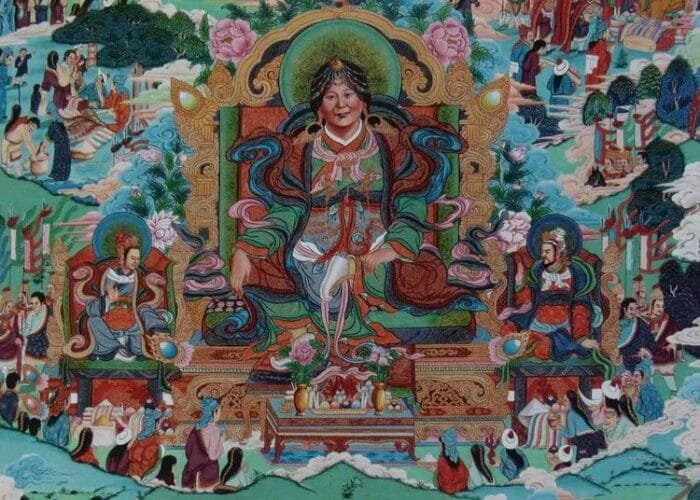
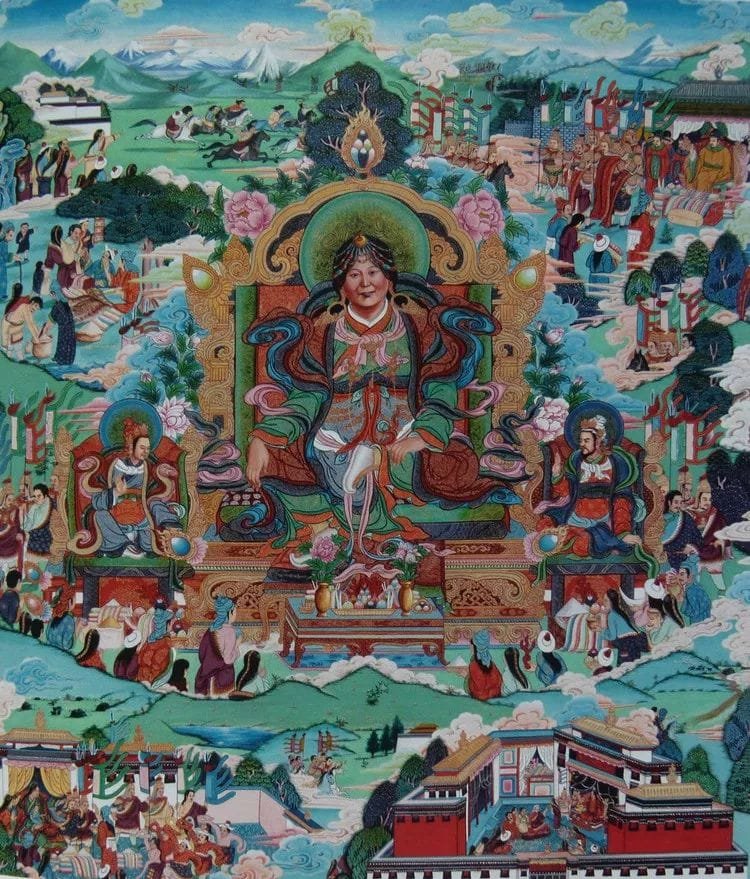
After the death of the Tibetan king in 676 CE (the Fire Bird Year), Queen Regent Trimalo—known in Tibetan sources as Droza Trima Lod—assumed control of the empire. She governed during one of the most turbulent yet transformative periods of the Tibetan Empire.
Assisting her were powerful court ministers, including Gar Trinring Tsendro (Gar family lineage) and We Daren Konglé, who served as key political advisors during her regency.
In 679 CE, the young prince formally ascended the throne, though real authority remained in the hands of the regent and her ministers.
Expansion Toward the East and Southwest
Under Trimalö’s leadership, Tibet continued its eastward and southwestern expansion.
In 689 CE, several Nanzhao tribal groups—previously under Tibetan influence—rebelled. By 690 CE, Tibetan forces launched military campaigns to suppress the uprising and reassert control in the Erhai region.
Earlier, during the Iron Dragon Year (traditionally corresponding to 680 CE in some chronologies), Tibet established a military encampment along the upper Yangtze River—often referred to as the “Yangtze Military Camp.” This move strengthened Tibetan presence in eastern frontier zones and laid groundwork for influence over much of present-day Yunnan.
These developments highlight how Tibet’s frontier policy combined military force with administrative consolidation.
The First Regency Ends: Dusong Mangpoje Takes Power
Trimalö’s initial regency continued until 692 CE, when Tridu Songtsen (Dusong Mangpoje) formally assumed full royal authority. At that point, Trimalö stepped back from direct governance.
However, events would soon pull her back into power.
The Second Regency: Crisis After the King’s Death
In 703 CE, during the southern campaign in the Nanzhao region, Tridu Songtsen was fatally wounded on the battlefield. His heir, Tride Tsuktsen (Tride Tsuktsen), was still a child.
Once again, Trimalö resumed regency, taking full control of both domestic and foreign affairs of the Tibetan Empire.
At this time, internal rebellions broke out among certain Tibetan factions. Through decisive planning and political maneuvering, she successfully stabilized the situation and restored order.
She appointed Mangpojé Larong as chief minister, but later—after listening to accusations and court intrigue—had him executed. Subsequently, she appointed We Chiri Xiangnian (We lineage) as the new chief minister.
Despite internal tensions, Trimalö maintained firm control over the imperial court.
Suppression of Rebellions and Frontier Control
During her second regency, the subordinate state of Seri (Se-ri) revolted against Tibetan authority. Trimalö responded with a combination of military force and legal enforcement.
In 709 CE (the Earth Bird Year), Tibetan forces captured the king of Seri, effectively ending the rebellion and reaffirming imperial dominance.
Her approach to governance blended military decisiveness with administrative discipline. She reinforced central authority while ensuring frontier stability.
Architect of Stability and Prosperity
Queen Regent Trimalö’s leadership played a critical role in maintaining political continuity during a vulnerable dynastic transition. Her regencies ensured:
- Smooth succession after royal deaths
- Suppression of internal aristocratic revolts
- Stabilization of frontier territories
- Sustained imperial expansion
Her governance created a period of relative internal stability and social order within the Tibetan Empire, even amid external military campaigns.
In 712 CE (the Water Bird Year), Trimalö passed away. By the time of her death, the Tibetan Empire had not only survived successive crises but emerged as a firmly consolidated regional power.
Her political legacy stands as one of the most influential in early Tibetan imperial history—demonstrating how regency leadership could shape the trajectory of empire.