The title Panchen Lama carries deep linguistic, cultural, and historical meaning within Tibetan Buddhism. More than an honorific, it reflects centuries of scholarship, spiritual authority, and evolving political influence in Tibet.
Understanding the origins and development of this title offers valuable insight into Tibetan religious tradition, the Gelug school of Buddhism, and the broader historical landscape of the Himalayan region.
Linguistic Origins of the Title “Panchen Lama”
The term “Panchen Lama” is composed of two main elements: Panchen and Lama.
- Pan derives from the Sanskrit word pandita, meaning “scholar” or “learned master.”
- Chen is a Tibetan term meaning “great” or “senior.”
Together, Panchen can be interpreted as “Great Scholar.” The word Lama means “spiritual teacher” or “guru” in Tibetan Buddhism.
This title reflects the intellectual and spiritual stature traditionally associated with the Panchen Lama. Historically, holders of this title were respected for mastery of the “Five Great Sciences” of classical Buddhist learning: philosophy, logic, medicine, arts and crafts, and linguistics.
Another historical addition to the title is “Erdini” (or “Erdeni”), derived from Manchu, meaning “precious treasure.” This emphasizes the reverence accorded to the Panchen Lama as a spiritual jewel within Tibetan culture.
The Historical Origins of the Panchen Lama Institution
The Panchen Lama system took shape in the 17th century within the Gelug school of Tibetan Buddhism. The Gelug tradition, founded by Tsongkhapa in the 15th century, became the dominant Buddhist school in Tibet during this period.
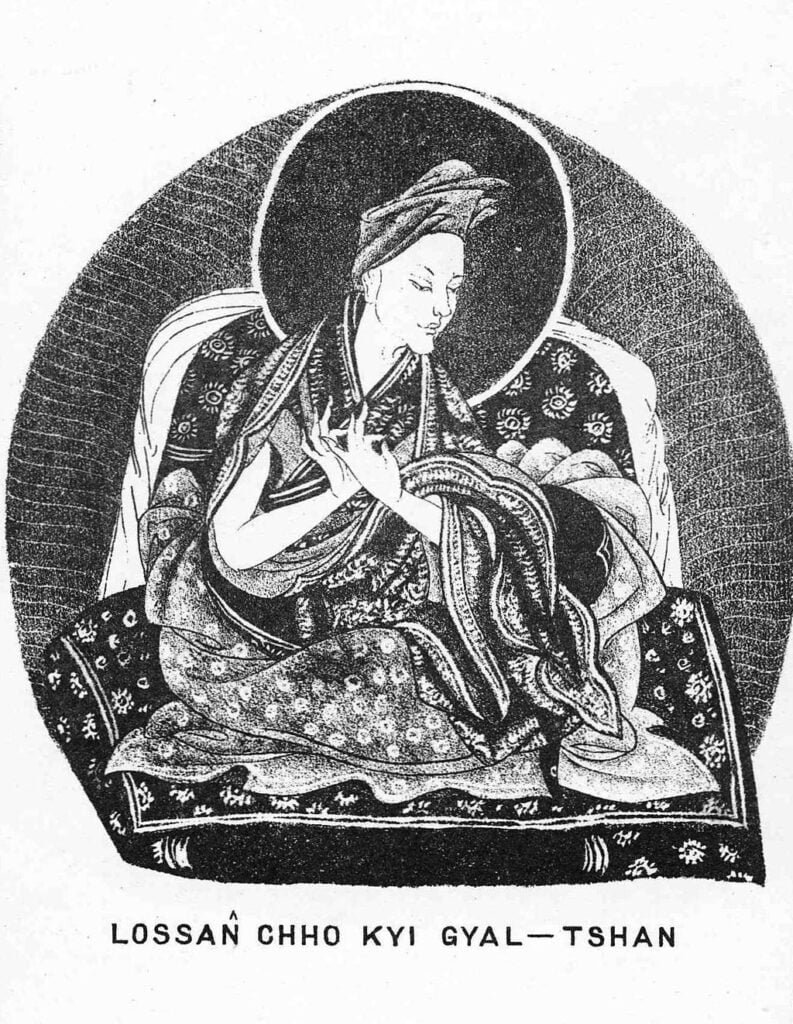
A key historical moment occurred in 1645, when Lobsang Chökyi Gyaltsen was granted the title “Panchen.” He was a renowned scholar and teacher and played a central role in strengthening Gelug philosophical and monastic traditions.
After his passing in 1662, the system of recognizing successive incarnations was formally institutionalized under the authority of the 5th Dalai Lama. From that point onward, the Panchen Lama was recognized as part of a reincarnation lineage (tulku system), ensuring continuity of spiritual leadership.
This development solidified the Panchen Lama’s role not just as an individual teacher, but as an enduring institution within Tibetan Buddhism.
Recognition During the Qing Dynasty
In 1713, during the reign of Emperor Kangxi, the Qing court formally recognized the Panchen Lama and conferred the title “Panchen Erdini.” This recognition included ceremonial symbols such as a golden seal and official documentation.
While this acknowledgment strengthened the public status of the Panchen Lama, it also marked the beginning of a more formalized relationship between Tibetan religious leaders and imperial authorities. The Qing dynasty’s involvement shaped administrative and political dynamics in Tibet for generations.
This period highlights how religious leadership in Tibet was historically intertwined with broader regional power structures. The Panchen Lama’s authority carried both spiritual weight and political implications.
Spiritual Role in Tibetan Buddhism
Within Tibetan Buddhism, the Panchen Lama is regarded as one of the highest spiritual authorities, traditionally second only to the Dalai Lama in the Gelug hierarchy.
The Panchen Lama is often associated with Amitayus, the Buddha of Infinite Life, symbolizing longevity and wisdom. This spiritual identification reinforces the sacred dimension of the role.
As a religious leader, the Panchen Lama:
- Preserves and transmits Gelug teachings
- Oversees monastic education and scholarship
- Provides philosophical guidance to monks and lay practitioners
- Plays a role in the recognition of high reincarnate lamas
The emphasis on scholarship embedded in the title itself reflects the long-standing expectation that the Panchen Lama be both a contemplative master and an intellectual authority.
Political Influence and Historical Governance
Historically, the Panchen Lama also held administrative responsibilities, particularly in regions such as Shigatse and Tashilhunpo Monastery, the traditional seat of the lineage.
In the 18th century, political arrangements defined spheres of influence between leading Tibetan religious figures. These structures positioned the Panchen Lama not only as a spiritual guide but also as a regional authority.
In modern times, the role of the Panchen Lama remains politically sensitive and symbolically important. The institution continues to represent both continuity in Tibetan Buddhist tradition and the complex relationship between religion and governance in Tibet.
Cultural and Religious Legacy
The title “Panchen Lama” encapsulates centuries of Tibetan intellectual history, spiritual devotion, and institutional development. It represents:
- The ideal of the scholar-monk
- The continuity of reincarnate spiritual leadership
- The integration of philosophy and governance
- The preservation of Gelug Buddhist doctrine
For students of Tibetan Buddhism, understanding the meaning and evolution of the Panchen Lama title provides deeper insight into the religious structure of Tibet and the historical forces that shaped it.
Through its linguistic roots and historical transformations, the title remains a powerful symbol of spiritual authority and cultural identity in Tibetan society.