

Mangsong Mangtsen (མང་སྲོང་མང་བཙན།) was one of the early rulers who guided the Tibetan Empire through consolidation after the era of imperial unification. He was the 34th emperor of the Tibetan Empire, ruling from 650 to 676 CE. He was the grandson of Songtsen Gampo, the founder of the unified Tibetan state,
He was born in 638 CE (Earth Dog Year). His father was Gungri Gungtsen, and his mother was Queen Mangje Trikha(འ་ཞ་བཟའ་མོང་རྗེ་ཁྲི་དཀར་) of the Tuyuhun royal lineage. In 650 CE (Iron Dog Year), he ascended the throne at a young age, marking the continuation of the Yarlung dynasty’s imperial authority.
Upon taking power, he appointed Kyungbu Daza as his close Bön spiritual teacher, reflecting the enduring influence of pre-Buddhist religious traditions within the royal court. He married Trimalo, who would later become one of the most powerful regents in Tibetan history.
Supporting the young emperor were key ministers, most notably the renowned statesman Gar Tongtsen Yulsung (མགར་སྟོང་བཙན་ཡུལ་སྲུང་), along with Chim’mang (མཆིམས་མང་), both instrumental in shaping Tibet’s military and diplomatic strategy.
Administrative and Legal Reforms
During his regency, major reforms strengthened the Tibetan state:
- Development of a structured taxation system
- Codification of laws and clearer social hierarchy
- Registration of households and land boundaries
- Expansion of central authority over regional territories
These changes helped transform Tibet from a tribal confederation into a more centralized imperial system. Economic control improved, social order stabilized, and state revenues increased—laying the foundation for military expansion.
Military Campaigns and Frontier Strategy
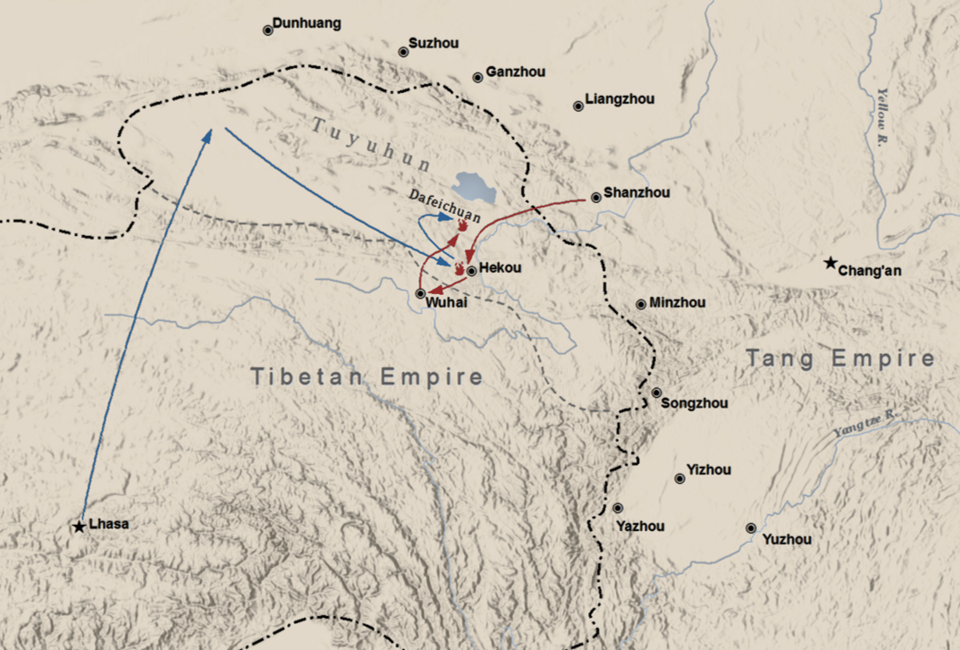
In 659 CE, Mangsong Mangtsen resided in the Womeng Palace, Lhasa in the central Tibet. During this period, Gar Tongtsen led more than a thousand elite Tibetan cavalry troops toward the Tuyuhun territories, reinforcing Tibet’s strategic interests in the northeast. After years of strategic positioning, Tibetan forces overwhelmed Tuyuhun, whose ruler Murong Nuohebo fled to the Tang court.
This victory brought much of the Qinghai region under Tibetan control and secured the northeastern frontier of the plateau.
By 662 CE, the emperor had relocated to the Dranang Palace in the Shannan region. That same year, Gar Tongtsen died of illness. His passing marked the end of an era, but his political lineage continued to shape Tibetan imperial policy.
Personal Rule and Final Years (667–676)
After the death of Gar Tongtsen Yulsung in 667 CE, Mangsong Mangtsen began ruling more directly. However, he continued to rely on members of the Gar family, including:
- Gar Tsenya Drowu (his chief minister)
- Gar Trinring Tsendro (military commander in the northeast)
- Gar Trizhé
- Lunri Doye
Under his leadership, Tibet maintained pressure on Tang positions in Central Asia and defended its newly expanded territories. Gar brothers became leading military generals, preserving the Gar family’s dominant role within the empire.
Expansion into Central Asia
Under Mangsong Mangtsen, Tibet expanded westward into strategic Silk Road territories.
Tibetan forces moved into areas around Kashmir and the Pamir region, influencing kingdoms such as Greater and Lesser Bolü. Control of parts of the Wakhan corridor provided access to key trade routes linking Central Asia and South Asia.
At the same time, Tibet began directly competing with the Tang dynasty for influence over the Tarim Basin.
The Battle of Dafeichuan and the Tang–Tibet Rivalry
The turning point in Tang–Tibet relations came in 670 CE. Tibetan forces captured territory around Kucha, forcing the Tang dynasty to temporarily withdraw from the Four Garrisons of Anxi. In response, the Tang court dispatched a large army under the famous general Xue Rengui.
The two sides clashed at the Battle of Dafeichuan (near present-day Qinghai). Tibetan troops, led by Gar clan commanders including Gar Trinring Tsendro, decisively defeated the Tang army.
This battle marked a major shift in regional power. From this point onward, Tang–Tibet relations evolved into decades of military confrontation punctuated by shifting alliances and territorial exchanges.
Southern Campaigns and the Strategic Yangtze Crossing
Under Gar Trinring Tsendro’s leadership, Tibetan forces launched major campaigns toward the southwest. In the same year, he personally commanded Tibetan troops against Nanzhao and subdued twelve tribal groups in the region.
A crucial strategic location in these campaigns was the Yangtze River crossing at Lepei—an essential military corridor for mobilizing troops between present-day Yunnan and Sichuan. Control of this river passage allowed Tibet to project power deeper into Southwest China.
To secure this route, Tibetan forces constructed an early iron chain bridge across the river near what is today Tacheng, north of Lijiang. This crossing became a logistical and military hub, laying groundwork for later large-scale infrastructure projects such as the Shenchuan Iron Bridge.
The establishment of fortified river crossings demonstrated how Tibetan expansion relied not only on cavalry strength but also on strategic engineering.
Death and Burial
Mangsong Mangtsen died in 676 CE in Lhasa. Because his successor was still a child and the empire faced ongoing military threats, his death was kept secret for three years. Only in 679 was the news officially announced—a strategic decision to maintain political stability. He was buried in the imperial burial grounds of the Yarlung Valley, interred to the left of his father’s tomb within the Tibetan royal necropolis.
His reign strengthened imperial administration, expanded territorial influence, and solidified the authority of the Gar ministerial clan. These developments would shape the political landscape inherited by his successors and set the stage for both internal power struggles and further frontier expansion.