
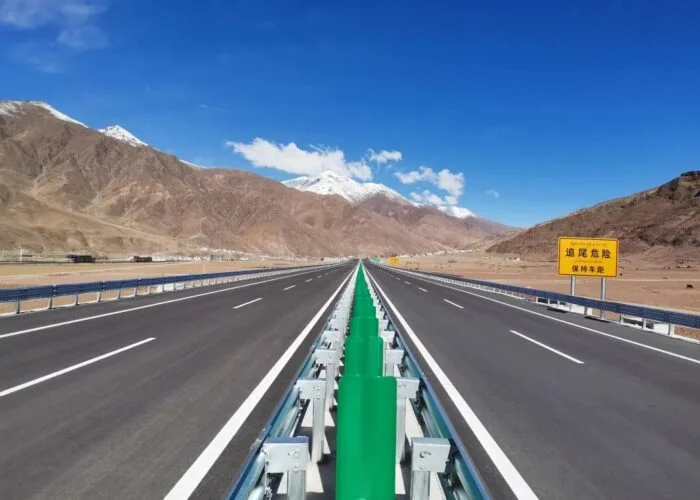
Qinghai–Tibet Expressway: The High-Altitude Highway Connecting Xining and Lhasa
Lhasa, the capital city of Tibet, is one of the few provincial capitals in China without a complete expressway network connecting it directly to other major cities. To address this gap, China has been developing the Qinghai–Tibet Expressway, a major infrastructure project that will link the Tibetan Plateau with the national expressway system.
This expressway forms part of the larger Beijing–Lhasa Expressway, connecting the plateau city of Lhasa with northern China through Xining. Once fully completed, it will become one of the highest and most challenging expressways ever built.
Overview of the Qinghai–Tibet Expressway
The Qinghai–Tibet Expressway is a high-grade highway project designed to connect Xining in Qinghai Province with Lhasa in Tibet. The total planned length of the expressway is about 1,900 kilometers, following a route that largely runs parallel to the existing Qinghai–Tibet Highway and the Qinghai–Tibet Railway.
The expressway is built along the Qinghai–Tibet Engineering Corridor, the main transportation corridor across the plateau.
Key Development Status
- Total length: about 1,900 km
- Completed sections: around 700 km
- Remaining sections: approximately 1,100 km from Golmud to Lhasa
- Expected completion: around 2035
The highway is also part of China’s national expressway system known as Network 71118, which includes:
- 7 routes radiating from Beijing
- 11 north–south routes
- 18 east–west routes
Within this system, the Qinghai–Tibet Expressway represents the final section linking Beijing to Lhasa.
Strategic Importance of the Qinghai–Tibet Expressway
The Qinghai–Tibet Expressway holds significant value in multiple areas, including transportation, regional development, and national strategy.
Strategic and Military Significance
The expressway improves access to remote areas of the Tibetan Plateau and allows faster movement of vehicles and logistics across the region. It also strengthens infrastructure near sensitive border areas such as the Line of Actual Control.
Improved transportation networks on the plateau support broader infrastructure development and enhance mobility in high-altitude border regions.
Economic Development and Connectivity
The new expressway will help integrate Tibet more closely with the mainland economy.
Key economic impacts include:
- Easier transport of mineral resources from remote plateau areas
- Improved access for trade and tourism
- Reduced travel time between Xining and Lhasa
- Expansion of Tibet’s highway network
By 2025, the total highway network in the Tibet Autonomous Region reached approximately 125,200 kilometers, reflecting ongoing development across the plateau.
Social and Public Benefits
Improved road infrastructure also benefits local communities in remote high-altitude areas.
Major advantages include:
- Safer long-distance travel
- Better access to public services
- Improved transportation reliability in harsh weather
- Faster emergency and disaster response
For travelers and residents alike, the expressway will provide a more stable and efficient route across one of the most remote landscapes in the world.
Construction Challenges on the Tibetan Plateau
Building an expressway across the Qinghai–Tibet Plateau presents extraordinary engineering challenges. The plateau averages more than 4,000 meters above sea level, with extreme environmental conditions that make construction difficult.
Harsh Environmental Conditions
Large areas of the plateau are covered with permafrost, which remains frozen throughout the year. Seasonal thawing and freezing cycles can destabilize road foundations.
Other environmental challenges include:
- Temperature differences of up to 30°C between day and night
- Strong ultraviolet radiation
- Low oxygen levels
- Powerful winds and irregular rainfall patterns
Permafrost thawing can lead to ground instability, which may cause road cracks and structural damage if not properly managed.
Geological and Engineering Difficulties
The terrain between Qinghai and Tibet includes mountain ranges, rivers, and seismic zones. Tunnels and bridges must be constructed in areas with unstable rock formations and geological hazards.
Common construction issues include:
- Rock bursts inside tunnels
- Landslides
- Water intrusion
- High ground stress in deep excavation areas
Special materials and engineering techniques are required, including frost-resistant asphalt, reinforced tunnel supports, and advanced ventilation systems.
Logistical and Human Challenges
Working on the plateau also affects both workers and equipment.
High altitude conditions reduce oxygen levels, which can cause altitude sickness among construction workers and reduce machinery efficiency. Harsh weather further complicates construction schedules.
Large infrastructure projects on the plateau may involve tens of thousands of workers, with construction timelines extending for several years due to environmental conditions.
The Nala Expressway: Nagqu to Lhasa Section
One of the most important completed sections of the project is the Nala Expressway, connecting Nagqu with Lhasa.
This expressway forms a key part of the G6 Beijing–Lhasa Expressway and is notable for being the highest expressway in the world.
Main Features
- Total length: 294 km
- Average altitude: about 4,500 meters
- Speed limits: 80 km/h to 100 km/h
- Roadbed width: 26 meters
- Opening date: August 2021
The route begins in Nagqu on the Qiangtang Grassland and ends at the West Ring Road in Lhasa.
Ecological and Technological Innovations
The Nala Expressway was designed with strong environmental protection measures to preserve the fragile plateau ecosystem.
Innovative technologies used in the project include:
- Tunnel insulation systems to prevent frost damage
- Anti-frost heave road structures
- Narrow central belt guardrails
- Smart lighting systems
- Wildlife passages for migrating animals
Service areas along the expressway were also designed with ecological concepts, creating what engineers describe as a “plateau ecological road.”
Yangbajing No. 2 Tunnel: A High-Altitude Engineering Challenge
One of the most technically demanding sections of the Nala Expressway is the Yangbajing No. 2 Tunnel, located in Yangbajing.
Key Specifications
- Length: 6,275 meters
- Altitude range: 4,145 – 4,875 meters
- Location: Damxung County, north of Lhasa
Because of its extreme altitude and geological complexity, engineers often refer to it as a “super tunnel in the restricted area of life.”
The tunnel required advanced construction techniques to address low oxygen levels, freezing temperatures, and unstable rock formations.
Why the Qinghai–Tibet Expressway Is Considered a Landmark Project
Compared with other highways in Tibet, the Qinghai–Tibet Expressway benefits from relatively flatter terrain between the Kunlun Mountains and Tanggula Mountains, making it one of the more feasible large-scale highway projects across the plateau.
At the same time, the expressway still faces challenges from permafrost, harsh weather, and ecological sensitivity, requiring continuous research and technological innovation.
Chinese engineers continue to develop new solutions for building roads on frozen ground, including specialized bridge structures, insulation layers, and monitoring systems designed to protect both the infrastructure and the fragile plateau environment.