
Sang’ngak Choeling Temple དཔལ་ལྷར་བསྟན་རི་བོ་གསང་སྔགས་ཆོས་གླིང་རྒྱ་མཚོ་གྲྭ་ཚང is an important Tibetan Buddhist monastery located in Sang’ngak Choeling Township, Longzi County. Resting at an altitude of 3,250 meters, the temple has long served as a spiritual center for the Kagyu school of Tibetan Buddhism and remains a significant religious landmark in southern Tibet.
Founded in 1515, Sang’ngak Choeling Temple reflects centuries of religious devotion, monastic life, and traditional Tibetan architecture, making it a valuable site for both pilgrims and cultural explorers.
Location and Foundation of Sang’ngak Choeling Temple
The monastery was founded in the 16th century by Kunkyen Padma Karpo, an incarnation of Jetsun Tsangpa Gyare, the great master of the Drukpa Kagyu lineage. After Padma Karpo founded the monastery, it became one of his later and significant establishments.
Padma Karpo was born in 1517 in Kongpo Tseten Do. Throughout his life, he founded many monasteries across Tibet. When he arrived at this site and surveyed the land from across the river, he perceived the terrain as possessing an imbalance—described as “three sky-cutting forms and three earth-cutting forms.” To dispel this unfavorable geomantic condition, he resolved to establish a monastery here, which led to the founding of Sang’ngak Choeling.
Sang’ngak Choeling became not only a major center in snowland Tibet, but also a vital source of the Drukpa Kagyu lineage that spread to regions such as Bhutan, Ladakh, and Kinnaur.
Origins of the Drukpa Kagyu Lineage
The Drukpa Kagyu tradition originated when Ling Repa, following the prophecy of Tsangpa Gyare, founded Druk Monastery at Namphu Chushur. During the monastery’s foundation, thunder resounded loudly several times, leading to the name “Druk” (Dragon). From that moment on, the lineage holders became known as the Drukpa Kagyu.
From Tsangpa Gyare to the present Gyalwang Drukpa Jigme Padma Wangchen, approximately twelve incarnations have appeared. Beginning with the fourth incarnation, Padma Karpo, the lineage holders took up permanent residence at this monastery.
Padma Karpo authored approximately twenty-four volumes of writings, contributing greatly to Tibetan Buddhist philosophy, ritual, and scholarship.
Lineage of Living Buddhas at Sang’ngak Choeling
Following Pema Karpo, Sang’ngak Choeling Temple has been guided by seven successive generations of living Buddhas, forming a continuous spiritual lineage. These include:
- Pasang Wangpo
- Mipam Wangpo
- Trinley Sinda
- Gongsekhe Lang
- Yami Agche
- Mipam Tsewang
- Tenzin Khenrab
This unbroken lineage has played a key role in preserving Kagyu teachings, rituals, and monastic traditions within the region.
Architectural Layout of Sang’ngak Choeling Temple
Overall Layout and Orientation
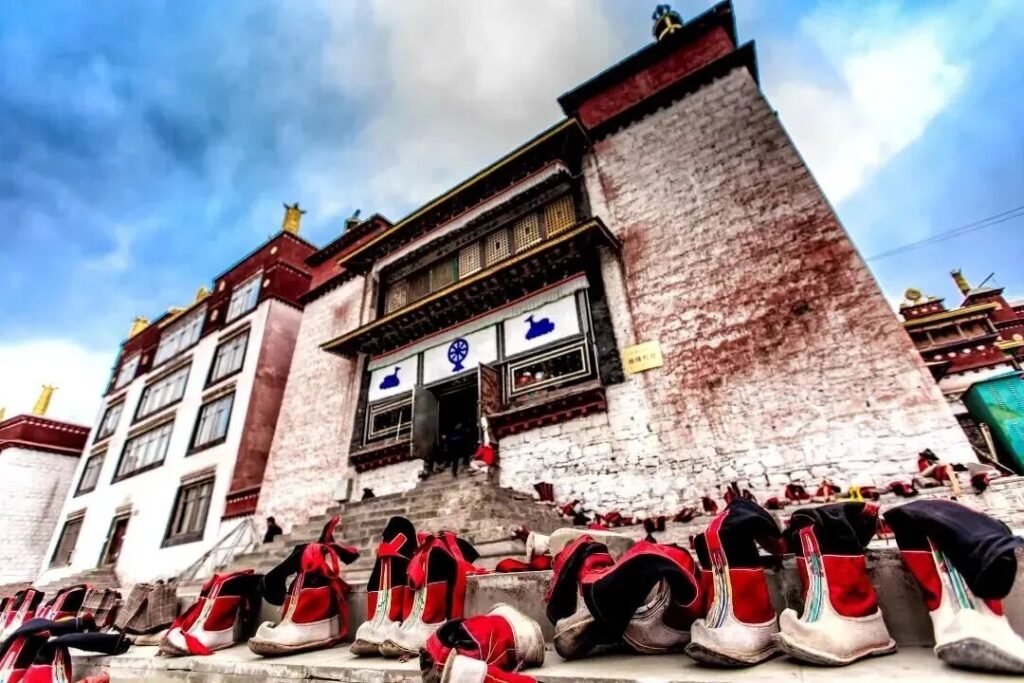
The temple complex is built along a mountain ridge, oriented east to west and facing south, following traditional Tibetan geomantic principles. The entire complex covers approximately 3,000 square meters, stretching about 100 meters in length and 30 meters in width.
At its height, Sang’ngak Choeling Temple supported more than one thousand monks, highlighting its former prominence as a major Kagyu monastic center.
Dukang Hall: The Heart of the Temple Complex
Structure and Function
The Dukang Hall serves as the central building of Sang’ngak Choeling Temple. It is a two-story structure, designed to support both religious activities and daily monastic life.
- Upper Floor: Used as a reception space and storage area
- Ground Floor: Houses the sutra hall, Buddhist hall, and other functional rooms for rituals and assemblies
Sacred Statues
Inside the Dukang Hall, the main objects of worship include statues of Sakyamuni Buddha and Tsangpa Gyare, one of the most revered masters of the Kagyu tradition. These statues form the spiritual focal point of temple ceremonies and prayers.
Present-Day Assembly Hall and Sacred Statues
The newly constructed assembly hall now stands on the site of the former retreat center. The principal statue is a newly created larger-than-life Medicinal Buddha.
Preserved from earlier times are statues of Dudsolma, as well as the Vajradhara image enshrined in the Lama Chapel. Also present are sacred images of:
- Guru Nangsi Zilnön
- Drukpa Padma Karpo
- Other lineage masters of the Drukpa tradition
On the former site of the old central hall, a 32-armed Shakyamuni Buddha statue made of gilded copper has also been newly installed, among many other sacred objects available for pilgrimage and veneration.
Dharma Protector Temple and Decorative Features
A Dharma Protector Temple has been added to the Sang’ngak Choeling complex in later years. This structure is built with solid stone walls, reflecting durability and traditional craftsmanship.
The eaves are decorated with pema grass and eight-treasure motifs, symbolizing auspiciousness and protection in Tibetan Buddhist art. These details highlight the monastery’s strong artistic and symbolic traditions.
Sacred Sites Around Sang’ngak Choeling
Walking about one hour downhill from the monastery, visitors can reach a nunnery known as Padma Karpo’s Meditation Retreat, where it is believed his mind dissolved into the dharmadhatu. This nunnery was established according to Padma Karpo’s instructions after he resolved to found Sang’ngak Choeling. As he departed for his encampment, he instructed:
“Build a place for me to stay in the upper valley of Yaki,”
and the site was constructed exactly as he directed.
Walking approximately three hours downhill from the monastery, one can also visit a sacred rock cave where Tsangpa Gyare stayed for a night after opening the sacred site of Tsari. Delighted by the location, he named it “Kyid Phuk” (Bliss Cave). Nearby are meditation caves and a small retreat community, all of which remain accessible to pilgrims today.
Mani Stone Carvings and Cultural Heritage
Sang’ngak Choeling Temple is also well known for its Mani stone carvings, which are scattered throughout the temple grounds. These stones, engraved with sacred mantras and symbols, hold both religious and artistic value.
The Mani stones enhance the spiritual atmosphere of the monastery while serving as a visible expression of Tibetan devotional culture and craftsmanship passed down through generations.
Religious Life and Cultural Importance
As a Kagyu monastery, Sang’ngak Choeling Temple has played a vital role in transmitting teachings, supporting monastic education, and maintaining ritual practices in Longzi County. Its architecture, living Buddha lineage, sacred statues, and Mani stone carvings together form a rich cultural and spiritual landscape that continues to resonate within Tibetan Buddhist tradition.