

Introduction to Simhamukha: The Protector Dakini
Simhamukha, known in Tibetan as “Sengé Dongchen” (སེང་གེ་གདོང་མ་), meaning Lion-Faced Dakini, is one of the most powerful protector deities in Tibetan Vajrayana Buddhism. She represents the fierce, fearless, and compassionate aspect of enlightened feminine wisdom.
Regarded as an emanation of Avalokiteshvara (Chenrezig), the Bodhisattva of Compassion, Simhamukha embodies compassion in its most wrathful form. Her role is not gentle or passive; instead, she confronts obstacles, negativity, and harmful forces directly and decisively.
Simhamukha is practiced across all major Tibetan Buddhist schools—Nyingma, Kagyu, Sakya, and Gelug—though her lineage is especially strong within the Nyingma tradition, where she is closely associated with tantric protection rituals and advanced Vajrayana practices.
The Spiritual Role and Significance of Simhamukha
The primary function of Simhamukha is protection through transformation. Rather than destroying harmful forces outright, she subdues and neutralizes them, preventing greater karmic consequences.
Her practice is believed to be exceptionally effective in:
- Removing obstacles and spiritual blockages
- Countering curses, black magic, and sorcery
- Protecting against epidemics, wars, famine, and natural disasters
- Dispelling fear, inner demons, and negative mental states
In renowned Tibetan monasteries such as Ganden, Sera, and Drepung, daily Simhamukha rituals are performed, particularly by monks engaged in tantric disciplines. Her practice is considered essential for maintaining spiritual balance and protection within monastic communities.
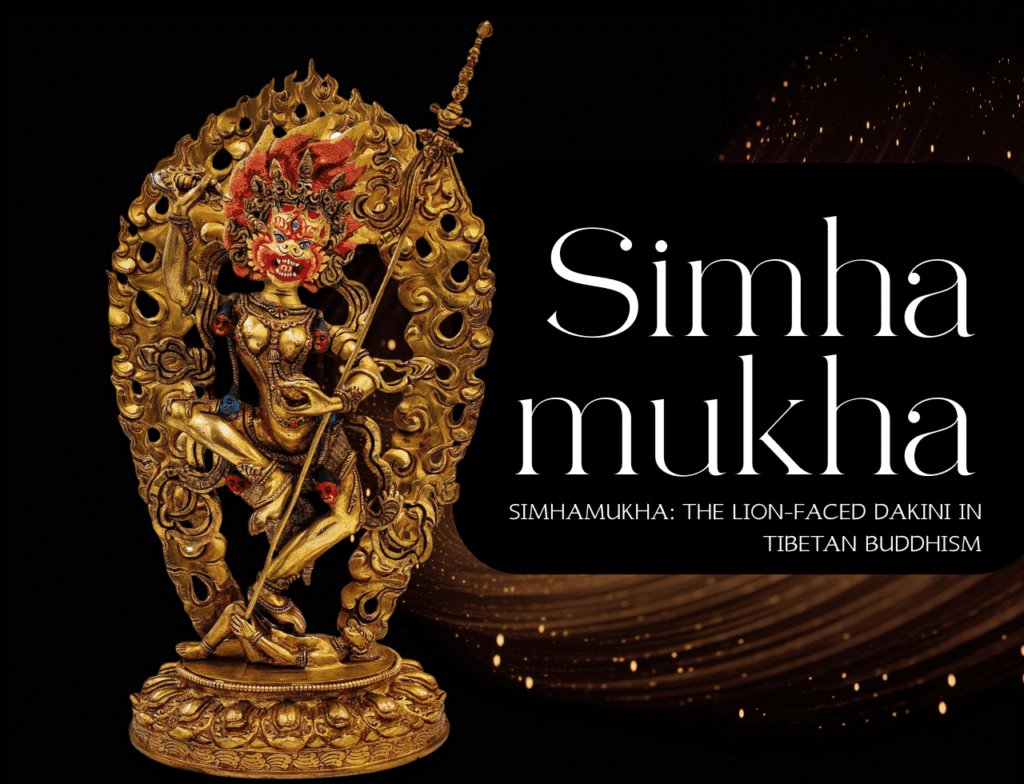
Simhamukha as the Fierce Expression of Enlightened Feminine Energy
Unlike peaceful deities, Simhamukha represents wrathful compassion—the idea that fierce action can arise from deep wisdom and love for sentient beings. She is a reminder that compassion sometimes takes a powerful, even terrifying form to protect the Dharma and practitioners.
Her lion face symbolizes fearlessness, authority, and mastery over ego and ignorance. In Vajrayana symbolism, the lion’s roar represents the fearless proclamation of truth, capable of silencing all negativity and illusion.
Iconography of Simhamukha in Tibetan Thangka Paintings
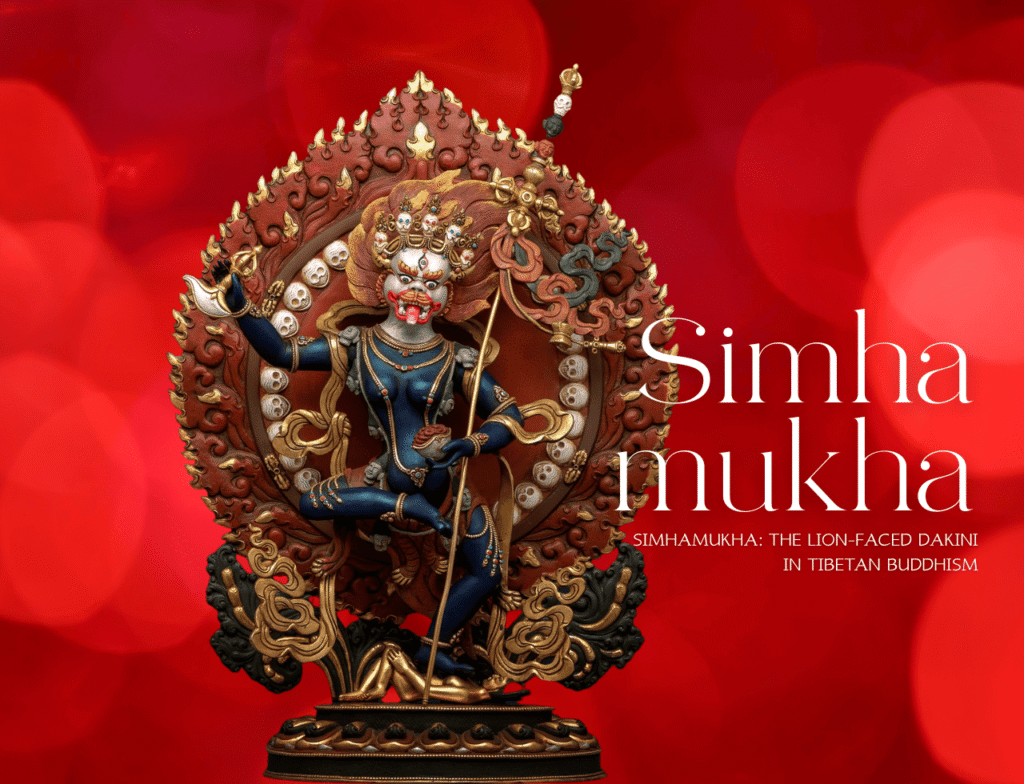
Simhamukha’s visual representation in Tibetan Thangka art is rich with symbolic meaning, reflecting her enlightened activities and tantric power.
She is depicted with:
- A dark-colored body, symbolizing her all-encompassing Buddha activities
- A white lion face, representing fearless wisdom and awakened awareness
- A wide-open mouth with sharp fangs, showing her ability to devour harmful forces and negative spirits
Her lion head is crowned with a five-skull crown, symbolizing the transformation of the five poisons—ignorance, desire, anger, pride, and jealousy—into the five wisdoms. Her hair flows upward, indicating the mastery of inner winds and full spiritual realization.
Sacred Ornaments and Ritual Attributes
Simhamukha is richly adorned with tantric ornaments, each carrying deep symbolic meaning:
- Necklaces, armlets, bracelets, and anklets signify mastery over samsaric existence
- A garland of fifty human heads represents purification of speech and liberation from ego
Her upper body is bare, emphasizing her dakini nature—free, unbound, and beyond conventional form—while her lower body is clothed in a tiger-skin skirt, symbolizing victory over primal instincts and fear.
Hand Implements and Their Symbolism
Simhamukha holds powerful ritual objects associated with Vajrayana wisdom:
- Left hand: A blood-filled skull cup (kapala), symbolizing transcendental bliss and the transformation of desire into wisdom
- Right hand: A curved chopper (kartika), representing the sharp wisdom that cuts through ignorance and illusion
- Khatvanga (trident) resting on her left shoulder, symbolizing her realization of the three kayas—Dharmakaya, Sambhogakaya, and Nirmanakaya
These implements highlight her role as both a fierce protector and a fully enlightened dakini.
Dynamic Posture and Enlightened Activity
Simhamukha stands in a dancing posture atop a lotus and moon disc, symbols of purity and wisdom. Beneath her feet lies a supine figure, representing subdued ego and negative forces.
She is surrounded by a blazing circle of wisdom fire, indicating her power to burn away negative karma, ignorance, and delusion. This dynamic posture reflects her continuous enlightened activity, never static, always responsive to the needs of beings.
Associated Deities in Simhamukha Thangka Paintings
Traditional Simhamukha Thangkas often include other wrathful dakinis who complement her enlightened activity.
Bear-Faced Dakini (Emanation of Manjushri)
Positioned above Simhamukha, the Bear-Faced Dakini is associated with wisdom and insight. She:
- Has a bear’s head and human body
- Holds a knife and a blood-filled skull cup
- Dances upon a supine figure, symbolizing the triumph of wisdom over ignorance
Her connection to Manjushri, the Bodhisattva of Wisdom, reinforces the intellectual clarity behind wrathful compassion.
Tiger-Faced Dakini (Emanation of Samantabhadra)
Below Simhamukha appears the Tiger-Faced Dakini, believed to be an emanation of Samantabhadra, the primordial Buddha. She:
- Has a tiger head and human form
- Wears a tiger-skin skirt and remains topless
- Holds a vajra and a skull cup
- Dances upon a subdued figure
Her presence represents primordial awareness and the raw, untamed power of enlightenment.
Simhamukha Practice in Vajrayana Buddhism
Simhamukha practices are considered advanced tantric methods, often requiring proper empowerment and lineage transmission. Practitioners rely on her mantra, visualization, and ritual offerings to invoke her protection and obstacle-clearing power.
Her practice is especially valued during times of:
- Spiritual obstacles
- Negative astrological influences
- Environmental or social instability
- Inner fear, anxiety, and psychic disturbances
Simhamukha remains one of the most revered and potent protector dakinis in Tibetan Buddhism, embodying fearless compassion, transformative wisdom, and unwavering protection of the Dharma.