

In the late 1930s, a German expedition backed by Nazi authorities traveled to Tibet, marking Germany’s first official visit to Lhasa. Over the course of six months, the team collected a vast amount of scientific data and established the first direct contact between Germany and the Tibetan local government.
This mission, widely known as the SS Expedition to Tibet (1938–1939), became one of the most significant and controversial episodes in Germany’s engagement with Tibet. It influenced the development of German Tibetology and shaped early diplomatic and scientific exchanges between Germany and Tibet.
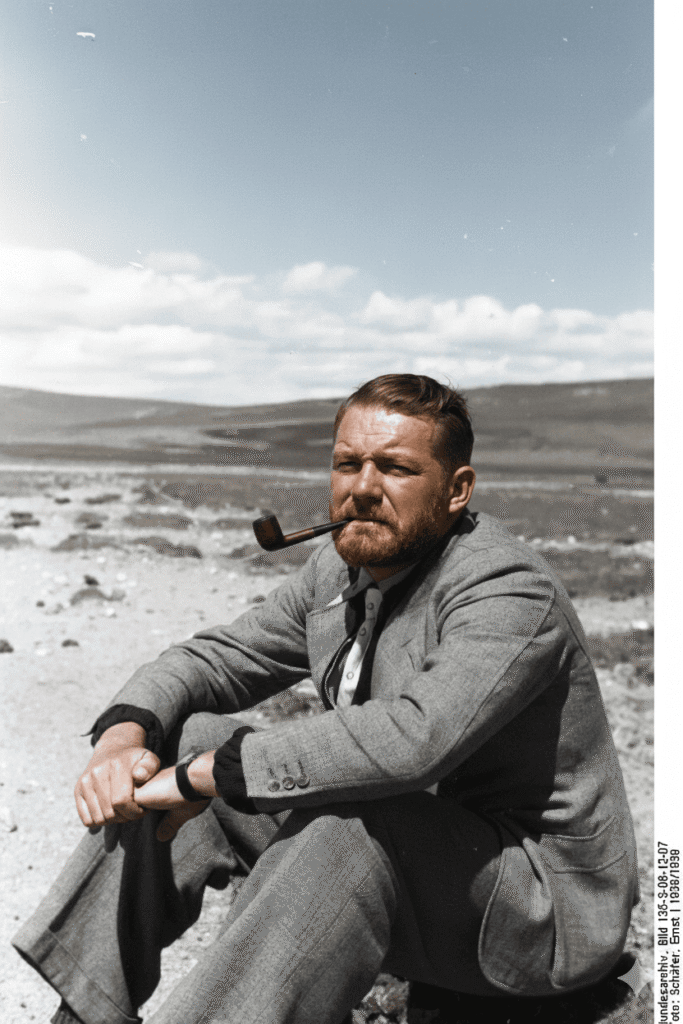
The expedition was led by zoologist Ernst Schäfer, under the patronage of Heinrich Himmler, a leading figure of Nazi Germany.
Why the Expedition Still Matters
Because of its association with Nazi Germany and the SS, the expedition has attracted global attention and controversy. Over time, simplified narratives, exaggerated claims, and even fabricated myths have surrounded the event.
Some accounts portray the mission as mystical or occult-driven, while others reduce it purely to propaganda. In reality, the expedition combined:
- Scientific research
- Political symbolism
- Strategic positioning in Asia
- Ideological motivations linked to Nazi racial theory
To understand its true significance, it is essential to place the expedition within its historical and geopolitical context rather than relying on sensationalized interpretations.
Germany, Britain, and Tibet Before World War II
British Influence in Tibet
In the early 20th century, Britain was the dominant foreign power influencing Tibet. Due to its colonial presence in India and long-standing Himalayan expeditions, Britain led diplomatic missions and scientific research efforts in the region.
Following the 1904 British expedition to Lhasa, British influence became deeply embedded in Tibetan external affairs.
Germany’s Strategic Position
Unlike Britain or Russia, Germany had no direct colonial presence near Tibet. However, it maintained a clear diplomatic position regarding Tibet’s status.
At the 1914 Simla Conference, German Ambassador Karl Max von Lichnowsky stated that Germany recognized Tibet as part of China, similar to other frontier regions. Germany insisted on maintaining the “most-favored-nation” rights granted under earlier treaties with China, including applicability to Tibet.
Germany adopted a similar stance regarding Mongolia in communications with Russia. The broader German strategy aimed to preserve Chinese territorial integrity and prevent British or Russian dominance in frontier regions. From Berlin’s perspective, the partition of China would weaken German commercial and diplomatic interests.
Maintaining the integrity of the Chinese Empire became a long-term strategic consideration for the German government.
Germany’s Rise in Central Asian and Tibetan Studies
Although Germany lacked colonial access to Tibet, it actively participated in scientific exploration across Central Asia.
German archaeological work in Turpan and scholarly research in Tibetan language and culture rapidly advanced in the early 20th century. German scholars became serious competitors to British and Russian researchers in Asian studies.
By the 1930s, scientific prestige had become intertwined with political ambition. Tibet represented both a field of academic research and a symbolic frontier of international recognition.
Nazi Germany and the “Dream of Lhasa”
During the Nazi era, German activities related to Tibet reached their peak. Within nationalist circles, the idea of a “Dream of Lhasa” emerged — a symbolic ambition for Germany to achieve what other European powers had accomplished: direct access and influence in Tibet.
For Heinrich Himmler, expanding SS prestige was a priority. He believed that sponsoring a successful expedition to Tibet would enhance the reputation of the SS as both a scientific and elite organization.
The Role of the Ahnenerbe
In 1935, Himmler founded the Ahnenerbe, formally known as Die Forschungsgemeinschaft Deutsches Ahnenerbe e. V. This SS-affiliated research society aimed to investigate Germanic history, archaeology, racial theory, and mythological subjects.
The Ahnenerbe sought to provide scientific legitimacy to Nazi ideology. Its research included:
- Germanic ancestral studies
- Archaeological excavations
- Investigations into Aryan origins
- Studies of ancient civilizations and myths
Within this framework, Tibet gained ideological significance. Some Nazi theorists speculated about connections between Indo-European heritage and Central Asian cultures.
Among the scholars associated with the Tibet expedition were:
- Ernst Schäfer – zoologist and expedition leader
- Bruno Beger – anthropologist tasked with racial measurements
While the mission collected zoological, botanical, and ethnographic data, it also reflected the racial theories promoted by Nazi ideology.
Objectives of the 1938–1939 Expedition
The SS-led expedition had multiple layers of purpose:
1. Scientific Research
The team gathered plant specimens, animal samples, geographic data, and cultural documentation. These contributions later influenced German Tibetology and zoological studies.
2. Diplomatic Engagement
The expedition established Germany’s first direct contact with the Tibetan local government in Lhasa. This symbolic achievement was important for international prestige.
3. Ideological Exploration
Some expedition members sought evidence to support racial and cultural theories promoted by the Nazi regime.
4. Geopolitical Signaling
The mission demonstrated Germany’s ability to operate in regions heavily influenced by Britain, subtly challenging British dominance in Himalayan affairs.
Significance and Ongoing Debate
The SS Expedition to Tibet remains a subject of academic debate. It reflects:
- Pre–World War II geopolitical rivalry
- The intersection of science and ideology
- European competition in Central Asia
- The politicization of academic research
Understanding this event requires separating myth from documented history. While the expedition contributed to academic knowledge, it also operated within the ideological framework of the Third Reich.
The story of Germany’s first visit to Lhasa is not simply about exploration. It reveals how science, politics, prestige, and ideology converged in a remote Himalayan region on the eve of global war.
The Pioneering Tibet Expeditions of Ernst Schäfer
The Tibet expeditions of Ernst Schäfer remain one of the most fascinating and controversial chapters in modern exploration history. Blending science, politics, and ideology, these journeys into the Himalayas were shaped not only by curiosity about Tibet’s landscapes and wildlife, but also by the ambitions of Nazi Germany.
This article explores the origins, objectives, political tensions, and historical impact of the German expedition to Tibet in 1938–1939—an event that continues to attract attention from historians, researchers, and those interested in Tibet’s modern history.
Early Explorations on the Sino-Tibetan Border
Before leading the famous 1938 expedition, Ernst Schäfer had already traveled near Tibet. In 1932, and again between 1934 and 1936, he explored the Sino-Tibetan borderlands with American explorer Brook Dolan.
Although these early expeditions expanded Western knowledge of remote Himalayan regions, Schäfer was unable to penetrate deep into central Tibet. At the time, Tibet was still largely closed to foreigners, and vast areas remained what Europeans described as “blank spots” on the map.
Schäfer believed that the era of discovering new continents had ended. Instead, the true challenge of modern exploration was to study the hidden interiors of known lands. For him, Tibet represented one of the last great unexplored regions in Asia.
Recruitment by Heinrich Himmler and the SS Connection
In 1934, Heinrich Himmler, one of the most powerful figures in Nazi Germany, recruited Schäfer into the SS. Himmler was deeply interested in Tibet—not only from a geographical perspective, but also for ideological reasons.
Impressed by Schäfer’s earlier research, Himmler agreed to support a large-scale scientific expedition into Tibet. He became the official “patron” of the mission, giving it political backing and symbolic importance within the Nazi regime.
Tibet, to the Western world at the time, was mysterious and isolated. For the Nazi leadership, it also represented a potential source of racial and mythological theories tied to their worldview.
The Objectives of the German Tibet Expedition
The 1938 Tibet expedition had both scientific and ideological goals.
Scientific Goals
Officially, the expedition aimed to conduct a comprehensive scientific survey of Tibet. This included:
- Botanical research
- Zoological studies
- Geographical mapping
- Ethnographic documentation
- Photography and cultural recording
Schäfer himself was primarily a zoologist and hunter. His personal vision focused on natural history—collecting plant and animal specimens and documenting Tibet’s unique ecosystems.
Ideological and Anthropological Goals
However, Himmler and his circle had additional motivations. Under the supervision of the SS research organization known as the Ahnenerbe, the expedition was expected to conduct anthropological studies.
These studies sought to investigate theories about the origins of the so-called “Aryan race.” Some Nazi theorists believed that Tibet might hold ancient connections to Aryan ancestry, influenced by mystical and pseudo-scientific ideas circulating in Germany at the time.
The mission plan, finalized in October 1937, included:
- Measuring physical features of Tibetan people
- Photographic documentation
- Anthropological modeling
- Research into racial classification theories
These elements reflected the darker ideological agenda behind the expedition.


Schäfer’s Vision vs. Nazi Ideology
A key tension surrounded the expedition from the beginning.
While Himmler and his advisors hoped to find evidence supporting racial myths, Schäfer did not intend to organize the journey around mystical ice-age theories or esoteric racial beliefs. He wanted a serious scientific expedition focused on zoology, botany, and geography.
The person most aligned with Himmler’s ideological goals was anthropologist Bruno Beger. Beger carried out racial measurements and studies among Tibetans, attempting to identify what Nazi ideology considered Aryan characteristics.
This internal conflict between scientific exploration and political ideology shaped the entire mission and continues to influence how historians interpret the expedition today.
Funding Challenges and Political Pressure
In January 1938, the Ahnenerbe—led by Wolfram Sievers—refused to fund the expedition. The organization believed Schäfer’s plans did not sufficiently support Himmler’s ideological research.
As a result, Schäfer had to secure funding independently. He obtained financial support from:
- The German Economic Advertising Council
- The German Scientific Emergency Aid Association
- The Nazi Party’s central publishing house
- Contributions from Brook Dolan
Eventually, Himmler allowed the expedition to proceed without direct Ahnenerbe leadership, but with one condition: all team members had to join the SS.
The expedition’s official name became “The German Ernst Schäfer Tibet Expedition,” publicly supported by Himmler and associated with the Ahnenerbe. However, this overt Nazi branding caused diplomatic issues in British-controlled India, forcing Schäfer to use neutral stationery during parts of the journey.
Geopolitical Motives Behind the Tibet Expedition
Beyond science and ideology, the expedition had clear geopolitical implications.
At the time, Nazi Germany viewed Tibet as a potential strategic opening in Central Asia. The region was seen as a “political vacuum” located between British India and areas influenced by the Soviet Union.
The British government was cautious. While they provided limited assistance to the German team, they closely monitored its movements. There were concerns that the expedition might gather intelligence useful for future German political or military strategies in Asia.
Thus, the Tibet expedition was not only a scientific venture—it was also entangled in global power politics on the eve of World War II.
Germany’s Historic Expedition to Tibet (1938)
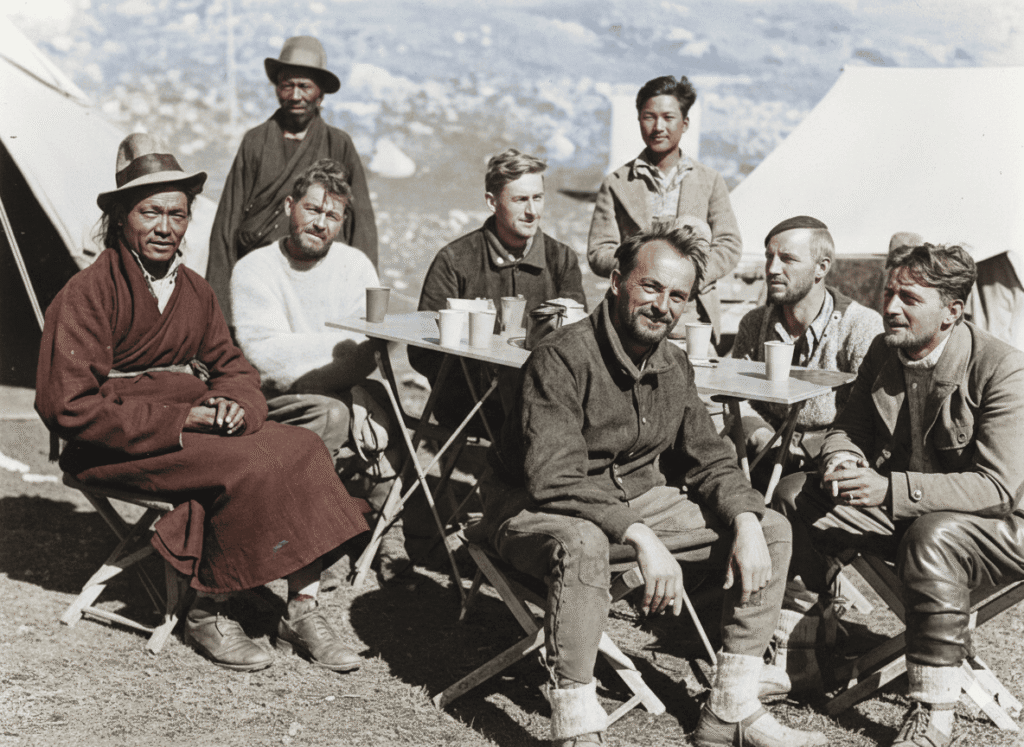
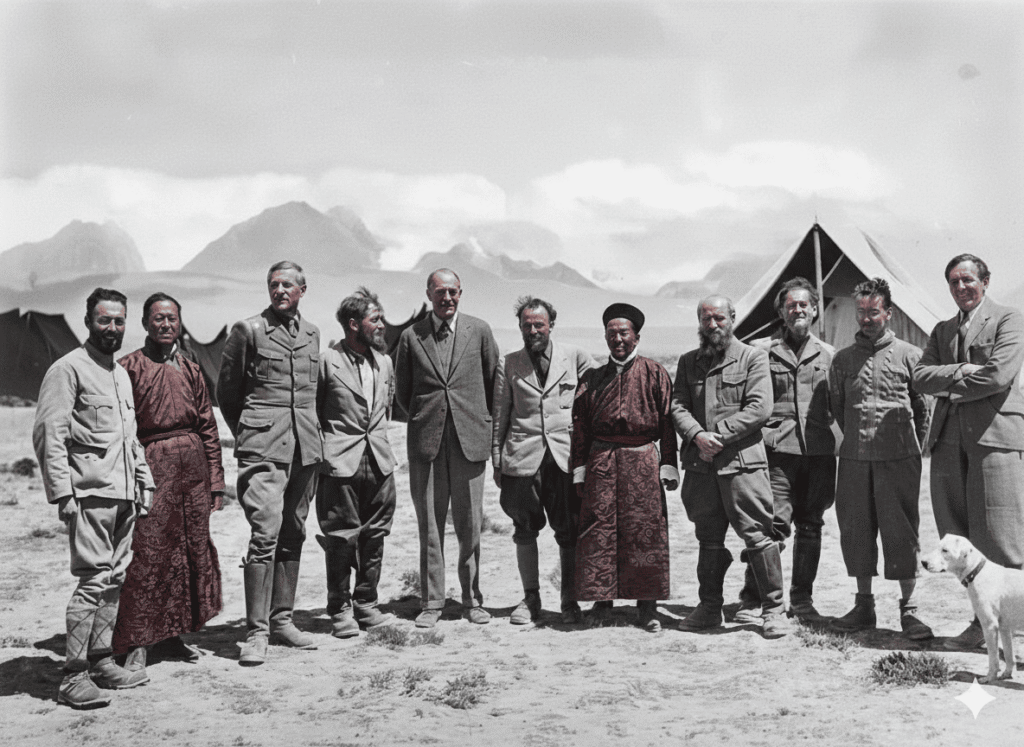
In 1938, a five-member German team officially set out for Tibet.
The expedition members included:
- Ernst Schäfer (leader)
- Bruno Beger (anthropologist)
- Karl Wienert (geophysicist)
- Ernst Krause (entomologist and photographer)
- Edmund Geer (technical and geographical specialist)
They arrived in India in May 1938. British authorities initially directed them to conduct surveys in Sikkim rather than allowing immediate access to central Tibet.
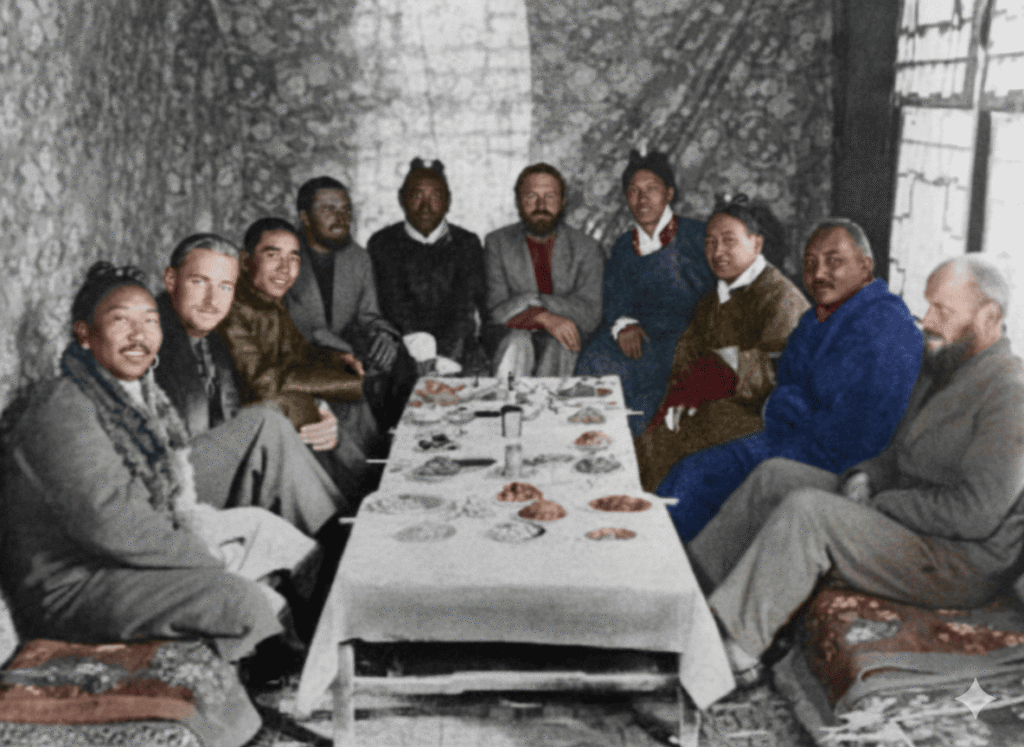
Taking advantage of the opportunity, the team traveled into Gangba Zong in present-day Tingri County. There, they were hosted by the Taring family, connected to the Sikkim royal lineage. Through diplomacy and gift-giving, they gained limited access to Tibetan regions while carefully navigating British political sensitivities.
Access to Lhasa: A Rare Diplomatic Breakthrough
One of the most remarkable achievements of the expedition was receiving an official invitation from the Tibetan government to visit Lhasa.
The team was granted a 14-day stay in the city. During this time, they were allowed to:
- Visit religious sites
- Study Tibetan architecture
- Build diplomatic relationships
- Document cultural practices
The permission came with strict conditions: they were not to harm local residents or wildlife.
For Schäfer, this invitation was a historic milestone. It provided rare Western access to Lhasa at a time when Tibet remained largely closed to foreign explorers. The visit highlighted the delicate diplomatic balance between Tibet, Britain, and Germany during a tense geopolitical era.
Tibet: Science, Myth, and Power Politics
The 1938 German expedition to Tibet stands at the intersection of scientific curiosity and political ambition. It combined genuine zoological and geographical research with racial theories promoted by the Nazi regime.
For historians, this expedition illustrates how exploration can become intertwined with ideology and international strategy. Tibet’s reputation as a land of spirituality and mystery made it a powerful symbol in European imagination—one that was shaped as much by myth as by science.
The story of Ernst Schäfer’s Tibet expedition remains a compelling example of how scientific journeys can reflect the political forces of their time.
The Legacy of the 1938–1939 German Expedition to Tibet
The 1938–1939 German expedition to Tibet, led by Ernst Schäfer, remains one of the most controversial and scientifically significant foreign expeditions in Tibetan history. Blending geopolitics, cultural exchange, and scientific research, the mission left a deep imprint on both German-Tibetan relations and Western understanding of Tibet.
This phase of the expedition, particularly its time in Lhasa and central Tibet, reveals how diplomacy, ideology, and exploration intersected on the eve of World War II.
Arrival in Tibet and the Journey to Lhasa
In December 1938, the five-member German team departed from Gangtok, traveling through the Chumbi Valley to Yadong and then northward to Gyantse. Along the way, they visited Gyantse Fortress, the site of the 1904 British military campaign in Tibet.
Local accounts described the 1904 battle as a tragic and unequal confrontation between Tibetan defenders and British forces—an episode that still shaped Tibetan views of foreign powers decades later.
By January 19, 1939, the German expedition reached Lhasa. Unlike many previous Western visitors, they were welcomed with formal ceremonies organized by the Kashag government. Lavish gifts were exchanged, and the Germans quickly established contact with influential nobles and high-ranking officials.
Building Elite Connections in Lhasa
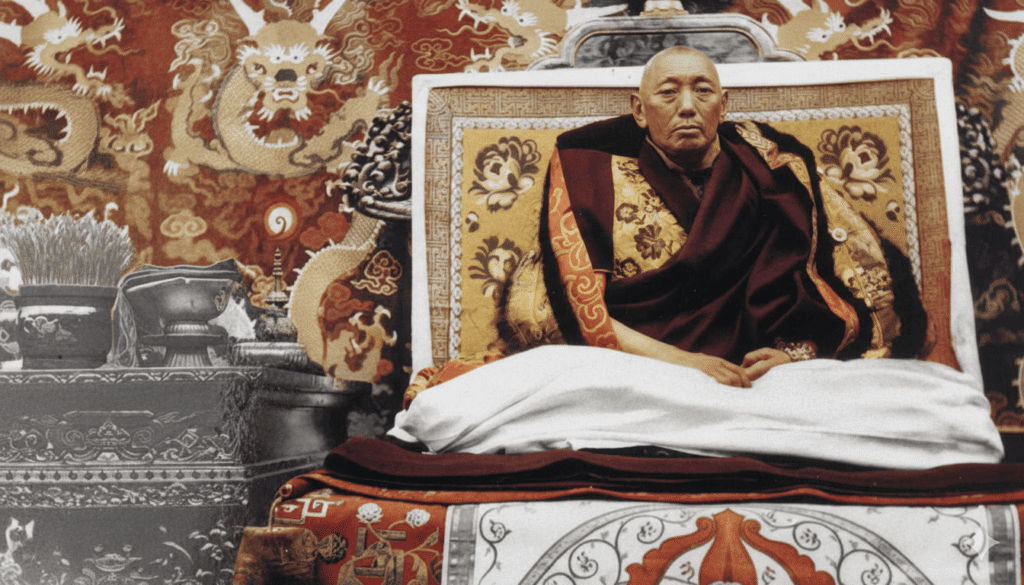
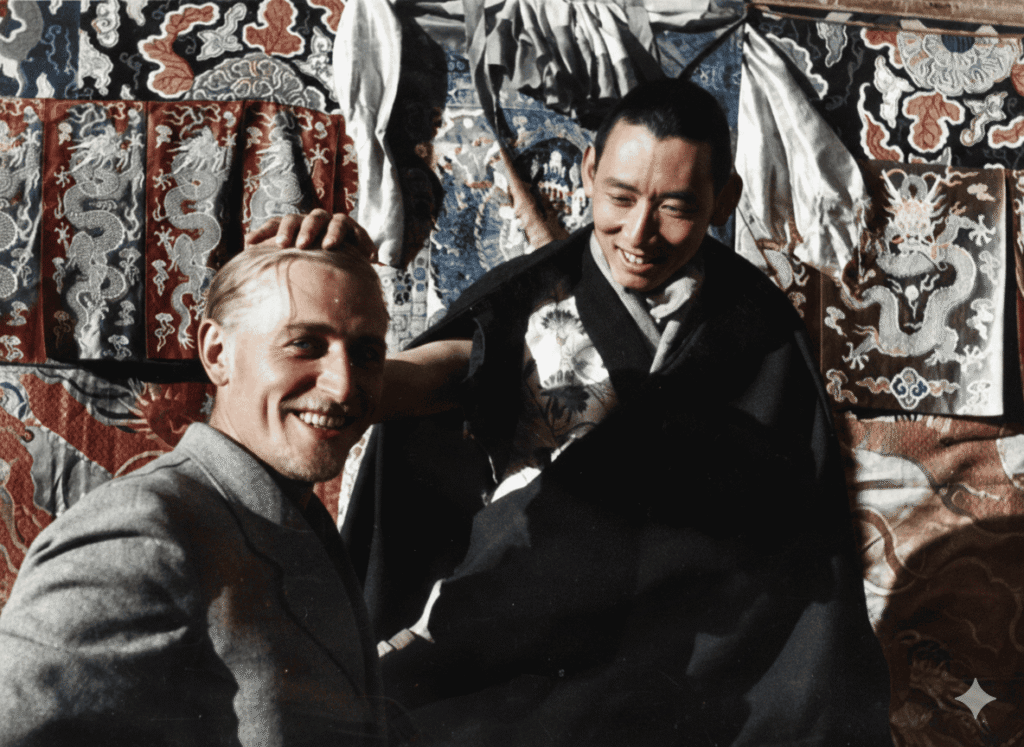
During their two-month stay in Lhasa, Schäfer and his team focused heavily on diplomacy. They met members of the Tibetan aristocracy, visited key government offices, and secured multiple audiences with Reting Rinpoche, the Regent of Tibet at the time.
Gift diplomacy played a major role. One notable gesture included presenting the Regent with a German pistol. Such exchanges helped the team gain rare access to political and religious elites—access that other foreign representatives struggled to obtain.
Schäfer also met prominent Tibetan political figures such as Tsarong Dzasa, often described as one of Tibet’s most influential modern reformers.
Through banquets, meetings, and cultural participation, the Germans promoted Germany’s technological progress and political strength. These interactions reflected more than curiosity—they were subtle efforts to build long-term influence.
Cultural Immersion and Documentation
Beyond politics, the expedition immersed itself in Tibetan society. The team participated in Tibetan New Year celebrations and documented daily life in Lhasa.
Their work included:
- Extensive photography of religious rituals
- Documentation of architecture and monasteries
- Recording festivals and social gatherings
- Collecting artifacts related to nomadic and urban life
Bruno Beger, the expedition’s anthropologist, became unexpectedly popular among Tibetan elites. With basic medical knowledge, he offered advice and promised to send German medicines. This increased his access to noble families.
At the same time, Beger conducted anthropological measurements, blood type testing, and created plaster facial casts of Tibetan elites—research shaped by racial theories prevalent in Nazi Germany.
A Letter from Tibet to Adolf Hitler
One of the most striking diplomatic moments of the expedition was persuading Regent Reting Rinpoche to write a letter to Adolf Hitler.
In the letter, the Regent expressed goodwill and acknowledged the German visitors. He also sent symbolic gifts, including:
- A red tea cup with a silver lid
- A tea strainer
- A Tibetan dog
While modest in material value, these gifts symbolized diplomatic recognition.
Some historians suggest that Tibet’s openness to Germany may have been a strategic move. With British and Chinese pressures looming, Tibetan leaders may have viewed Germany as a potential balancing force in international politics.
Schäfer’s Reports to Heinrich Himmler
Throughout the expedition, Schäfer reported enthusiastically to Himmler. He emphasized that German influence had reached one of the most isolated regions in Asia.
For the Nazi leadership, this access was politically meaningful. Tibet had long been closed to most Western nations, and gaining entry symbolized diplomatic success. The expedition was no longer just scientific—it had become a geopolitical statement.
Unprecedented Access to the Yarlung Valley
One of the expedition’s most remarkable achievements was gaining entry to the Yarlung Valley, widely regarded as the cradle of Tibetan civilization.
There, the team visited:
- Yarlung Valley
- Samye Monastery
- Ancient ruins tied to early Tibetan kings
This access was unprecedented for a Western expedition. Even British representatives in Lhasa, such as Hugh Richardson, had not been permitted to explore the region so freely.
Schäfer reportedly claimed that the swastika symbol originated in the Yarlung Valley thousands of years ago—a statement that aligned with Nazi symbolic narratives but had no solid historical basis.
As political tensions rose in 1939, the expedition sensed a tightening atmosphere. In July 1939, shortly before the outbreak of World War II, the team left Tibet and returned to Gangtok.
Scientific Achievements and Data Collection
Despite the political overtones, the German expedition produced substantial scientific documentation.
Their research included:
- Geomagnetic measurements
- Atmospheric and climate data
- Geological and mineral studies
- Botanical and zoological surveys
The scale of their collection was remarkable:
- 2,000 wild plant seeds
- 5,000–6,000 flowering plant specimens
- 3,500 bird specimens
- 2,000 bird eggs
- 400 mammal specimens
- 100 livestock skeleton collections
- Over 1,000 butterfly species
In addition, the team created one of the largest early Western visual archives of Tibet:
- 20,000 black-and-white photographs
- 2,000 color photographs
- Tens of thousands of inches of film footage
Even British official Basil Gould acknowledged the expedition’s commitment to genuine scientific work.
Anthropological Research and Controversy
Bruno Beger’s anthropological studies formed another major component of the expedition. He conducted physical measurements on more than 400 Tibetans and created over 1,000 facial casts.
Beger concluded that Tibetans displayed features primarily aligned with Mongolian populations, with some traits he interpreted as intermediate between European and Asian groups. He also suggested that Tibetan nobility showed closer resemblance to Europeans—an interpretation shaped by racial theories of the time.
Today, these racial classifications are recognized as scientifically flawed and ethically problematic. However, they reflect how anthropology in the 1930s was often influenced by ideology.
The Expedition’s Historical Significance
The German expedition to Tibet (1938–1939) occupies a unique place in the history of Western exploration of Tibet. It combined:
- Diplomatic maneuvering
- Scientific discovery
- Cultural documentation
- Ideological ambition
The mission expanded Western knowledge of Tibetan geography, biodiversity, and culture. At the same time, it exposed how scientific exploration could be intertwined with political agendas and racial ideology.
Its extensive visual documentation and specimen collections continue to be referenced in research on Tibetan history, ecology, and anthropology, making it one of the most documented foreign expeditions to Tibet before World War II.
The German SS Tibet Expedition and British Diplomacy Before World War II
The 1938–1939 German SS expedition to Tibet, led by Ernst Schäfer, was not just a scientific mission. It unfolded during a period of rising political tension between Nazi Germany and the British Empire. The expedition reveals how exploration, diplomacy, intelligence, and rivalry were deeply intertwined on the eve of World War II.
This phase of the German Tibet expedition highlights the complex German-British relations, British surveillance efforts, and the long-term geopolitical ambitions behind the journey.
Navigating Diplomatic Tensions Between Germany and Britain
By the late 1930s, relations between Germany and Britain were increasingly strained. However, Britain was still following a policy of appeasement under Prime Minister Neville Chamberlain.
Originally, Schäfer had planned to enter Tibet through Sichuan in China. But the outbreak of the Second Sino-Japanese War made that route impossible. As a result, British India became the only realistic gateway into Tibet.
This placed the expedition under British authority from the very beginning.
Initial British Resistance to the SS Expedition
The British Foreign Office initially rejected Schäfer’s request to enter Tibet via Assam. Officials cited regional instability, but deeper concerns were at play.
The expedition was composed entirely of SS members and had clear ties to Heinrich Himmler. British authorities viewed the SS as a militarized and intelligence-driven organization. They suspected the scientific mission might conceal political or espionage objectives.
The German consulate in Calcutta concluded that the rejection was largely due to the expedition’s SS identity rather than purely logistical concerns.
Himmler’s Intervention and British Reassessment
In response, Himmler wrote to his British acquaintance, Barry Domvile, expressing surprise and disappointment over the British treatment of German scientists. He denied that they were spies and argued for fair treatment of German citizens abroad.
Domvile forwarded the letter to Prime Minister Neville Chamberlain. This triggered a reassessment within the British government. British intelligence service MI5 quickly reviewed the political risks of allowing the expedition to proceed.
Ultimately, the British concluded that permitting the Germans to enter Tibet through Sikkim was politically manageable—provided they remained under close observation.
Diplomatic Maneuvering in Lhasa
British officials sought to reduce open confrontation while maintaining influence. Basil Gould, the British Political Officer in Sikkim, was instructed to minimize diplomatic friction.
Gould proposed allowing the German visit under Tibetan authority, while keeping the option open to exert British influence through the British mission in Lhasa if necessary. This strategy reflected Britain’s effort to balance diplomacy and control.
Interestingly, even Francis Younghusband—who had led the 1904 British invasion of Tibet—endorsed Schäfer’s expedition. He reportedly compared the Germans’ entry strategy to a snake quietly crossing a border, suggesting a discreet approach.
British Surveillance and Distrust in Lhasa
Despite granting permission, British officials did not trust the German SS expedition.
Hugh Richardson’s Watchful Eye
Hugh Richardson, the British representative in Lhasa, strongly opposed the German presence. Although ordered to cooperate, he maintained a tense relationship with Schäfer and his team.
Richardson closely monitored:
- The Germans’ movements in Lhasa
- Their meetings with Tibetan elites
- Their communications using the British-Indian postal system
British authorities reportedly intercepted mail sent to Germany and placed informants among local workers hired by the Germans.
Richardson feared the Germans were positioning themselves as “natural allies” of Chinese representatives in Lhasa and using Chinese wireless equipment to transmit information.
British Concerns About German Influence in Tibet
Richardson’s primary mission was to preserve Tibet as a buffer zone protecting British India. Any growing influence from a rival European power—especially Nazi Germany—was viewed as a strategic threat.
He accused Schäfer’s team of portraying Germany as the world’s most powerful nation to Tibetan elites. British officials worried that Germany was using science and diplomacy as tools to undermine British prestige in the region.
Reports to Basil Gould claimed that the Germans were actively promoting Nazi ideology during their stay.
Reputation and Rivalry: Competing European Images in Tibet
British officials believed they had carefully built a respected image of Europeans in Tibet. They emphasized formal dress, disciplined behavior, and imperial prestige.
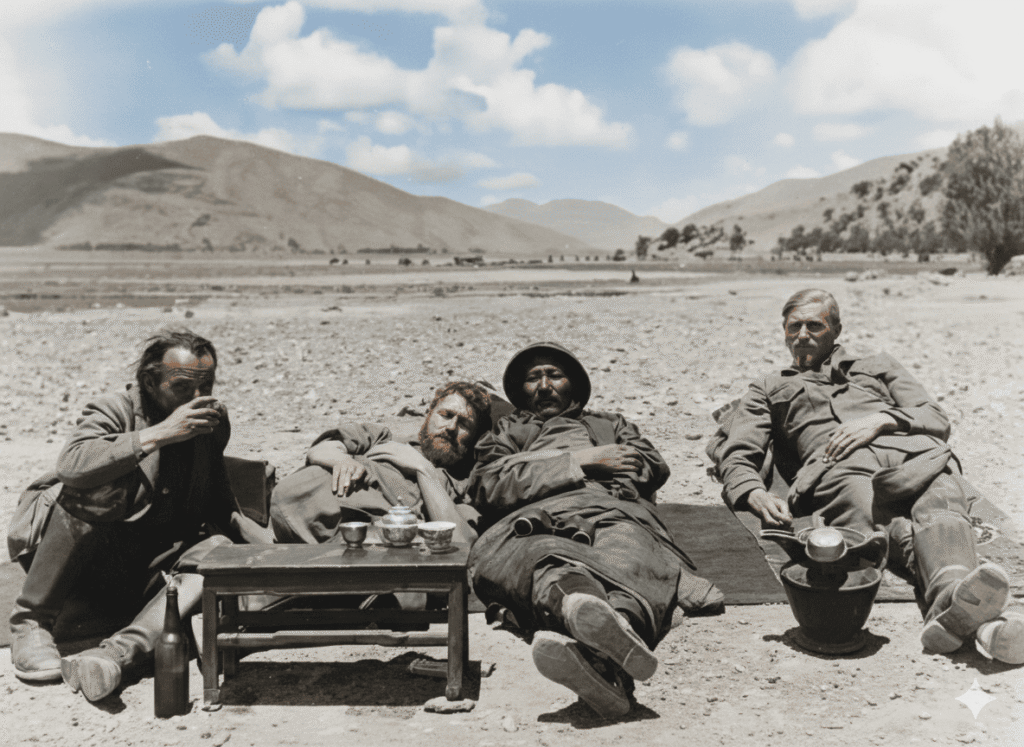
In contrast, British reports described the Germans as:
- Poorly dressed
- Rude to local employees
- Engaging in animal slaughter near temples
- Purchasing goods below market rates
There were also complaints about anthropological measurements conducted by the expedition team.
While the Germans considered their mission a major success, British assessments were largely negative. Gould described them as unpopular among Tibetans and criticized their treatment of local workers.
This rivalry over reputation reflected deeper imperial competition between Britain and Germany.
Intelligence Gathering and Political Strategy
Although the expedition conducted legitimate scientific research, British officials believed it also gathered military and political intelligence.
From Berlin’s perspective, Tibet held strategic value. If Britain were to be weakened, India would be a crucial target. Tibet’s geographic location made it potentially useful in plans aimed at destabilizing British control in South Asia.
After World War II began in September 1939, these ambitions intensified.
The “Tibet Plan” and Nazi Strategic Ambitions
Following the outbreak of the war, the German Ambassador to Turkey, Franz von Papen, reportedly suggested that defeating Britain required attacking India.
Ernst Schäfer proposed what became known as the “Tibet Plan” to Foreign Minister Joachim von Ribbentrop and Heinrich Himmler.
The proposal involved:
- Sending a small SS expedition through the Soviet Union
- Supplying weapons to Tibetans
- Encouraging unrest along the Indo-Tibetan border
- Disrupting British strongholds in northern India
Schäfer compared the strategy to operations carried out in the “spirit of Lawrence of Arabia,” envisioning a small elite team supported by significant funding.
Two possible routes were considered:
- Through Almaty to Hami into Tibet
- Along the Silk Road via Kashgar and Hotan to Lhasa
Negotiations with the Soviet Union were handled by Peter Kleist, representing Ribbentrop. In December 1940, the Soviets reportedly agreed to allow German passage. However, the plan collapsed when Germany invaded the Soviet Union in 1941.
Myths, Mysticism, and Historical Reality
After Germany’s defeat in World War II, the SS expedition faded from political relevance. However, myths about Nazi-Tibet connections continued to spread.
Modern conspiracy theories claim:
- Nazis searched for mystical energies in Tibet
- Hitler had Tibetan spiritual advisors
- Tibetan lamas performed rituals to assist Germany’s war efforts
There is no credible evidence supporting these claims. While Nazi ideology included esoteric elements, the historical record shows that the Tibet expedition was primarily a mix of science, diplomacy, intelligence gathering, and geopolitical maneuvering—not occult fantasy.
Nonetheless, the dramatic setting of Tibet and the SS association have fueled decades of sensational narratives.
The Broader Historical Significance
The German SS Tibet expedition reflects a critical moment in global history. It illustrates:
- The fragile diplomatic balance between Germany and Britain before World War II
- The strategic importance of Tibet in imperial geopolitics
- The blending of scientific exploration with ideological ambition
- The role of intelligence and influence in foreign expeditions
For historians of Tibet, colonial diplomacy, and World War II geopolitics, the expedition offers a powerful case study of how exploration can serve as a tool of state strategy.
It also reveals how narratives about Tibet—whether scientific, political, or mystical—were shaped by international rivalry and propaganda during one of the most volatile periods of the 20th century.
German–Tibet Relations: History, Myth, and Cultural Legacy
The relationship between Germany and Tibet in the 20th century is often surrounded by mystery. Much of this perception stems from the 1938–1939 expedition led by Ernst Schäfer and later cultural narratives in Europe.
In reality, German–Tibet relations were shaped by diplomacy, scientific research, political propaganda, post-war memory, and modern reinterpretations. Understanding this history requires separating documented facts from exaggeration.
The Letter from Tibet to Hitler — And the Silence That Followed
Three years after returning from Tibet, Schäfer presented the letter from the Tibetan Regent to Adolf Hitler. Despite the symbolic value of the gesture, Hitler neither responded nor pursued further contact with Tibet.
This silence is significant. While Nazi officials such as Heinrich Himmler showed interest in Tibet, there was no sustained diplomatic or military cooperation between Germany and Tibet.
However, from the 1960s onward, Western films and literature increasingly portrayed a “mysterious Nazi–Tibet connection.” These stories often exaggerated or fabricated links between Nazi mysticism and Tibetan spirituality.
This narrative was driven more by post-war fascination with Nazi occult myths than by historical evidence.
The Myth of Nazi Mysticism in Tibet
The idea that Nazi Germany sought mystical powers in Tibet has been widely repeated. Claims range from secret spiritual missions to supernatural alliances.
In truth, these theories grew largely from:
- Post-war sensationalist literature
- Limited access to archival research
- Western fascination with both Nazi symbolism and Tibetan mysticism
In post-war Europe, especially in Germany, any unusual or unexplained historical detail was sometimes linked to Hitler or the SS without sufficient evidence. Tibet, already viewed as mysterious in Western imagination, became an easy setting for such stories.
Modern historical research shows that while ideology influenced aspects of the expedition, there is no credible evidence of occult missions or mystical collaboration.
The Comprehensive German Study of Tibet
The Creation of the Sven Hedin Institute
In 1942, as German forces advanced into the Caucasus, Himmler ordered expanded research into Central Asia and Tibet. This led to the creation of the Sven Hedin Institute at the University of Munich.
The institute was named after Swedish explorer Sven Hedin and led by Ernst Schäfer.
Initially, the institute’s main task was to analyze and organize the materials collected during the Tibet expedition. Later, it also received estates and research collections from:
- Wilhelm Filchner
- Wilhelm Rickmer-Rickmers
The institute operated directly under SS leadership and Himmler’s oversight.
Schäfer’s Vision for Integrated Research
In correspondence with Hans Heinrich Lammers, Schäfer described the institute’s mission as advancing “true, comprehensive, and holistic scientific research.”
He cited the ideas of Alexander von Humboldt, advocating integration between natural sciences and human sciences.
The institute established 13 divisions, including:
- Geomagnetism
- Geophysics
- Geography
- Botany
- Limnology
- Anthropology
- Ethnology
- Theology
However, the realities of World War II made this ambitious research agenda impossible to fully implement.
The Salzburg Tibet Exhibition: A Visual Legacy
In 1943, Schäfer, Bruno Beger, and their team created an immersive Tibetan exhibition at the Haus der Natur in Salzburg.
The exhibition featured detailed dioramas of:
- Potala Palace
- Tibetan nomads and aristocrats
- Sky burial sites
- The Red Valley landscape
- Himalayan wildlife
Visitors felt transported into Tibet, even without traveling there. Sven Hedin attended the opening ceremony, and Himmler praised the exhibition.
Today, these dioramas remain on display. The museum openly acknowledges their origin in the SS-sponsored Tibet expedition while distancing itself from Nazi crimes.
The exhibition continues to serve as an anthropological record of pre-1950 Tibet and remains one of the most visible legacies of the German Tibet expedition in Europe.
Heinrich Harrer and “Seven Years in Tibet”
Many people confuse the SS expedition with the story of Austrian mountaineer Heinrich Harrer.
Harrer joined the SS and Nazi Party in 1938 and participated in a 1939 expedition to Nanga Parbat. After World War II began, he was captured by the British in India. In 1944, he escaped and eventually reached Lhasa in 1946.
Harrer later became close to 14th Dalai Lama and returned to Europe in 1952. His memoir, Seven Years in Tibet, became internationally famous.
Although Harrer had Nazi affiliations earlier in life, his time in Tibet was not directed by Himmler or Hitler. Still, his popularity in Germany reinforced public interest in Tibet and contributed to modern Western narratives about the region.
Interestingly, in the 1980s, the 14th Dalai Lama visited Ernst Schäfer in Germany. Bruno Beger also maintained contact with Tibetan figures, including Thubten Jigme Norbu, the Dalai Lama’s brother.
British Suspicion and Later Reconciliation
Before World War II, British officials in Lhasa—particularly Hugh Richardson—were deeply suspicious of German activity in Tibet. Richardson monitored Schäfer and later attempted to expel Harrer.
However, by the 1950s and 1960s, former British and German figures increasingly presented themselves as historical witnesses of Tibet.
In 1994, the 14th Dalai Lama invited Harrer, Beger, and Richardson to London to discuss Tibet’s historical status before international media.
These figures published works emphasizing Tibet’s political position in the early 20th century, including:
- Richardson’s Tibet and Its History
- Beger’s writings on Tibet’s 1938–1939 status
- Harrer’s memoirs
Harrer’s influence was particularly strong in Germany. His writings shaped public opinion and even influenced policy debates within the German Green Party during the 1980s.
Archival Memory and Untapped Research
In December 1939, Sven Hedin recorded a conversation with Himmler in which Himmler expressed concern that publishing the expedition’s findings during wartime would diminish their impact.
As a result, much of the expedition’s material was never widely released.
Today, the German Federal Archives holds:
- Manuscripts
- Diaries
- Letters
- Media reports
- Approximately 17,000 photographs
These documents provide detailed information about:
- Tibetan geography and climate
- Daily life in Lhasa
- Economic and social systems
- Religious and political structures
- Sino-Tibetan relations in the late 1930s
Despite their historical value, many of these materials remain underutilized in modern Tibetan studies.
German–Tibet Relations in Historical Perspective
The relationship between Germany and Tibet was shaped by exploration, diplomacy, propaganda, and post-war memory.
While Nazi ideology influenced parts of the 1938–1939 expedition, later myths about mystical alliances greatly exaggerated reality. The documented record shows a combination of scientific ambition, geopolitical strategy, and cultural documentation—rather than occult collaboration.
The legacy of these interactions continues to influence how Tibet is perceived in Europe today, particularly in Germany, where early explorers and writers played a major role in shaping public understanding of Tibetan history and identity.