Jamtrin Temple: A Historical Marvel
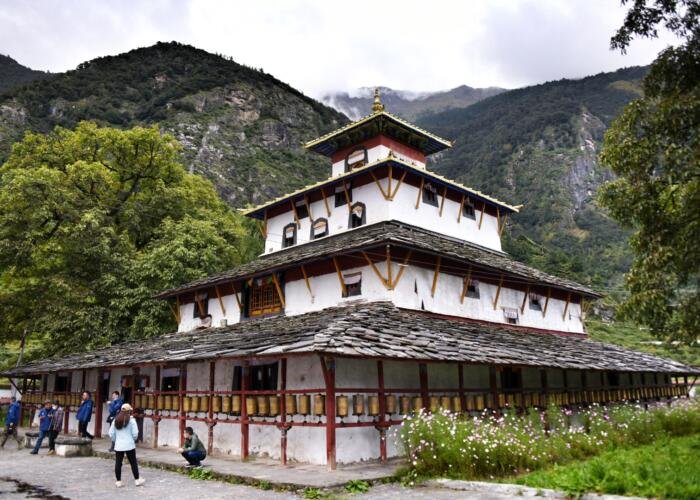
Jamtrin Temple, also known as Jamtin Lhakang and referred to as “Qiangzhen Gajie Temple”. It stands as a remarkable historical site. Nestled in Bangxing Village, Gyirong Town, Shigatse, Tibet, this ancient temple boasts a history of over 1300 years. It was established during the era of Tibetan King Songtsen Gampo and is recognized as one of the four major temples erected to subdue the mythical Tibetan demoness, situated above her right knee.
Historical Significance and Mythology
Recorded in Tibetan historical texts like “Annals of Tibetan Kings” and “Records of the Tibetan Kings and Ministers, Jamtrin Temple’s founding is linked to a captivating mythological tale. Following Princess Wencheng‘s entry into Tibet, King Songtsen Gampo, guided by her astrological insights, initiated the construction of temples to suppress the ‘Rakshasa demoness’ and other malevolent spirits. Jamtrin Temple, in particular, was built to suppress the demoness’s right knee, as detailed in these ancient texts.
These documents also highlight the strategic placement of other temples on different parts of the demoness’s body, such as her left shoulder, right foot, right shoulder, and left foot, forming a mystical pattern to restrain her.

Architectural Marvel of Jamtrin Temple
Jamtrin Temple is an architectural gem, featuring a wooden, pagoda-style structure with four levels. Its square main body, with a hollow interior, is accessible via wooden stairs leading to the top. Each floor is beautified with overhanging eaves, windows, and unique peach-shaped pot doors on the second level. The temple’s pinnacle, adorned with a flame jewel, exemplifies the intricate craftsmanship of its time.
A wooden railing encircles the ground floor, forming an external corridor lined with 108 prayer wheels. The temple stands approximately 16 meters tall, with its widest part measuring 22 meters. Builders constructed the lower walls with slate stones and plaster. The upper floors, made from small fire bricks, rest on original wooden beams and stone slabs. The primary temple structures are located on the first three floors, showcasing the architectural style of the Tang Dynasty.
Jamtrin Temple, with its rich history and mythology, offers a unique window into Tibet’s cultural and spiritual legacy, making it an essential destination for history buffs and spiritual seekers alike.
Exploring the Layers of Jamtrin Temple: An Architectural and Spiritual Journey
The Ground Floor: A Gateway to Serenity
The west side of the ground floor of Jamtrin Temple features a porch supported by two pillars, spanning an area of 57 square meters. To the east of the porch, there are dual corridors, an external bright corridor and an internal dark corridor, each about 2 meters high. At the heart of these corridors lie six secret chambers, with each room covering an area of 3 to 4 square meters and a height of 1.8 meters. Small windows measuring 20 cm by 30 cm are carved into the walls of these chambers, illuminating the spaces with a soft, natural light.
The Second Floor: Sanctuary of the Protectors
The second level houses the Protector’s Hall, encircled by a corridor and containing five secluded chambers for Lama’s meditation practices. This floor serves as a spiritual retreat for those seeking to deepen their meditation and connect with the divine protectors of the faith.
The Third Floor: The Heart of Jamtrin
The third floor stands as the temple’s main structure, featuring a hall that spans three bays in width and depth, covering an area of 182 square meters. It proudly houses a 120 cm tall gilded bronze statue of Jamba Buddha, flanked by numerous gilded Buddha statues, each residing within one of the 18 niches. This floor also safeguards precious Buddhist scriptures, including the Kangyur and Tengyur texts. Despite the devastation during the Cultural Revolution, the temple was faithfully restored in 1986, preserving its spiritual essence and architectural grandeur.

The Murals of Jamtrin Temple
Across its layers, Jamtrin Temple boasts wall paintings that have largely withstood the test of time. These murals, potentially crafted by Nepalese artists or influenced by their style, depict a variety of themes from tropical and subtropical landscapes to serene mountainous and water scenes, complemented by architectural elements. Significant murals include depictions of the Western Pure Land, images of past Dalai Lamas, and the sixteen arhats, showcasing a blend of religious reverence and artistic mastery.
Porch and Ground Floor Corridor Murals
Over a thousand seated and standing figures of Shakyamuni Buddha decorate the porch and the external ground floor corridor walls. Artisans have outlined these smaller standing figures, approximately 20 cm in height, in blue on yellow walls, vividly capturing the essence of the Buddha’s form in a minimalist yet profound manner.
Inside the Protector’s Hall on the second floor, vibrant paintings of Vajrayana protective deities adorn the walls, set against a black background with yellow outlines and red accents, creating a visually striking space dedicated to spiritual guardians.
On the third floor, the pinnacle of Jamtrin Temple’s mural artistry comes to life in the main hall and surrounding corridor. Here, a rich array of themes, clear patterns, and vibrant colors celebrate Buddhist iconography. Murals depicting Amitayus Buddha, Guru Rinpoche, and the Fifth Dalai Lama, among other revered figures, highlight the temple’s deep spiritual heritage and artistic wealth.
Interplay of Nature and Humanity in Jamtrin Temple Murals
Jamtrin Temple is not only a spiritual sanctuary but also a remarkable showcase of Tibetan Buddhist art and mural painting. Its walls, sculptures, and sacred spaces preserve centuries of artistic expression, blending divine symbolism, natural landscapes, and everyday human life into a vivid visual narrative.
One of the most striking features of Jamtrin Temple murals is the seamless fusion of nature and human life. Between the portraits of revered Buddhist figures, artists painted sweeping landscapes filled with mountains, rocky cliffs, forests, mist, flowing rivers, and cascading waterfalls. These natural elements create depth and movement, giving the murals a sense of living space rather than static decoration.
Interwoven with these landscapes are scenes of secular life, including half-naked figures engaged in daily activities such as feeding dogs, making pottery, and farming. These depictions highlight the vibrancy of ordinary existence, reflecting a worldview where the sacred and the mundane coexist harmoniously.
Main Hall Murals: A Vision of the Western Pure Land
The north wall of the main hall features a grand mural of the Western Pure Land, one of the most important themes in Tibetan Buddhist art. Measuring approximately 4 meters high and 2.5 meters wide, this composition is arranged into three symbolic layers.
Upper Layer: Amitabha Buddha and the Celestial Realm
At the top, Amitabha Buddha stands gracefully on a lotus pedestal, surrounded by celestial beings. A pagoda-style Buddhist temple rises nearby, symbolizing spiritual refuge. Around it, serene ponds filled with swans at play add a peaceful, otherworldly atmosphere to the heavenly scene.
Middle Layer: Tsongkhapa and the Ascent to Enlightenment
The middle section portrays Tsongkhapa and his disciples, ascending through clouds toward the heavens. Snow-capped mountains, lush greenery, and a winding stream form the backdrop. In the valley below, three deer drinking water symbolize harmony, compassion, and the Buddhist ideal of peaceful coexistence with nature.
Lower Layer: Protective Deities and Auspicious Symbols
The bottom layer features powerful protector deities, including Palden Lhamo and Gonpo, set against snowy mountains and swirling clouds. Deer reappear in this section, along with the Eight Auspicious Symbols, reinforcing themes of protection, prosperity, and spiritual balance.
West Wall Murals: Deities and Dharma Protectors
The west wall presents a rich assembly of enlightened figures and guardians. At its center are Tara, Avalokiteshvara, and Rigs Sum Gon Po, representing compassion, mercy, and enlightened wisdom.
Below them appear the Four Great Vajras and the temple’s main guardian deity, Begtse. Begtse is depicted wearing a wide-brimmed hat, with three faces and six arms, riding a fierce lion. His powerful posture conveys unwavering protection of the Buddhist teachings. This wall also includes images of Amitayus Buddha and Milarepa, adding historical and spiritual depth to the mural program.
South Wall Murals: Medicine Buddha and the Sixteen Arhats
The south wall focuses on healing and protection. At its center is the Medicine Buddha, seated calmly in meditation. He is flanked by attendants holding a staff and a bowl, symbolizing healing and compassion.
Surrounding the central figures are the Sixteen Arhats, each portrayed with unique postures and slightly exaggerated facial expressions, bringing individuality and liveliness to the composition. A wrathful protective deity dominates part of the wall, wearing a skull crown, tiger-skin skirt, and wielding six arms while trampling demons beneath his feet—an intense visual representation of spiritual defense.
Sacred Sculptures: Highlights of Jamtrin Temple Art Collection
Beyond murals, Jamtrin Temple houses several exceptional Buddhist sculptures, reflecting high levels of craftsmanship and devotional artistry.
Sandalwood Buddha Sculpture
Standing at an impressive 220 cm, the Sandalwood Buddha is a masterpiece of religious sculpture. The Buddha wears a distinctive mountain-shaped crown, large earrings, and a monk’s robe that bares his right shoulder. He holds a vajra against his chest with his right hand, while the left rests naturally near his hip.
Seated cross-legged on a lotus pedestal, the sculpture conveys serenity and authority. Its fine detailing and balanced proportions make it one of the temple’s most revered artistic treasures.
Bronze Vajrayana Protector Deity Statue
This 17 cm bronze statue, dating to the Ming dynasty or slightly later, depicts a Vajrayana protector deity with striking intensity. The figure wears a high bun, elaborate jewelry, and a short skirt, sitting barefoot on a lotus base layered with a tiger skin.
Holding a battle-axe and a skull bowl, the deity is draped in a human-skin cloak, with pronounced feminine features such as full breasts and a rounded abdomen. This statue reflects the complex symbolism and ritual importance of Vajrayana Buddhist art.
Turquoise-Inlaid Bronze Statue
This 24 cm Ming dynasty statue stands out for its refined inlay work. The deity wears a high crown topped with a stupa, with a turquoise urna set into the elongated face. Jewel earrings, layered ornaments, and flowing robes enhance its elegance.
Seated cross-legged on a lotus base, the figure leans slightly to one side, forming a teaching gesture with the hands. The turquoise inlay and graceful posture demonstrate advanced metalworking techniques of the period.
Gilded Avalokiteshvara Bronze Statue
Standing 23 cm tall and dating to the Ming period, this gilded Avalokiteshvara statue radiates compassion and refinement. The deity wears a high crown, double-layered lotus earrings, and richly detailed jewelry. Three urna markings appear on the body, emphasizing spiritual perfection.
With a slender waist, dignified facial features, and a meditative seated posture on a lotus base, the statue captures the essence of Avalokiteshvara, the Bodhisattva of Compassion.
Practical Visiting Information for Jamtrin Temple
- Admission: Free
- Opening Hours: 9:30 AM – 5:00 PM
- Location: Approximately 200 meters from the county forest management station
- Access: Reachable by public road; visitors can drive, hire a car, or walk to the temple
Jamtrin Temple stands as a living gallery of Tibetan Buddhist murals, sacred sculptures, and spiritual symbolism, offering visitors a rare opportunity to experience art, history, and devotion woven into a single sacred space.