

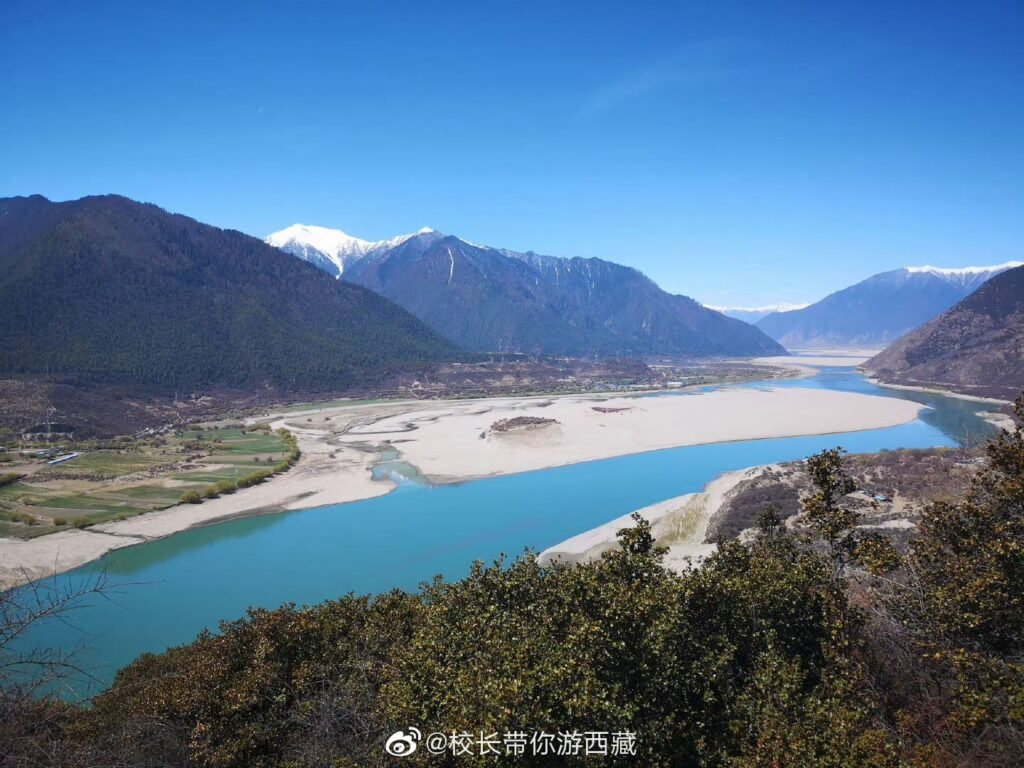
The Brahmaputra River, known in Tibet as the Yarlung Zangbo River, is one of Asia’s most dramatic waterways. Cutting deeply through the Tibetan Plateau from west to east, the river shapes a landscape of steep slopes, roaring waterfalls, lush vegetation, and ancient mountain lifestyles. This remote region offers travelers a rare chance to witness raw natural beauty while tracing the footsteps of generations who once thrived along its banks.
A Dramatic Descent to the River Valley
Reaching the river requires navigating a striking slope of nearly 60 degrees, descending toward the river’s edge at an altitude of around 3,500 meters. The journey itself is an adventure, revealing breathtaking views at every turn.
A narrow mountain road runs parallel to the river, hovering about 20 meters above the rushing waters. In spring and early summer, the route transforms into a colorful corridor lined with wild peach blossoms, apricot trees, and vibrant rhododendrons. The floral display contrasts beautifully with the rugged cliffs and deep blue sky, creating a dreamlike atmosphere for travelers and photographers alike.
Traditionally, the area was accessible only by horseback, with the journey taking nearly three hours. Even today, the route retains a sense of untouched wilderness that makes visitors feel far removed from modern life.
Life Along the Brahmaputra: A Mountain Heritage
The moist climate and fresh mountain air have long supported human settlement here. Ancient communities survived by fishing in the powerful river, hunting in the surrounding hills, and cultivating barley and peas on the flatter slopes.
Homes built from wood and stone reflect practical mountain architecture—durable enough to withstand harsh weather while blending naturally into the landscape. The people seemed born to this terrain, skilled at climbing mountains, navigating rivers, and preserving fish for year-round sustenance.
In the village of Dagu, residents have always lived with the constant thunder of the Brahmaputra. The sound, echoing through the valley, is partly created by the nearby Neka Hot Spring and the turbulent waters that define this stretch of river.
Neka Falls: Where Geology Meets Power
Every year, as spring transitions into summer, fish gather downstream, waiting for rising water levels that allow them to swim upstream. The river surges with nearly a thousand cubic meters of water per second, churning the current into a powerful spectacle.
Neka Falls owes its existence to a geological fracture in the earth. A massive round boulder interrupts the river’s flow, forcing the water to plunge dramatically.
- Twin drops fall from a height of about 6 meters.
- During summer, increased water levels create a roaring cascade that can reach 7 to 8 meters, filling the valley with thunderous sound.
Standing before the falls, it is hard to imagine that the wide Yarlung Zangbo River near Tsedang—stretching 6 to 7 kilometers across—narrows here to barely 40 meters. The sudden transformation highlights the immense geological forces that shaped the Brahmaputra Grand Canyon.
Trekking Toward Zeng Waterfall
The adventure continues from the Dagushuo River toward Nujiao, followed by a demanding five-kilometer trek to Zeng Waterfall. Interestingly, “Zeng” simply means waterfall in Tibetan, yet the experience is anything but ordinary.
The trail is a mix of thrill and challenge:
- Half the path clings to steep cliffs.
- The other half requires scrambling across fallen boulders.
- Monkeys often appear along the route, picking wild fruits from trees growing improbably out of the rock face.
At certain points, the trail rises nearly 100 meters above the river. Below lies the raging current; beside you stands the sheer mountain wall. After descending again toward the riverbank, travelers must carefully step across massive stones. One wrong move could send you tumbling into the maze-like shoreline.
A Waterfall Wrapped in Mist and Rainbows
When the waterfall comes into view, the effort instantly feels worthwhile. Water crashes against giant rocks like a natural breakwater, sending countless waves into the air. The impact generates a heavy mist that often catches the sunlight, forming brilliant rainbows across the gorge.
Though the drop measures around 5 meters, the visual impact is enormous thanks to another giant boulder blocking the river’s course. Here, the Brahmaputra runs narrow and fierce, accelerating into a torrent that slices through the earth.
This relentless force helped carve the legendary Brahmaputra Grand Canyon, one of the deepest and most spectacular canyons on the planet.
The Brahmaputra Grand Canyon: Nature’s Ultimate Artwork
The Grand Canyon of the Brahmaputra is more than a geological wonder—it is a living testament to the power of water, time, and tectonic movement. Towering cliffs, roaring rapids, hidden waterfalls, and untouched forests combine to create a landscape that feels both primal and sacred.
For travelers seeking off-the-beaten-path destinations in Tibet, this region delivers an unforgettable blend of adventure, scenery, and cultural history. Every bend in the river reveals another masterpiece shaped entirely by nature.