Tonpa Shenrab Miwoche is the legendary founder and central teacher of Yungdrung Bön (Eternal Bön), the ancient pre-Buddhist spiritual tradition of Tibet and the Himalayan regions.
In Bön tradition, he is regarded as a fully enlightened Buddha—often called Buddha Shenrab or Tonpa Shenrab—who appeared long before Shakyamuni Buddha. His mission was to teach the path to liberation and to alleviate the suffering of sentient beings.
Although modern scholars debate his historicity and note that no archaeological evidence predates the 10th–11th centuries, within Bön cosmology he holds a timeless and central role comparable to Shakyamuni in Tibetan Buddhism.

Traditional Chronology and Historical Debate
Birth and death dates for Tonpa Shenrab are unknown in historical terms. However, traditional Bön chronology places his life around 18,000 years ago, with some accounts dating his birth to 16,017 BCE—long before the era of the Tibetan kings (Tsenpo).
Core Bön scriptures such as the Dho Due and Zermig emphasize his origin in a sacred western realm rather than central Tibet. Some later folk variants suggest different locations, but canonical texts consistently describe a mythical western homeland.
While historians view him as a symbolic or composite figure shaped by evolving tradition, Bön practitioners revere him as a real and fully enlightened Buddha of a previous age.
Meaning of the Name Tonpa Shenrab Miwoche
The name carries deep spiritual meaning:
- Shen – Refers to his priestly clan linked to ancient Zhangzhung spiritual lineages
- Rab – Supreme or excellent
- Miwo – Man or human
- Che – Great
The name translates to:
“The Supreme Great Man of the Shen Clan.”
He is also known as:
- Dampa Shenrab (“Holy Shenrab”)
- Tonpa Shenrab (“Teacher or Founder Shenrab”)
These titles reflect his spiritual authority and enlightened status.
Birth in the Sacred Land of Olmo Lungring
According to Bön scriptures, Shenrab was born in the mythical kingdom of Olmo Lungring (Tagzig Olmo Lung Ring), a paradisiacal realm described as lying west of Tibet, sometimes symbolically associated with Central Asia.
Olmo Lungring is portrayed as:
- Shaped like an eight-petaled lotus
- Surrounded by an eight-spoked celestial wheel
- Centered on the Nine-Fold Yungdrung Mountain (Yungdrung Gutseg)
From this sacred mountain flow four great rivers that nourish the world, symbolizing the spread of wisdom.
Shenrab was born in the southern palace Barpo Sogye to:
- King Gyalbon Thökar
- Queen Yochi Gyalzhed Ma
He belonged to the royal Mu (dMu) lineage.
Early Life as Prince Mura Tahen
His original name is often given as Mura Tahen. As a young prince, he mastered both worldly and spiritual sciences, including:
- Logic
- Astronomy
- Medicine
- Grammar and phonology
- Ritual knowledge
He married at a young age and had eight sons and two daughters according to traditional accounts.
At age 31, he renounced royal life, cut his hair, distributed his wealth to the poor, and devoted himself entirely to spiritual realization.
His enlightenment is often associated with the sacred region of Mount Kailash, one of the holiest mountains in Tibetan spiritual traditions.
The Teachings of Yungdrung Bön
The teachings attributed to Tonpa Shenrab form the foundation of Yungdrung Bön. They include:
- Shamanic elements and ritual practices
- Ethical conduct and monastic discipline
- Cosmology and sacred geography
- Advanced meditation systems, including Dzogchen-like teachings
- A vast canon of scriptures
Many of these scriptures were revealed as terma (treasure texts) in the 14th century by masters such as Loden Nyingpo.
A central mantra in Bön practice is:
Om Ma Tri Mu Ye Sa Le Du
This eight-syllable mantra invokes enlightened wisdom and the realization of the ultimate pure land described in Bön cosmology.
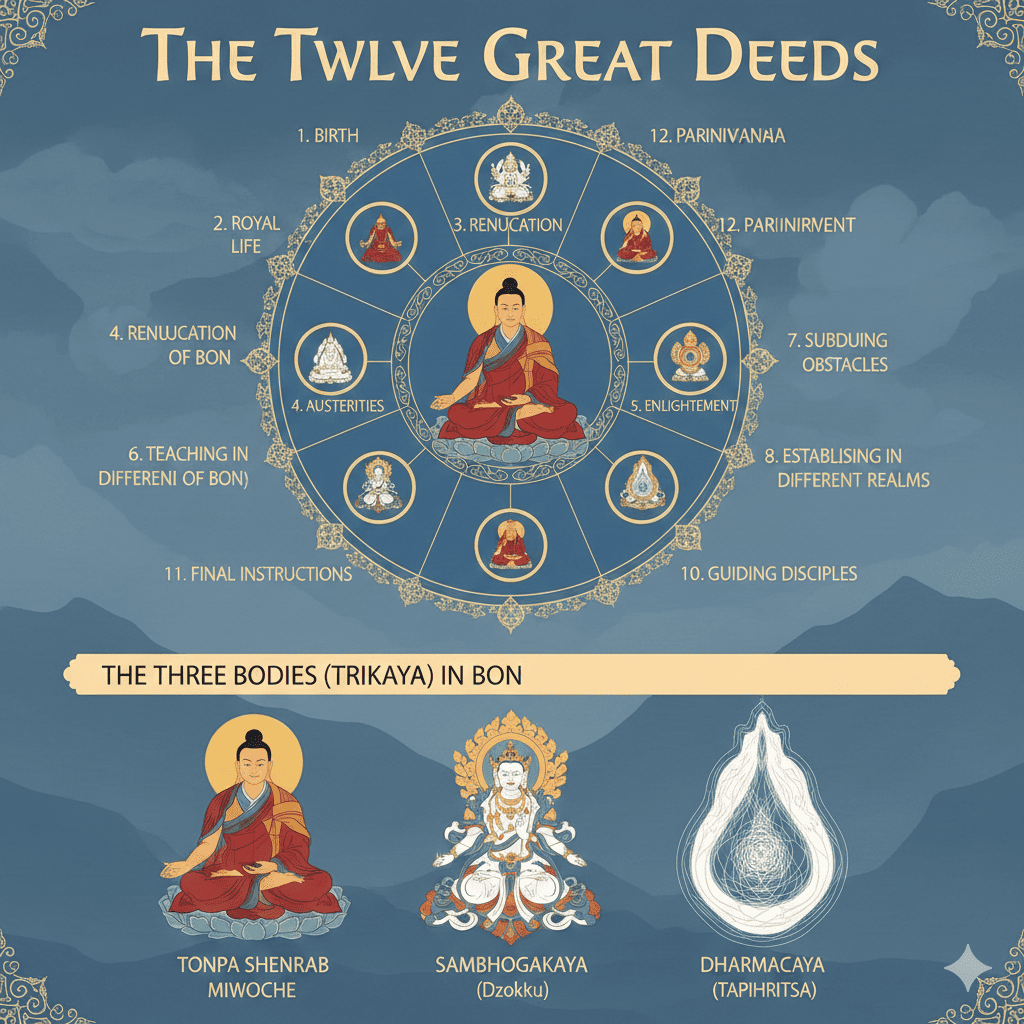
The Twelve Great Deeds
Shenrab’s life story is structured around The Twelve Great Deeds (Mdzad-chen bcu-gnyis). This sacred narrative parallels the life structure of Shakyamuni Buddha but retains distinct Bön elements.
Bön texts state that he lived 82 years in his realm—equivalent to thousands of human years due to different cosmic time scales.
Struggles and Spiritual Mission
A famous legend recounts his conflict with the demon Khyabpa Lagring, who stole his horses and fled to Zhangzhung. Shenrab pursued him, subdued negative forces, and spread Bön teachings across Tibet and neighboring regions.
Although some stories describe wrathful manifestations, core texts emphasize compassion and transformation rather than violence. His fierce forms symbolize the taming of ignorance and harmful forces.
He traveled through regions including:
- Zhangzhung (ancient western Tibet)
- India
- China
- Central Asia
His mission was to bring spiritual knowledge, ritual order, and the path to liberation.
The Three Kayas (Bodies) in Bön
In Bön cosmology, Tonpa Shenrab manifests in three enlightened bodies:
- Nirmanakaya (Tulku) – Tonpa Shenrab Miwoche (human manifestation)
- Sambhogakaya (Dzokku) – Shenlha Ökar (celestial enjoyment body)
- Dharmakaya (Bönku) – Tapihritsa (ultimate truth body)
He is also recognized as one of the Four Transcendent Lords (Sugatas) in Bön teachings.
Iconography and Sacred Depictions
Traditional statues and paintings of Tonpa Shenrab Miwoche depict him with:
- A serene and compassionate expression
- An elaborate crown
- Rich symbolic ornaments
- A teaching posture
His iconography reflects his status as an enlightened being within Bön spiritual art.
Living Tradition and Sacred Sites
Today, Yungdrung Bön remains a living spiritual tradition. Important centers dedicated to Shenrab include:
- Menri Monastery in India
- Yungdrung Ling Monastery in Tibet
Practitioners celebrate key events from his life, including his birth anniversary, and continue to practice rituals, meditation, and teachings rooted in his legacy.
For followers of Bön, Tonpa Shenrab Miwoche is not merely a legendary founder but the eternal teacher whose wisdom continues to guide spiritual practice across the Himalayan world.